
Shipping your belongings to Cambodia: customs, costs and what to leave behind
When you move your home to Cambodia, your used household goods can come in free of duty and tax, but only with a customs permit and the right papers. A car is another story. Here are the rules, checked at their source, what shipping costs and how long it takes, and what our guests found when they arrived.
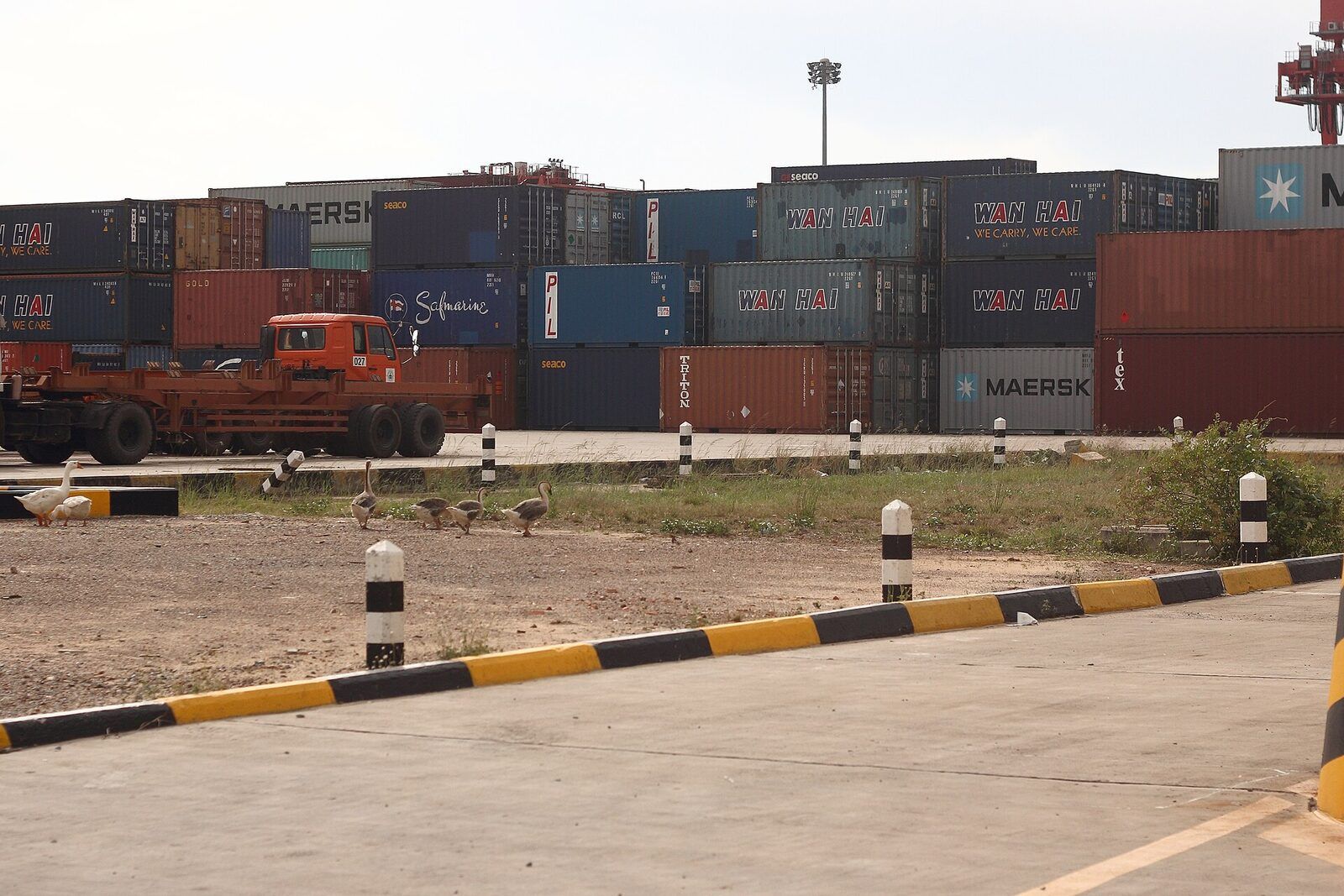
Photo: Dmitry Makeev, CC BY-SA 4.0, via Wikimedia Commons
At a glance
- Duty-free?
- Used household goods and personal effects, when you move your home here. Not cars or motorbikes. More
- What you need
- A customs permit, applied for with a request letter, the packing list and the bill of lading; movers also ask for your passport and visa pages. More
- Otherwise
- Customs duty of 0% to 35%, a special tax on some goods, and 10% VAT, each charged on top of the last. More
- Small parcels
- Free of duty and tax up to $50 of value. More
- A car
- Left-hand drive only. In the transport ministry's example, a petrol car pays about 123% of its value in taxes; a fully electric family car about 21% since April 2026. More
- A pet
- A health certificate, a pet passport and the vaccination record, declared to customs. More
- How long by sea
- About 25 to 32 days from Los Angeles to Sihanoukville port to port; 8 to 14 weeks door to door, depending on whether the container is shared. More
- Which port
- Sihanoukville, the main deep-sea port, or Phnom Penh's river port, by barge through Vietnam. More
- Choosing a mover
- In the US, use one licensed by the Federal Maritime Commission, and get quotes after an inspection. More

The short answer
Cambodian customs exempts from duty and tax the "household goods, personal effects and belongings" of people "changing residence to Cambodia", except motor vehicles, in quantities the customs director decidessource 1. The exemption is not automatic: you, or your mover's agent here, apply for a customs permit before the goods are clearedsource 2. The international movers' federation, FIDI, counts returning Cambodians among those who qualifysource 3.
A car pays heavy taxes and must be left-hand drive. A pet needs papers. Everything else is a question of freight, time and whether it is worth shipping at all: the Returning to Cambodia overview has the short version, this page the detail.
Duty-free when you move here
Who. Prakas 114 speaks of "persons changing residence to Cambodia", with no condition of nationalitysource 1. In practice, FIDI says used household goods and personal effects come in free for those holding a one-year visa when the shipment arrives, and lists two groups: foreigners working for a company registered in Cambodia, and Cambodian nationals returning from abroad to take up residence. It does not say how a returning Cambodian without a visa is treatedsource 3. If you have a Cambodian ID card or passport, have it ready; if you are proving you are Cambodian, our citizenship guide explains how.
The customs permit. Customs lists "personal effects and household goods imported by individuals migrating to Cambodia" among the goods that need a customs permit, granted on a request letter approved by the customs department. The application goes through the National Single Window with the invoice, the packing list, the transport document, an authorisation letter for whoever acts for you and any supporting documentssource 2.
The papers movers ask for: the original bill of lading or air waybill, a detailed packing list in English, a copy of your passport's photo and visa pages, a letter to customs, a letter of authorisation and, for someone employed here, the employer's business registration. FIDI adds that you must be in Cambodia when the shipment arrives, and that the documents should reach the agent at least 10 working days before the ship dockssource 3.
Keep it used. FIDI describes the exemption as for used household goods and personal effects, and notes that alcohol is taxed even in a removal (same source). Label new items, such as new clothing, as new on the list: the US maritime regulator advises it to avoid seizure at customssource 4.
Don't let it sit. Goods arriving by sea can wait in customs storage for 45 days (30 days at an airport). After that you have three more months to clear them, paying 0.1% of their customs value for every day, and then they count as unclaimedsource 2.
What is taxed, and how much
Anything outside the exemption pays three layers, each on top of the last: customs duty on the customs value, then a special tax on value plus duty, then 10% VAT on all of itsource 2.
| Duty rate | Examples from the customs manual |
|---|---|
| 0% | Medical products, sport equipment, telecom equipment, stationery |
| 7% | Clothing, kitchenware and domestic appliances, bicycles, office supplies |
| 15% | Electronic appliances, telecom devices, motorcycles, textiles |
| 35% | Alcoholic drinks, cosmetics, furniture, motor cars |
The special tax runs from 0% to 55% depending on the item, and VAT is 10% (same source). The manual's own example, a 35% duty with a 10% special tax, comes to 63.35% of the goods' value in all.
Small parcels. Postal and express parcels worth up to $50 (free on board) are exempt from duty and tax (same source). Private importers. A person with no VAT registration number has 20% added to the customs value of what they import, and 10% for a car or motorcycle (same source).
In your suitcase. Each passenger may bring in, free of duty and tax, 2 litres of alcohol, 200 cigarettes or 50 cigars or 250 g of tobacco (the alcohol and tobacco allowances only from age 18), and 350 ml of perfume and cosmetics, plus what they reasonably need for the trip. Anything over that is declared, on arrival or through the e-Arrival form (same source).
What you can't bring, or need a permit for
Customs keeps a list of restricted goods that need a permit from another ministry before they come in. On it are medicines (Ministry of Health), live plants and seeds (Agriculture), drones (Defence), radio and telecommunication products (Post and Telecommunications), and used electric and electronic household products (Environment)source 2. The full list is Sub-Decree 370 of December 2023 (same source). Ask your agent whether the line on used electronics applies to your own appliances before you pack them.
Movers list firearms, ammunition, pornography, food other than dry food, medicine, toy guns and short-wave radios as prohibited in a removalsource 3. Medicine is on both lists: ask before you ship any.
Bringing a car
Left-hand drive only. Right-hand-drive cars are banned from import; in July 2022 the Prime Minister reaffirmed the ban and warned that anyone who imports one now "will be arrested"source 5. "We will not accept any tax payment or steering wheel modifications for someone who intends to import a right-hand drive," the Prime Minister saidsource 6.
No exemption. The duty-free rule for people moving here excludes motor vehiclessource 1.
The taxes. In the transport ministry's own example, a petrol car pays 35% duty, a 50% special tax and 10% VAT: about 123% of its value on top of what it cost you. The special tax varies with the carsource 7. Since 1 April 2026, a fully electric family car pays no duty and a plug-in hybrid 7%, down from 35%source 8. With the 10% special tax on electric cars (UNESCAP presentation) and 10% VAT, that is about 21% for a fully electric family car, by our arithmetic. Without a VAT number, 10% is added to the car's value first: about 135% for the petrol car and 23% for the electric one.
American cars. Cambodia charges 0% duty on some goods from the United States, but for cars only on US-made models of the current, previous or next model year with no more than 5,000 km on the clock, in their original conditionsource 9. The family car you have driven for five years is not one of them.
Bringing a pet
Customs treats dogs, cats and other house pets as their own procedure: a summary declaration with the pet's health certificate, its pet passport, the vaccination record, the owner's passport or ID and the transport documents. Other animals need a permit from the Ministry of Agriculture, Forestry and Fisheries and/or a CITES certificate firstsource 2.
From the United States, for countries without published requirements, the Department of Agriculture advises a USDA-endorsed health certificate and proof of a current rabies vaccinationsource 10. Check with your airline: each sets its own rules for animals in the cabin and the hold.
Sea, air or suitcase
By sea. A shipping company that carries cars to Cambodia gives 25 to 32 days port to port from Los Angeles or Long Beach to Sihanoukville, and 37 to 45 days from Savannah, Georgiasource 11. Door to door, with packing, the wait for a sailing and clearance, one published estimate puts it at 8 to 12 weeks in a container of your own and 10 to 14 in a shared onesource 12.
What it costs. Published estimates for a household from the US differ widely. One gives $3,800 to $7,000 for a one-bedroom home in a shared container and $11,000 to $13,500 for two or three bedrooms in a container of your ownsource 12; a mover quotes about $5,000 to $12,000 or more for a full-service 20-foot containersource 13. The only figure that counts is a written quote after someone has seen your things: see "Choosing a mover".
By parcel. For a few boxes, courier prices are published. One parcel forwarder lists a 10 lb (4.5 kg) parcel from the US at $68.67 by its slowest service, 10 to 20 days, and $176.41 by DHL Express, 2 to 5 dayssource 14. Parcels worth up to $50 enter free of duty and tax (see "What is taxed, and how much").
In your luggage. The cheapest freight is often the airline. EVA Air allows two 23 kg bags on most economy fares on flights to and from the USsource 15, and Asiana charges $200 for each extra 23 kg bag between Asia and the USsource 16.
The two ports
Sihanoukville is the country's main deep-sea port, and handled 1,347,726 containers (TEUs) in 2025source 17. It is 226 km from Phnom Penh by National Road 4, or 187 km by the expresswaysource 18.
Phnom Penh has a river port: its LM17 container terminal is reached by barge up the Mekong from Vietnam, about 28 to 32 hours from Cai Mep. The port as a whole handled 600,023 TEUs in 2025source 19. For a home in the capital, ask your mover which route your container takes.
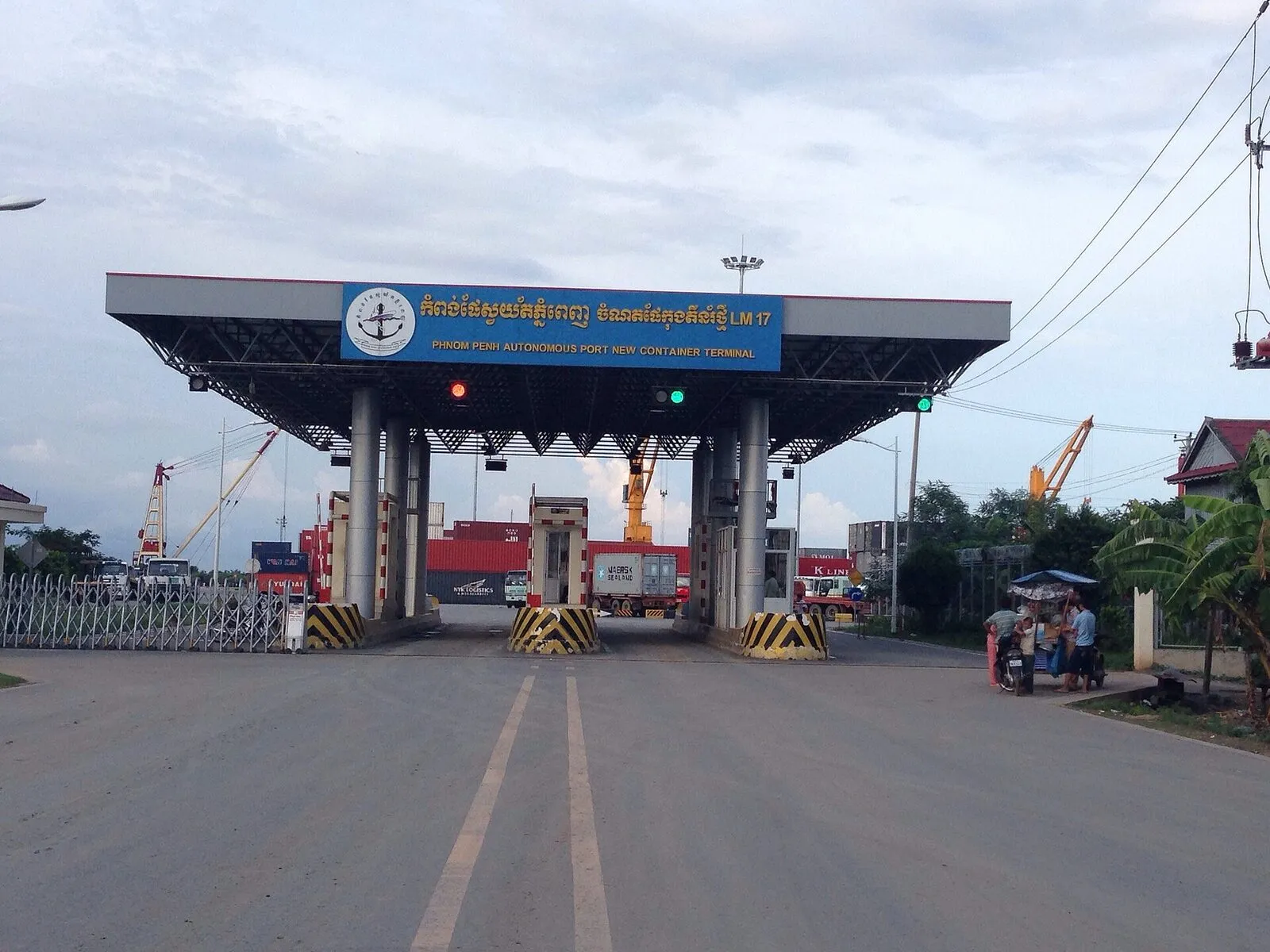 The gate of Phnom Penh's river container terminal, LM17, in 2014. Photo: Kiensvay, CC BY-SA 3.0, via Wikimedia Commons.
Choosing a mover
The US Federal Maritime Commission's advice, in shortsource 20:
- Licensed. A company that ships household goods or cars overseas by sea must be licensed or registered with the FMC; it keeps a list of licensed companies.
- Quoted after an inspection. Estimates from an online calculator or a phone call are often wrong.
- The fine print. Port terminal handling charges are often left out of estimates and billed later; check who handles customs clearance at the other end, and who pays the duties.
- Insurance. Movers limit their liability, and many won't insure what they didn't pack.
- Not the cheapest. Rogue movers use low quotes to lure customers; check the payment and cancellation terms.
One car shipper quotes marine insurance at 1.75% of the declared value, with a $200 minimumsource 11. Keep a numbered inventory with values: customs, insurance and any claim all run off it.
What our guests say
Ali Syed, who came to Cambodia in June 2018 (10:46), spent his first eight months in a hotel, living out of a suitcase and buying small jars of Nutella and small portions of butter because he didn't want to settle. That has changed, he says (26:46).
 Ali Syed has lived in Cambodia since 2018. His story is in the episode.
What can't be bought is the rest: Keo Sar remembers stepping out of the airport on his first trip back to find his cousin holding a sign with his name, relatives he knew only from photos (25:40).
Questions
Can I ship my household goods to Cambodia duty-free?
Yes, if you are moving your home here: used household goods and personal effects are exempt, with a customs permit asked for in advance. Cars and motorbikes are not included. See "Duty-free when you move here".
Do returning Cambodians qualify?
The rule speaks of persons changing residence to Cambodia, whatever their nationality, and movers' guides list Cambodian nationals returning to live here among those who qualify.
How long does shipping from the USA to Cambodia take?
About 25 to 32 days by sea from Los Angeles or Long Beach to Sihanoukville, port to port, and roughly 8 to 14 weeks door to door. A courier parcel takes 2 to 20 days depending on the service.
Can I bring my car to Cambodia?
Only a left-hand-drive car, and it pays duty, special tax and VAT: about 123% of its value for a petrol car, about 21% for a fully electric family car since April 2026. Right-hand-drive cars are banned.
Can I bring my dog or cat?
Yes, with a health certificate, a pet passport and the vaccination record, declared to customs on arrival.
Do I pay tax on a parcel from the US?
Not if it is worth $50 or less. Above that, duty, any special tax and 10% VAT apply.
Is it worth shipping furniture?
Furniture pays 35% duty if it is not covered by the exemption, and shipping a container takes two to three months. Weigh that against buying here.
Ask us
Planning a move home, and not sure what to bring? Tell us what you're shipping and when, and we reply by email.
The conversations in this guide




More guides
-

-
-
-

-

-

-

-

-

Sources (20)
- 1Ministry of Economy and Finance, Prakas 114, 15 February 2008
- 2General Department of Customs and Excise, Manual on Customs Procedures, January 2025
- 3FIDI customs guide, December 2023
- 4FMC, small shipments
- 5Cambodianess, 6 July 2022; Khmer Times, 6 July 2022
- 6Cambodianess, 6 July 2022
- 7Cambodia's presentation to UNESCAP
- 8Khmer Times, 29 March 2026
- 9GDCE Instruction 3724/25, 8 August 2025
- 10USDA APHIS
- 11Seaway Export, read 12 November 2026
- 12Move Abroad Index, June 2026
- 13Terra Relocations, read 12 November 2026
- 14MyUS, rates as of 11 November 2026
- 15EVA Air
- 16Asiana Airlines
- 17Sihanoukville Autonomous Port
- 18PAS annual report 2025
- 19Phnom Penh Autonomous Port, July 2026
- 20FMC, Moving Dos and Don'ts