

Bunika San: from Southern California to Cambodian agriculture
With Bunika San, Agri-Smart Innovation
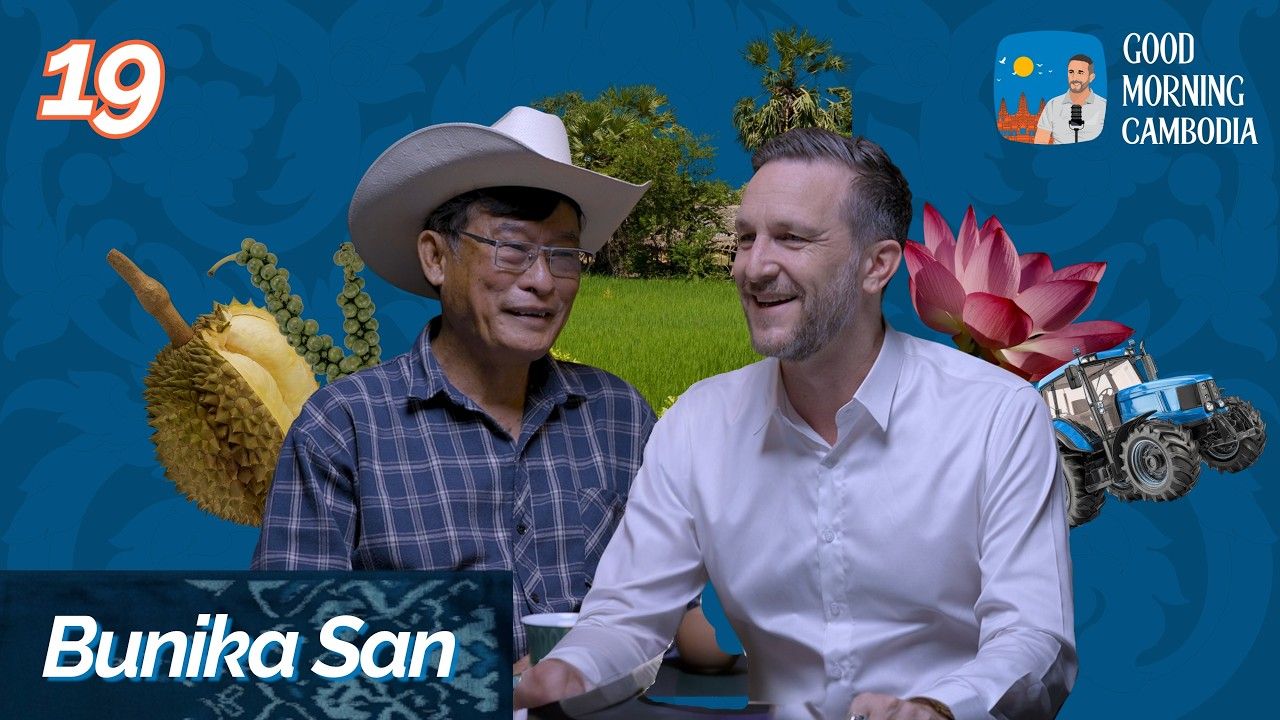
About this episode
Jesse McCaul talks with Bunika San, founder and CEO of Agri-Smart Innovation, who was born in Kampot, served in the Cambodian navy and moved to Southern California in the mid-1970s, where he studied landscape design and permaculture and rose from busboy to manager at Denny's. Back in Cambodia since the mid-1990s, he talks about Kampot pepper and durian, how labor shortages pushed farmers to broadcast rice seed instead of transplanting it, and the affordable, locally built rice transplanters he designed, which the former prime minister bought for farmers and the current prime minister named the Angkor Seed Planter. He also explains why he believes work with farmers should start by listening to them.
Where the stories happened
See them on the story map →Chapters
- 0:00Introduction
- 2:05Growing up in Kampot town
- 3:27Kampot durian and Kampot pepper
- 13:19Navy years and studying in California
- 17:14From busboy to manager at Denny's
- 21:14Donut shops and coming back to Cambodia
- 25:24How rice was traditionally planted
- 34:36Designing an affordable rice transplanter
- 47:02How the Angkor Seed Planter got its name
- 53:38Working with farmers at the grassroots
From the conversation
So when I clean the restroom, I write my name on the door. Right. And the boss say, "Why you do that?" I say, "I if something wrong, I will my responsibility."
Then he saw my face said, "Haha, I saw your face. I know I losing money again."
So we able to listen, use our ear more than our mouth. Yeah. So the best school for us is the farmer. We not to go and teach the farmer, right? But the farmer teach us listen to them as well.
Read the full transcript
0:12 Greetings from the Kingdom of Cambodia. We're live and well, and I want to let you know there are so many amazing things happening right here in the Kingdom of Cambodia and we're excited to have you with us wherever you are. you're our friends and welcome into our world right here in Good Morning Cambodia. And today it's an honor to have I always say Bong, but actually Lok Pu but we'll say Bong Bunika the founder and the CEO of Agri-Smart here in Cambodia. Bong. Bunika, it's wonderful to have you here.
0:52 And Bong means older brother. Lok Pu means uncle in the Khmer language. And Bong Bunika, you are 74 years young. so technically that's kind of Lok Pu, but I'm going to keep on calling you Bong because it makes everyone here feel nicer, right? That's right.
1:11 Well, it's great to great to be able to have you here. Glad to be here, too. Yeah. Yeah. looking forward to some very I believe some very eye-opening conversations both about Cambodia in particular the agricultural sector which you gave up your life in the US to come back here and to be a very integral part of the agricultural sector of course recognized by former prime minister current prime minister so many different numerous international agricultural entities and organizations and they've taken your innovations and even looked at bringing those into other countries outside of Cambodia. Yes. So we have a lot to talk about there.
2:05 But first it's great to you know be able to for everyone to be able to get to know you a bit as well. So you were born here in Cambodia. Yes. In the 1950s.
2:18 And what province? Kampot. I born in Kampot. Okay. So Kampot is one of the four coastal Yes. Uhhuh. Provinces, right? Yep. Yep. Ah. Okay. Were you were you born because you know Kampot has both kind of the mountains and then of course you have the coastal regions. Were you your village, your hometown? What part of Kampot? Right then in Kampot town. Oh, okay. So in the in the capital there. Yep. by next to the durian. Oh, the big durian statue. Really?
2:46 Yes. About a kilometer from there, that's all. Yeah. Wow. And back in those days, of course, that you know, Kampot and then the neighboring province of Kep, which is just a few minutes down the road, there's a favorite holiday location of the former king, King Sihanouk, you know, and Bokor Mountains also. And then you have Bokor Mountain on the other side of course as well which was a very well-known French Frenchmade resort up on the mountain on the clouds on the plateau there. So that's where you were that's where you grew up right there in Kampot town right next to the giant durian statue right in the middle of town. Yep.
3:27 Wow. When we talk about durian, I think many foreigners, especially of European people, they don't care much about durian because the smell of that. I don't know if you're familiar with durian, those of you that are watching, but it's an exotic fruit, right? It's a and I believe that in this part of the world, some people classify it as the king of fruits.
3:53 Yeah. The king of the tropical fruit. King of tropical fruits. Yep. Right. Yep. Yep.
3:58 And myself, I have a farm. You have a durian farm, right? Yeah. Has about almost 1,000 durian farm there. Really? 1,000 tree plant,000 trees. Yeah. Yeah. And start fruiting it. And last year we get about only the fifth year we get about four tons or so of fruit. Yeah. Wow. And durian is very high quality fruit and the price wise never go down. It's always up at all. Always goes up. Always go up. I mean I mean just retail one Kampot durian when it's in season what I mean I know it keeps going up each year and it changes but Kampot durian by the way is considered the best of the best because you have amazing soil there and then you have the rain that comes down the hillside and the the coastal weather as well. So it's it's very good but I mean it's expensive Kampot durian is an expensive fruit per kilo y what during normal season what would the normal season cost about $5 per kg $5 per kg and one fruit is how many kg from six five six kg up to 10 kg or so one fruit yeah so very expensive and at the same times also Kampot the most realness is pepper. Yes, the peppercorn pepper p. Yep. And because based on the whirlpool system that ecosystem involving the seas and air together and mix through the mountain ate the whirlpool there that create aroma of the dura of the pepper that spread the number one peppers in the world. So everybody in the world Kampot pepper is hot pepper. Yeah, it is. It's it's considered the best pepper in the world. Yep. Y it's what they call a GI geographical index species. Yes.
6:01 So very specific to that region. And what explain that again the weather circle? Why what makes Kampot pepper? And I know that the weather has the same effect for the durian as well. Even though it's not you know Kampot durian they don't have like number one number two but for the pepper it is they call ecosystem involving with the sea breeze yep coming with the salty air and come through the mountain y and circle through the mountain there the air distributed into almost everywhere at the lands and Kampot so that's reason why creating the best pepper there that's an out of wool that don't have it so it is involved to whirlpool system that they're creating there.
6:46 The top planting and all kind of stuff is normal. But for example, you talk about 100 km or so from Kampot no longer is the best. Completely different taste. I mean it's good taste but different taste. Yeah. Yeah.
6:59 Evan and Krell, right? They plant a lot of peppercorns also, right? But there is no aroma just like in Kampot when you're talking Kampong Cham. So they have pepper as well of course. Yeah. Yeah. And many hot pepper is the best.
7:16 And many peep people that's when they go back to their own country they already take a lot of pepper. Yeah. Of course. And last month the German company Yep. they plan to order like 100 tons Wow. Wow.
7:35 of peppercorn. So, we talk about 9,000 tons or so of the black. Yep. 5,000 tons or so of the white and a few more of the red ones. So, combined together. Interesting. Interesting. Yeah. Kampot pepper. I mean, you can even for those that are living abroad, you can go on to like Amazon.com. You can see it. Expensive. but celebrity chefs swear by, you know, the best restaurants in the world. They if they're going to provide quality cuisine, yeah, they're going to be using Kampot pepper from Kampot province. You know, I've been there and they put a beautiful steak and after they just grind a nice Kampot pepper on the top of that and that the price just double. Yeah. Yeah. Because of the pepper. Yeah. Yeah. Yeah. Incredible. So in Cambodia it's just a lot of thing that can expose many mind of to people that they don't think what we have but at the same times also they receiving a lot of bad stuff.
8:43 Yeah. Manipulated by other country other people that's Cambodia this and this and this. Yeah. So by not using their judgment they're assuming whatever they say is correct. Right. Right. If the wish to come and visiting Cambodia is the best country. See the reality. See the reality. Yeah. I said that maybe I am Cambodian, but I've been across 20 nearly 20 countries already. Yep. Yep. We counting people as people, right? Of course. Not just another face, you know, or friendship or sincerity. how they involve with the people we facing that everyone will helping anyone and we don't have a heart to resentment or against any nation at all. We just open up no matter our enemy. We still respect them. We still salute them and counting as a friend. That's really the Cambodian attitude, isn't it? That look, we'll be friends with anybody. We don't want to have trouble with anybody politically, anything, racial, anything. We just want to get along with everybody. That's that's really the Cambodian attitude. Yeah. The pictures in the Angkor Wat that the lady get on a small rowboat just pick up the flower 1,000 years ago. Right now still do the same thing.
10:08 This is a lot of history. What is it again? So the lady she sit on a rowboat. She pick up the lotus. Oh. So she's rowing in the fields and there's the lotus flowers floating in the lake there lake in the pond or whatever. Yeah. Yeah. Yeah. a thousand years ago. Yeah. Right now, the thing is still doing the same thing. Same lifestyle. Yeah. Same lifestyle. Thousand years later in Cambodian, it's a lot of slower pace of life. It's true. That's a good that's a good picture. I think you know the young lady, she's rowing her boat alone in the lake picking some flowers from the lake. She's going to bring them home to decorate or whatever. and that's a that's a bit of a slower pace, a laid-back pace, but at the same time enjoying life, enjoying what's available here.
10:57 I think that's a good description. Yeah, because I was in the US for 30 more than 30 years. When I retired, I said, "What should I do?" So, I want I want to jump into that a little bit. And you So, you mentioned you grew up in Kampot Province. Yeah. And of course that's Kampot province is known for its coastline. Of course it's known for Bokor Mountain. B O K O R mountain.
11:26 Incredible former French. Yeah. Like a like a like a retreat up there, you know, like a resort up there up in the mountains in the clouds. Beautiful. but then also known for Kampot pepper and Kampot durian. Other agriculture is very good too but in particular Kampot pepper and Kampot durian like we said durian is the king of tropical fruits. Y hard spiky shell big fruit expensive like you mentioned. Yep. Yep. very strong smell. Yeah, very strong smell. Many people that aren't accustomed to it, they have trouble with the smell. Yep. Yep. I was first introduced to durian in Singapore. Yeah. and then was able to enjoy it here. And I very much enjoy durian now.
12:16 But the smell, some people say this about durian. They say it tastes like heaven. It smells like hell. But never put durian in the refrigerator. Oh. Everything will smell like durian. No. In the chicken that changing you know when you go to hotels two different thing the guns and durian what's the difference between a gun and the durian at the hotel that's true you see the signs on you know no weapons allowed and you know in these in these you know places and then also nerd no durian allowed indoors because it smells up the whole place y so you grew up there Bong in Kampot did you were you there all the way into and through the Khmer Rouge regime or did you leave before that or I let me see just try to rewind back and Right.
13:19 It was a long time. It was a long time ago. Yeah. And I was the Navy the Cambodian Navy.
13:25 So under the King Sihanouk regime. Okay. Yeah. As a young man back then. Yeah. Still a young man but Yeah. Yeah.
13:31 Young man back then. Yeah. After that I was a Lon Nol Navy regimes also. Yeah. The next regime. Yeah. Yeah. Yeah. And after that I been supporting the US Navy, right? We get into the Koh Tang. Uhhuh. Yeah. That to get the ship back from Koh Tang because the Mayaguez. Yeah. That is one of the islands and there was a there was a the conflict because the Khmer Rouge captured one of the merchant ship.
14:03 US merchant ship. Yeah, that's right. It's a long story. This is back in the Vietnamese war era, you know, back in those era and there was conflict in Cambodia as well, of course. Yeah.
14:15 So anyway, I went back to the US and I start to looking what can I do. So that was in the in the in the in the early 70s. Five. Yes. Yeah. So you were in the Navy and you supported the US efforts to recover their merchant ship there. Yes.
14:39 And then there was conflict here in Cambodia. Of course, still very strong conflict. And because of that, you were you were able to Yeah. immigrate to the US. And that was in Southern California.
14:52 Yes. And San Diego area. Marine Base Camp Pendleton. Okay. Navy's in Riverside, California. Yeah.
14:59 So, you moved there in the in the mid70s. Yep. Yep. And so, what as a young man still and what did what did your first several years look like of your new life in the US there? It's not easy, but it's still the best country there is or there was whatever it is there. But anyway, at that time, I'm thinking of well, I am Cambodia. Yeah. in Cambodia is a lot of land.
15:29 Yeah. A lot of opportunity to grow part education. What should I take? Yeah. Okay. So you went there, you had you had the desire to further your education, get an education there.
15:40 Yeah. So based on the government support me behind that. Yeah. So I decide to take in agricultural landscape designing and landscape architects. Ah interesting. And this is so I been went to college they call Mira Costa College and Riverside and after that I went to UCR University Riverside California I took an permaculture so that's reason why because the reason I say this I took all those thing there because I think one of those day yeah I will come back to Cambodia interesting and I am not good a liar and do a lot of and stuff. So I will not join the politics. Right. Right. Right. So you so you so you got an education in agriculture and what was it? Landscape. Landscaping. Landscape design. Designing. And then furthered your education in permaculture. Yeah. And this was all keeping in mind that Cambodia is an agricultural nation. A lot of agricultural land. There's a lot of things that could be done here. Yeah. And I hoping to one of those I will come back to Cambodia. Yeah. So anyway, while I'm studying there, I had to looking for the job. So my English was very poor and I went I went out there to the restaurant. They look into bus boy.
17:14 So question yourself when you do not know much about English, right? When they talk about bus boy, what you think in your mind? Yeah. You talk of the bus. Yeah. You understand you have limited English and so they say, "We'd like to hire you as a bus boy." And so you're thinking bus lung, you know, the the bus, the school bus, city bus. And I was thinking like in Cambodian, the bus boy helping pick up the stuff, put in the bus and go and you stop, put the stuff down. Right. Right. Right. Loading things onto the bus.
17:43 Yeah. Loading cargo onto the bus to go across the country because that's how we would transport it back then. Yeah. Yeah, in Cambodia. So I was thinking, "Oh, yes, I can do it. No need English." Right. Right. I can load cargo onto the bus. Yeah. So I went out there and they said, "Uh, in case you in a restaurant, I said, why in the restaurant?" I said, "Maybe they meet together there." So I went to restaurant there. They said they want at 10:00. I went 8:30. Yeah. And they said, "What you looking? Why you're here?" I said, "I'm looking for the job." Yeah. What's that bus boy? Yeah.
18:17 fill up application. I said you come back at 1:00. So I went up there at 12:00. Yeah. Said I tell you to 1:00. I said to them, I'm say the white boy, the Mexican boy, a Asian boy out there, you take them first, not taking me. So I had to come before everybody else. So you can't take me otherwise they'll hire those guys, not me. Yeah. So they're looking and sit there. So at that time I launched there at 12:00. Yeah. Yeah, it was busy and not no people help to the plate say okay come doing what pick up the plate put in the tray this and so on so nothing yeah that's the job of the bus boy yeah the bus boy said oh boy there's something new here think about it you know so they hired you on the spot on the spot for you to work immediately and it was completely different than what you were expecting because you're expecting you're going to be loading cargo onto a bus but you're actually busing tables Yeah.
19:13 And they gave me a shirt with a nice hat. Yeah. Like this, you know, like a boat I put in your head and I walk like a king. Yeah. Yeah. Yeah. It was hard day hard work out there. And after that the dishwasher walk away. They just met something. I become a dishwasher.
19:33 I count in one day I wash it more than 10,000 dishes. Are you serious? Yes. Wow. This is a busy restaurant then, right? Yep. Yep. Yeah. Denny's. Denny's. Oh, yeah. Yeah. Denny's.
19:44 And after that, Yeah. had to clean the restroom once every hour. Yeah. So when I clean the restroom, I write my name on the door. Right. And the boss say, "Why you do that?" I say, "I if something wrong, I will my responsibility." Right. Right. Yeah. Wow.
20:02 Four months I become a prep cook. Okay. Yep. Yep. After prep cook, I become a cook.
20:09 Really? After cook I become assistant manager in the same Denny's. Yeah the same Denny's. Wow. Later I became a manager. Wow. So all the way up through there.
20:22 Wow. Incredible. Yep. And your original expectation was be loading cargo onto the bus.
20:28 But still more to come. You had a different destiny. You had a different destiny. Yeah. Yeah. Wow. So it's it's a hard day and by then and they sold it to other company and they said well I thought in the US they cannot sell people but they sell people too. Yeah. Yeah. Yeah. When you sell the company you are part of the you're part of the company. You're part of the company. $1 million you get that all included people there. Right. Right. Including this guy named Bunika. But anyway it was all good. Then after that I decide no I'm not going to go with them because they promised me salary this and this and this after 3 months later nothing up. So I decide to get my own business.
21:14 Okay. Y I creating a donut shops. Yeah. First in the Asian people you know that in Cambodia and in California a lot of Cambodian people run a business and donut shop. That's right.
21:25 Yeah. So I went out there. I get some the small business loan from the US to support us. Yep. And build a business up and up and after that I build it and sold it. Build it and sold it. Build and sold it. So you build it up, sell it, build up another one, sell it. Yeah. Yeah.
21:44 Yeah. After I got six of them, so that's enough for me. So yeah. Wow. And after that I said, "Well, I'm happy." But I question myself.
21:56 I saw a lot of friend of mine in the Navy together. Mhm. And when they retired after two years they die because they had nothing to do. Nothing to do. Nothing looking forward the next day beside just go at the donut shop, drink coffee and eat donuts. Right. Right. And later on they just die in a chair.
22:16 In the morning we go fishing. Right. So I decide no I'm not going to die that way. Right. Right. So I decide to come to Cambodia. So my hometown. So right now the reason why I involving with the agricultural sector. Yep. When I get here because this is something I can do with my loving nature. Yep. My own country and do something good for the farmer. That's the reason why I pick up the agriculture. Right. Part of the my job up to today.
22:48 Right. Right. Wow. So you so you sold your businesses there. Uhhuh. and decided to come. Had you visited Cambo? What year what year was that you came back that you moved back? moved back in 1995 96. I still in and out in and out. Yeah. But before that you had you had traveled back and forth a bit.
23:07 No. No. When was your first trip back? 93. 93. That was the when we had the elections. Yep. Yep. Yeah. Our first elections after the war. Yeah. Yeah. And after that I said, "No, no way. I'm not going to stay here to get the gun shooter everywhere here." It was a bit wild back then. Yeah. Yeah. And I go back. Yeah.
23:25 Yeah. Okay. So you made your first visit in 93. Yeah. And 959 96 I back here a little more stable, right? So well maybe it's a good time now, right? I came in 95. Yeah.
23:38 Yeah. Yeah. So that it was then you was young too then. Yeah. Yeah. We're all young. We're all young.
23:43 Yeah. Yeah. So that's reason why I just keep on carrying and I work with the different organization like a GIZ and u many German development organization and the UCC United Cambodian community service and all stuff there on it. Yeah. Yeah. Okay. Incredible. Incredible. B.
24:08 So you know you moved back in the mid 90s. Yeah. And you had your education in the agricultural field. Yeah. And when you came back you begin to work with different development organizations in the agricultural field. Yeah. Yeah.
24:29 And then recently it's not too recently but over the last many years here. Yeah. you begin to you begin innovating as well and maybe let's talk a little bit about that in particular some of your innovations such as the Angkor Seed Planter y and some of the other innovations with you being in the agricultural sector for so many years you've seen how things are working you had you had plenty of time and plenty of opportunity out in the field with the farmers, what's working well, what's not working well. And several years ago, you decided to create some very unique solutions. Yeah.
25:24 For the farming community. So maybe talk a little bit about that. You see, and my old tradition family when we talk about the rice, we transplant it, right? And we taking if we want to finish one hectare in one day. Yeah. We have spent the many people in there. So let's talk a little bit about that.
25:43 And some people would be familiar with rice farming, some people wouldn't, but with rice farming you have what's the whole process of rice farming from beginning to end. Okay. The process is at that time we have only one type of rice that grow in Cambodia. Yeah. Those thing is they call seasonal rice.
26:05 Yes. So in one year you can plant only one time. You cannot plant many because the dorman time and that's rice that can cannot grow if it's a different month. Mhm. Mhm. So this traditional and after they work on that they transplant it they doing nothing. Yeah. For the next three months, four months they wait until the rain coming up they start to do it again. So planting season traditionally Yeah. would have been what month?
26:35 start from May. May. So that's the planting season. Yep. Yep. So May or June or July because depend on the raining coming but no raining they wait until the raining right. So the July must be right at the latest. The latest. Yeah. Because the rice are there at that time at least four months. Right. Yeah. So right now the Cambodia get three type of rice. We got shortterm, midterm and long-term duration. The short term take three months or 100 days, right? Midterms four months. Okay. And long term up to six months. Oh, okay.
27:14 Yeah. But based on that factor because the people they have no factory, no nothing to do, right? They just wait until rain is coming, right? They do the growing rice, right? So and I had to think about what can we do. So the process would be the planting May, June at the latest July. Yeah. And then waiting and then there's the transplanting as well, right? All transplanting at that time. Okay. Okay. So now we come up to the modern times.
27:47 Right. So nowadays, yeah. Now day based on nobody many people, millions of people come up to the city, right? working for the factory, right? So then the factory earning the income four months per year, right? When you're growing rice, you earn income only four months per years, right?
28:08 So another eight months you do nothing, right? So the people start to come to work for the factory, right? When they come to work for the factory, there is no more young people to do the whole transplanting process because the transplanting process was manual using Yeah. Yeah. Dozens and dozens or hundreds of workers. Yeah. Yeah. Per field. Yeah. Yeah. And so at that time only old people, right, left. So they just plowed the broadcasted, right? When they broadcasting it, they using like a 300 to 350 kgs per hectare.
28:44 So for transplanting you use only 50 kgs per hectare. M when broadcasting using six to eight bag of fertilizer per hectare. So when you're okay so explain this a bit more. So when you're traditionally Yeah. when there were many there was much physical labor available.
29:05 Yep. Yep. Yep. Then they would manually transplant it. Yep. And it would use much less seed, right? Yeah. Because it's manual. Yeah. But then when there's no labor anymore, they broadcast it just everywhere. Throw it throw it manually. Yeah. Yep.
29:25 Rather than actually planting it and the amount of seed needed for that much higher. Yeah. Is that right? Uhhuh. Because based on that because when you broadcast it, you're talking about rats, mice, bird, right? insect come and eat the rice seed because it's just thrown out. Yeah. Yeah. Yeah. So talk about 350 kg. If you're lucky, you still 100 kgs at the field. So 350 kilograms broadcasted. If you're lucky, there might be a hundred left after the insects and the birds and the Y interesting. So at that time I'm thinking of well I have to do something about it, right? So I decided my own experiment. I grow the rice seed and the rice paddy.
30:18 Yep. as a nursery. So I hire three people to pull it and bundle it ready to transplant it. Yep. And I take 40 people to transplant in one day based on no labor. I have to go around and collecting many farmer in the morning at 6 o'clock in the morning bring them to work at 7:00.
30:46 Yep. 11:30 they had to stop go home feed the baby. Yeah. And watch the house and 1:00 they come back again until 5:00.
30:57 Yeah. This is the lifestyle. Yeah. Yeah. So because there's no not many people at the village anymore, right? So end up I facing 43 people in one day. And what we got is the rice that we transplanted. Yeah. And compared to money cost 1 million 120 million riel.
31:27 120 million. How many dollars? No. 1 million and 1 million. Okay.
31:33 Equals about 1 million. That's $250. It's about cost almost $300 per hectare just to transplant it. The cost the cost of transplanting. Right. Right.
31:45 But I can I save some money of herbicide to spray to kill the grass. Right. Because the water there, right? And I say not spending much fertilizer because spray less. And with the rice out there is very part different apart there. So they do not demand much fertilizer on it. Right. So but end up in one hectare I spend almost $500 per hectare.
32:18 So I decided the labor the pesticides everything. Yep. Yep. That's involving. So that's end up I have to think about how to do something about it. Right. So I came up with a different method of rice transplanting. Yeah. When I start to move in 200 2022. Yeah. Yeah. We start to working on a rice transplanting machine. Yeah. So I'm going to I'm going to pause there for a minute. And so what you've described is you've given us a good picture of really kind of even the ancient for generations and generations and generations process of rice farming. Yeah. Y that the process was very a very manual process. Yes. Right. You know and so you're planting and then you're transplanting.
33:17 It's all done by hand and it's dependent on a labor force. Yes. That is available. Yeah. Right. And then the evolution of that that there's more jobs in the cities and the metropolitan areas.
33:36 Therefore less labor force and people are less interested in doing this manual labor of course as well. and so the other alternative was just to to transplant by broadcasting by throwing you know large amounts of the seed. but then it was not only not as efficient but it was it also was very costly. Yes.
34:03 Is what you're saying. Yes. Yes. And so you're in the middle of all of this and you've seen the kind of the the evolution of this and you know how things are changing in the country.
34:16 Yep. And so you began thinking okay what can be done that can do a more effective job. Yep. and the rice planting transplanting process as well as save the farmers money so that they can have more profits and their hard work of trans of rice plant farming.
34:36 Is that right? Yep, that's correctly right on the top of that I was thinking of is the import rice transplanting machine from Japan, from Korea, from China or so on so on are there right? because there are rice transplanting machines that have been created in some of these places. Yes. So, I decide to look at that. The brand new one cost more than $30,000.
35:02 A brand new rice transplanter. Yeah. And so, how can how could how could a simple farmer or even a mediumsized farmer afford one of these, you know? so, we're looking for secondhand. Yeah. The second hand, the cheapest one cost about $3,000. Cheapest? Yeah. Yeah. But that's about 20 years old already.
35:26 When the when the thing break down. Yeah. There's no part to replace. So we talk about 3 months or so before the parts coming if they can find it.
35:37 So the rice season is over. The rice season's over. The whole harvest is ruined then. Yeah. Yep. Yep. So whole crop is ruined. I decide to get a couple of men together. Let's sit and design yourself.
35:48 Yeah. So what we did, we designed it and first of all we get only two row of rice transplanting machine. Yeah. With hand cranking. Yep. And there's no way they take forever.
36:00 Okay. So you first you created a locallymade rice transplanting machine that would not cost $35,000. No. Cost about $200. Cost about $200. So it's affordable for the farmers. But the first version was hand cranking. cranking. Yeah.
36:18 And the pickle very heavy and you walking all day long. So I decided to come up with six row. Okay. And that one was only two rows at a time. Right. So you said, "Okay, that's good, but it's too much work still for the farmers. They're not going to they're not going to Still had to need two people, right? Right. One cranking, one had to bring the seedling. Yeah. And all day. Yeah. Yeah. It's not easy. Yeah. And after that I brought six. I'm making a six row. You can plant six rows at a time. Yeah. And each space this is 20 cm.
36:53 Okay. 20 cm. Yeah. Yeah. 20 cm square. Yep. And work well.
36:58 Yep. And the machine go by itself. Propel it by itself. Also has an engine.
37:03 You have the engine. Ah. And but you need them people to guiding it, right? So it needs people to guide it. Of course. Yeah. Yeah. But I'm guiding it go everywhere. Yeah. Yeah. Yeah. So that's the people the guiding it and the first year is so great purchasing 100 units.
37:22 So the second version six rows at a time. Yeah. With an engine. Yeah. and all it needs is one person. Yeah. To guide it.
37:32 It can do six rows. So I mean a hectare takes about one days. One hectare of rice field Yeah. would take one day to plant. It takes about two people and that one helped to bring out the roottock. Right. Okay. So, if we compare that to the traditional Yeah. way where there were laborers and all that, how many laborers would you need?
37:57 43 labor for one full day to do it one hectare. Okay. So, you would need 43 people working a full day. Yep.
38:08 Transplanting. Transplanting for one hectare. Now, two people. Yep. One full day.
38:13 Mhm. For one hectare. Yeah. And how much how much did your rice transplanter cost?
38:20 that one cost that's about $1,000. About $1,000. Yeah. And we have we built it here. So all part repairing everything we take full responsibility because our machine when we sold it to someone Yeah. we transport it to them free without charge. Okay. We teach them how to make a rice nursery and we teach them to transplant it and we warranty it for six months. Ah, so warranty for six months as well. And of course all it's made locally.
38:48 Yes. So the spare parts which I'm familiar I've been to your workshop of course and so I'm familiar with the rice transplanter but there's not too many moving parts either that is going to easily break down and if there is something then they can immediately get replacements. We are I always told the farmer we are far apart just from the transporting company for example wean you know just in Cambodia. So I see a pet today will get it tomorrow. The rice seat the right the nursery not even they're still in a good condition ready to go again. So they can get spare parts within the same day or at the latest next day.
39:31 Yes. Yes. Right. Yeah. So this is how it work and later on the people said well I don't want to walk anymore. Can you do any better? So I decide to make it eight row. Okay. So the next one is the version three. Yes. The eight rows. Eight rows. Yeah. You're driving like a car, right? Yeah. So, the thing go and go 300 meters before they refill it. The rice seat. So, when you say driving like a car, what does that mean? Is it seat? Yeah. The seat and the steering wheel. Oh, really? Yeah.
40:04 Yeah. Okay. So, seat, steering wheel, and you're driving it like a car. One person again. Yeah. Maybe. Is there two or three more person? Two more person to help to bring the right seat.
40:15 Right. Right. But that thing take only half a day for one hectare. Wow. What about the efficiency of the rice seeds? Because you mentioned that you know later on because of the labor shortage. Yes. Yes. That people are just broadcasting seed and so compared to what many farmers would be doing with just broadcasting their seeds to now the Angkor rice planter. what about the efficiency in seed usage? we to make a rice nursery to transplanting one hectare we need only 8 by 8 m square to make a rice nursery there. Yep. After 12 day we can transplant it. We use those transplant. So the effective of do that we need at least one or two people to make those rice nursery right with a proper protection from chicken and everything out there right and it's easier to taking care more than you toss the seed right with the time ready we just pick it up and go out there ready to transplant it right so it's most easy more reliable and most caring the people and at the same times al so we educate ated the farmer before you make any rice transplanting, right? The land must be nice and flat evenly. Try to get the water evenly.
41:43 Right. Right. Yeah. And a proper fertilizer distribution. Right. The basal fertilizer must be applied on it. Right. Right. So instead of got three time with do only two time fertilizer. It's a perfectly okay. Yeah. It's it work very great. And now we get a four versions coming up.
42:01 Fourth version is coming. So third version is you can actually has a steering wheel and you can drive it like a vehicle. Eight row and that's eight rows half day for a hectare. Yeah. Right now we got a 12 rows.
42:12 Really? Yep. The tractor. Yep. When the farmer had the tractor like a 40 50 horsepower. Yeah. They can plant it take two hour for a hectare. For a hectare. So they it can be pulled on the tra by the tractor. Yeah. Yep. Y and two hours per hectare. Yeah. So if and of course there's many farmers not all but many farmers do have tractors right or even they have a community tractor that they share amongst themselves you know they are service provider because when they plowing the land the farmer pay the tractor owner you plow for me I pay for you. Yep. Yep. So those are not the job. Yeah.
42:51 For the tractor. When they have the tractor they can provide a service provider. Right. Right.
42:56 Yep. So this is something for the fourth version here. Right. coming up. So this stuff I need the government right to help right to promote it. So that mean right now Cambodian and crisis of the rice right now abandoned rice plenty of rice tons and tons of millions ton of rice been grow up and there no market you see based on that the price cheap the price not that cheap but at the same times also because they are overspending right you know of land preparation the seed need of fertilizer, of herbicides, of insecticides, right? Their costs are too high. The cost too high, right? So if they do that, right, the price must be this gap before they can make profit. But we do it proper with the transport transplanting only half. So they can save half. They can save half. So even at the 800 riel talk about a dime. Yeah. Yeah. 10 cents. Yeah. 10 cents or so. Yeah. 10 cent and a half. Yeah. You know, so to say 20 cents a kg, you still make profits about 10 cents, right? Just for ex just for cost of saving of the spending. Right. Right. But at the same times also the yield is higher than broadcasting. So, so using a rice transplanter and really with regards to rice transplanters for the farmers, they only have a few choices is what I'm understanding. One, they can continue to do it, you know, manually or just broadcasting. second, they can buy a brand new rice transplanter from Japan or Korea, 35,000 bucks or something like that. they could buy a secondhand one. but of course spare parts are not readily available and so then it breaks down in the middle of the season and the whole crop is ruined. or they can use an Angkor Seed Planter. Yeah. And you have both now you have
45:19 what was it four rows? six rows. Six rows. Six rows. Eight. Eight rows. And now 12 rows.
45:26 Yep. And we are still prototype of 18 row. Okay. And so and obviously when they're doing when they're when they're using an Angkor Seed Planter costs are minimized but the yield increases. Yes. And based on that we do not use any herbicide at all. Right. Because when we transplant it the rice field must be have water.
45:52 Mhm. When the rice will have water, the grass, the weed will not grow. Right. Right. Has a stay submerge. Right. And after three or four weeks, the rice already covered the rice field. Yeah. The grass cannot grow anymore. If it grow, it cannot go strong enough to hurt the rice. Right. Right. And that's it help a lot. And that so a lot of thing that we using the fertilizer when you're using eight bags. Yeah. You mean you're feeding to the grass, you're feeding to everyone, right? But the rice the rice too, but at the same time when it's so dense, right, rats, many rats at the field destroy the eat the grains. Yeah.
46:35 Yeah. Yeah. But in open field of transplanting, the rat had no place to sleep on it. Right. Right. Because the rat eat there, sleep there, stay there. Wow. because so dense did not touch the ground or water at all. Right. Right. So this is something another issue that we found that the rats they always save the rice transplanting place as the running place.
47:02 Right. When somebody's coming up they can run into the rice transplanting field without interrupting more faster when your rice so dense you just can't because it's so much obstacle for them to run forward. Interesting. Interesting. So, version two, six rows. Yes. version one, you didn't really ever anything with it. Yeah. Yeah. Yeah. But version two, that was what, 2023? Yep. Yep. Yep. And I know that, if I'm not wrong, you attended some of the national agricultural events. Yep. And you bumped into or met or were introduced to former prime minister. Yeah. And he was introduced to you and to your seed planter, right? What happened there? And happened him and I had a little discussion. Yeah. And based on that he been purchasing 130 unit of rice planter, right? Not transplanter to rice planter. Right.
48:14 Then he saw my face said, "Haha, I saw your face. I know I losing money again." Every time he meets you, every time Yeah, that was my understanding. Every time that he meets you, he says, "Oh, you know what? Every time I meet you, I end up spending more money because he buys these to donate to the farmers." Of course.
48:31 And my reply, it's okay sometime because your money is worth it. Yeah. Work will to support farmer. Yeah. And he pay very much attention. Yeah. And to that watching every step of the way.
48:44 Yeah. He said, "Give me 100 of that." Yeah. Yeah. Yeah. And some met. And he said, "Prime minister." Yeah. Yeah. And he said to me, I said, "Uh, did you get the name and that thing yet?" I say, "No, maybe you can't help me to give the name of this machine here." Right. I said, "Why don't you give Angkor transplant?" And I said to him, I said, "I can't." I said, "Why you can't?" Because Angkor been in Saber already and he said that's right but let's make Angkor something good. Right. Right. Right. Instead of just beer, you know. So that's reason why the name been. So he current prime minister Hun Manet. Yeah. He gave the name for the seed planter the Angkor Seed Planter.
49:32 Angkor Seed Planter. Yeah. Yeah. Wow. So a lot of stuff that been happen and we have done a lot of supporting been and I am very lucky that from the old prime minister to the new prime minister from the old minister of agriculture right and the new minister of agriculture. Yeah. And many of 24 province the chief of department agriculture provincial area they really supporting. Yeah. And many AC of the rice production and seed production. Yep. Been very active in supporting us. Yep.
50:12 Because I am looking for is not a profit on that but I'm looking for what can we do to keep our economy moving in our country. Yeah. You talk about you take thousands of dollar to buying a junk from there and then break down. Nobody responsible or anything. There's no there's no Yeah. There's no repair shop or anything. Yeah. Yeah.
50:39 Yeah. And at the same time the space planting is bigger. They have 30 cm. Right. So the space so big planters. Yeah. They build for the country not for us.
50:50 Right. Right. So it is the crop is not the same as 20 cm because the shortterm duration the growing time it's the same. Yeah. So you cannot grow a 30 cm is still a lot of empty spaces but a 20 cm it grow the same spaces as a 30 cm.
51:15 Yeah. So the space between it is too far apart. Right. you're talking about 10,000 square meter there. That's a lot of empty spot there. So for the imported seed planters, whether Japanese or whatever, yeah, the spacing is different than what we use for our rice planting here because they're made for different Yeah. different countries.
51:37 and so what you've done with your rice planters is you've made it specifically for what we use, what's best for rice farming here in Cambodia. Yep. Yep. Yeah, I appreciate what you said as well, Bong, that and I know, you know, I know your business model. I know the recognition that you've received from former prime minister, current prime minister, Ministry of Agriculture, as well as numerous development organizations that are focusing on farmers livelihoods and rice farming. And I know that your model is not necessarily at this moment a high profit model but high impact. Yep.
52:22 And I know that's your that's your heart, you know, and we've had lots of time together, you know, over the years. And I appreciate that your heart is look, it's enough to keep the business Yes. moving, you know, but it's it's about making a high impact in a very important sector. Yes. in Cambodia, which is rice farming.
52:49 Yeah. I mean, Cambodia traditionally was called the rice bowl of Asia, right? Because we're plains land, a lot of plains land. Kampot, where you're from, is a little bit different. And that's the other unique agriculture like we talked about earlier. but a lot of Cambodia is plains land and so Cambodia has been called the rice bowl of Asia. It's a very important sector and times are changing, methodologies are changing, labor is changing and yeah what you have done and bringing down costs as well as increasing efficiency and production y is essential for this for this very important sector.
53:38 Yeah. And at the same times also machine there been we don't want to talk about politics but anyway many high ranking officer that's involving for supporting the CPP they've been purchasing a lot of those unit there y and to their the sector that's the section that they working with the group you know right so for example like a different commune they get one or two machine out Yeah. So they promoting those machine by themsel right to get the farmer to changing it based on because in Cambodia the mentality is why is a dead beats do not wish to change it so it's a habit creature habit still do the same thing right and the thing is seeing believing right so they that's all they think in the mind not listen to it seeing believing seeing they have to see it first and then they'll believe you if you go and teach them and do charts and presentations the farmers they're not going to listen to you know when we look at by prove it to me and in Cambodia here we talk about since 2009 1993 up to now many NGO that working with the farmer y wasting a lot of money but the impact right the outcome from those fund been don't see much on it really because Good intentions but wrong methodologies. Yes. Right. And working with the rural folks. Yes. Yes.
55:13 Farmers. you can't just go there and just tell it doesn't work. No. No. No. It doesn't work. You know the methodology I have in my mind, you know, work with them, plan with them.
55:26 Mhm. And eat with them, right? Sleep by them. Yeah.
55:32 So we able to listen, use our ear more than our mouth. Yeah. So the best school for us is the farmer. We not to go and teach the farmer, right? But the farmer teach us listen to them as well. What are they experiencing? What are they dealing with? So we take those idea back to our home office. So we redesign to what the farmer think right? If it works be great. If it doesn't it doesn't so what do it again right? But at least we listen to them. Right. Instead you come to the meeting I give you money for bicycle gasoline you come to meeting I give you lunch you give come to m I give you money for the daily right I come but for what get whatever you give to them this is this is common in the development world sometimes and it's it's it's not effective like you said you know they'll they'll pay the farmers to come to their event give them a free lunch to sit in their workshop and to sit and listen. And so, I mean, they're spending money on transporting the farmers and paying for their lunch. And it's it's it's done with good intentions.
56:41 but 99 out of a hundred times, they're saying, "I don't know what they called me for and I just kind of went along because they gave me some gas money and they said they're going to have a free lunch and I'm not really quite understanding what they're talking about, but anyway, it was just one day anyway and I go back to my farm tomorrow." Yeah. That's it, you know. And so the wives come in, they don't communicate it back to the husband. Yeah. So the wife goes, the husband's on the farm. The wives come for the meeting.
57:10 Yeah. She gets to meet her friends, you know, and come back and talk about I don't know. So that's the result of those NGO and many NGO I do not wish to work but they call NGO syndrome. Yeah. It's a lot of planning, a lot of planning, planning, planning. I say just great but I have no money for planning. Yeah. Yeah. Grassroots.
57:33 Grassroots. It's it's very easy for the whole nonprofit world to lose their grassroots touch and it can happen very easily in that whole kind of development world that you know sitting in boardrooms and planning and all that and that can be part of it. That's fine. but you can't lose the grassroots touch. Once you lose the grassroots touch, you're out of touch. Yeah. That's it. You know, and all of your planning, it can be amazing, you know, pages and pages and pages, but you have to be in touch with what's going on. Yeah. On the ground. And at the same times also we've been work very closely with the University of Agriculture in Cambodia here. Yeah. We been take many student y to work with us, stay with us, go to the field, work with the farmer. Yeah. When they get back to his classroom, they have something to teach not the new friend out there. Yeah. This is something that I'm very much appreciative of the new minister agriculture there and the agriculture university there that provide a lot of help for us. Y yeah. So, Bong, yeah, I I really respect what you're doing and, you are doing this out of a desire to see a significant impact here in Cambodia. Of course, it's a passion. I appreciate the grassroots approach that you have and you could be doing a lot of other things as well, you know.
59:17 I can't do nothing. But you can't do nothing, right? Yeah. I can't do nothing when I'm happy. But Right. What life is all about, right? Yeah. You could be doing a lot. You could be doing a lot of other things or Yeah. But you're you're choosing to do this because it's it's very necessary for the rice industry. Yeah. In Cambodia and for the farmers.
59:42 Yeah. You know, we are I am this age already. Yeah. My question to me is how many more 10 years can I survive? Right. One more 10 years. Two more 10 years.
59:53 Yeah. When I'm gone. Yeah. But it left. Yeah. For the next generation, right? So this one I was thinking of might be when I'm gone. This one's still alive.
1:00:05 Yeah. It's a legacy project. Yeah. It's still it still help. Yeah. That's right. Yeah. And at the same times also it's to do R&D on each unit. But I just sat there. It cost a lot of money.
1:00:19 And I look at like this way, you know, and I know that your broadcast is very benefit. Yeah. Too many rural country. And if I wish if somebody out there that listen to, you know, y if they can support either one, you know, with involving with the investment or idea or volunteer to support us here.
1:00:43 Yeah. Yeah, I very much appreciate that they are able to see this maybe a good benefit. That's right. For the human life. Yeah, that's right. They can contact you at the Agri-Smart Innovation. Agri-Smart innovation. Yeah. Yeah. Yeah. And we'll put all the information on there.
1:01:00 Yeah. M in closing, what do you what do you do in your free time? And I know that you stay pretty busy because you're passionate about this, but what do you do in your free time? Fishing. Fishing. Yeah, I go to the King Islands. Yeah, there a lot out there. A lot of barracudas, a lot of tunas and, you know, sea bass. All there's a lot out there. So, sea fishing. Yeah, sea fishing. Not fresh water. Fresh water for the bird.
1:01:30 Too slow. Too slow. Yeah. Sometimes stay two night or so in the boat. Really? Yeah. Very happy.
1:01:36 Yeah. Yeah. So that's how you that's how you relax is you go on a sea fishing expedition just off of the coast of Kampot, right? Yeah. Koh Kong. Oh, over to Kasa.
1:01:49 King Island. Yeah. Yeah. So there's good fishing down there, huh? Yeah. A lot of good fishing area there.
1:01:54 And a lot of nice guest house and everything south. Of course. Yeah. Yeah. Yeah. It's beautiful down there. You've been there? I have been. I have been. Yeah. Yeah.
1:02:01 Beautiful down there. I love I love that whole area, that whole region. Yeah. Yeah. And at the same times also my durian farm in Kampot. Yep. It really keep me alive.
1:02:15 Yeah. And do some research for the different type of insect or water and all kind of stuff also. Right. Right. That's amazing. Vong Bang. Thank you so much for you know sharing today. I think it's very it's not just a very interesting topic but it's a very important topic and like I said I respect you Bong for look you know you had you could have continued your life there in the US of course yes but you came back to Cambodia in the early days and you jumped into the whole agricultural field and then when when you could have just said you Oh, you're just going to retire and enjoy life. You couldn't not do anything because you saw the situation in the country. You saw the need and now of course with the Angkor Seed Planters and other innovations that you're creating. you're you're really bringing very real solutions to the Cambodian farming community.
1:03:24 Small unit I've been adding on to it is a solar water pump. Right. Mobile. You mentioned that to me the other day. Yeah. So that's the farmer did not use any engine at all and the pump last three four years and the solar last for 20 years, right? So they can mobile it, right? You know, from one field to another field, right? And can pump the water from sunrise to sunset, right? And the best time. But anyway, this is just another innovation. Yeah. Yeah. And I appreciate that for you invite us invite me to be part of this your program here.
1:03:59 Of course. Of course. B. Thank you. Yeah, thank you Bong. And so yeah, for all of you wherever you are, thank you for joining us as well today and come and explore more about what Cambodia has. Why would someone who had a nice life in San Diego, Southern California, choose to come back to Cambodia, jump into the middle of the agricultural sector and back then things were very different than now even. But there's an opportunity to make an impact and a lasting impact and Cambodia is very livable, very doable. You can do your fishing trips, you can do your durian and you can do your Kampot pepper, you can do your seaside. It's very livable, but it's also very easy to make a very significant impact here in Cambodia. And so we invite you to explore with us and looking forward to talking to you very soon again on Good Morning Cambodia. Thank you. Thank you.