Sopheak Lach on Cambodia's golden age of music, fashion and culture
With Sopheak Lach
About this episode
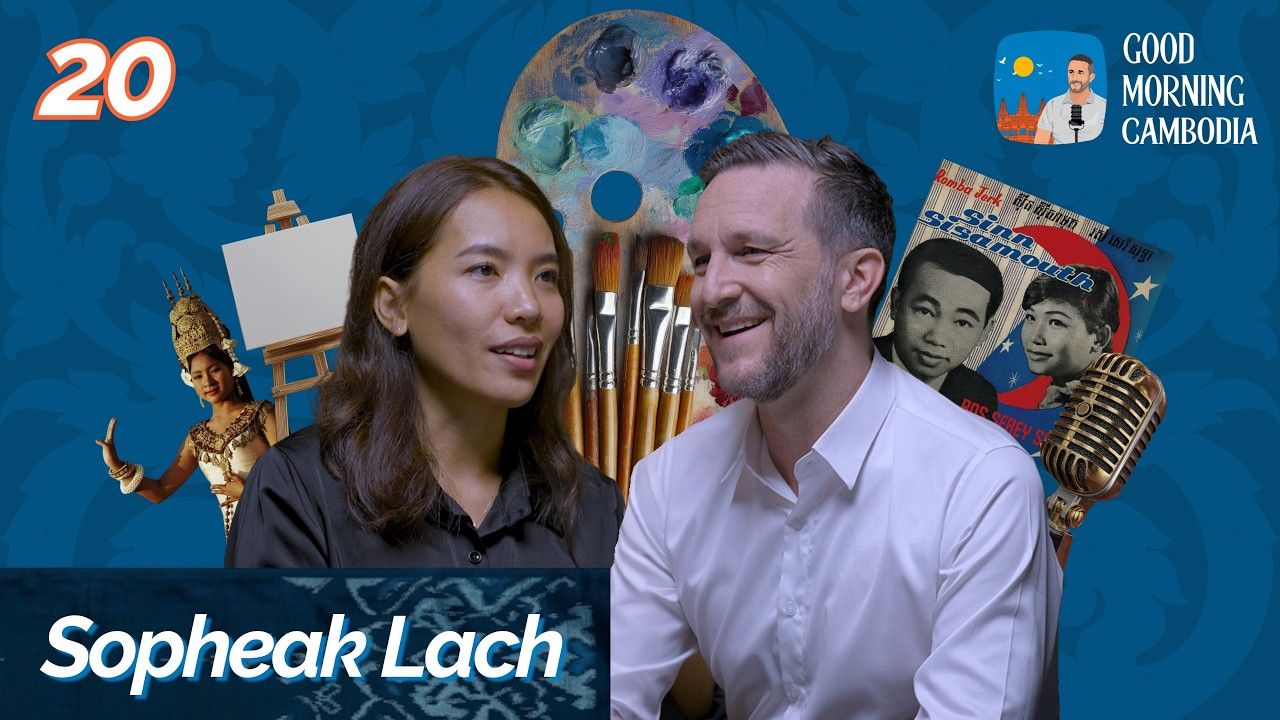
Jesse McCaul talks with Sopheak Lach, a Phnom Penh artist who was born in a refugee camp on the Thai border and grew up in a family of artists. She explains how the COVID lockdowns and visits to museums in London and Paris led her to start a painting project in 2022 about the singers and songwriters of Cambodia's 1960s and 70s golden era, many of whom are now little known. They also talk about showing visitors a side of Cambodia beyond the war, her grandmother's survival story and her first big exhibition.
Where the stories happened
See them on the story map →Chapters
- 0:00Introduction
- 0:59From a refugee camp to Phnom Penh
- 4:21Turning to art during the COVID lockdowns
- 9:08Tracing the songwriters behind old Cambodian songs
- 16:39The golden era and Cambodia's artistic talent
- 25:36Growing up in a family of artists
- 31:19Showing Cambodia beyond the war
- 36:01Her grandmother's story of survival
- 43:31Her first big exhibition
- 47:43Cambodia's growing art scene
From the conversation
this is me as a Cambodian artist and this is what I want to show about people back in the day, not just the war that we heard about Cambodian.
But I tell them, yeah, you of course you go and learn the history about the country what they the country been through and stuff, but outside from that you can enjoy in Cambodia.
my grandma she she the oldest in the family and she lost her finger because like it's so to say that I'm so lucky like how are you lucky because you lost your finger.
Read the full transcript
0:12 Greetings from the Kingdom of Cambodia. We are live and well right here in Phnom Penh, Cambodia. And we're excited to have you with us wherever you are, whatever time zone you may be in. Welcome to our world right here in Cambodia, the kingdom of wonder. And like I said, there's so many good things happening right here. And we're excited to bring you into it. And you're in for a treat today with some very intriguing, eye-opening conversations and excited today to have Miss So Le with us today. And Sopheak, it's it's an honor to have you here. Thank you for coming on to the show today.
0:59 Thank you. Yeah. Yeah, it's exciting. Thank you for having me today. Yeah, absolutely. It's it's exciting to be able to have you here. And we're going to talk of course there's your story. Of course, there's the amazing country that we live in, the amazing people of this country that, you know, we work with and we interact with every day. but then we're also going to talk a bit about the art scene as well, right? And Sopheak is a professional artist in particularly promoting and highlighting the golden age or the golden era of Cambodia. And you'll figure out what that's all about here soon. So yeah, it's cool to have you here. And Sopheak, you were you were you were raised here in Phnom Penh. were actually born in a refugee camp on the Thai border. Yes.
1:53 For just a very short like less than a year, right? And then you're and then moved to Phnom Penh and you grew up right here in Phnom Penh. Yeah. Phnom Penh's gone through a lot of changes since when you were little until now. Yeah, it's it's it's hard because when my family moved back to Cambodia and we kind of don't know what to start the life because you were living as refugees in the refugee camp with really nothing, right? Yeah. Really nothing. And then you moved to Phnom Penh to start a new life, right? Yeah. And yeah, the life that time is really hard. And for when I remember when I was like five, six.
2:38 Yeah. But yeah, my grandmother telling me about how they put other family together and trying to you know live life. Yeah. In Phnom Penh even this is our country but Yeah. Yeah. It's it's been through a lot I think. Yeah. Yeah. So from those early years probably in the 1990s when you were growing up here and then now we're here in 2025 this city it's changed a lot.
3:17 Yeah. Yeah. It's a lot of development and yeah more people great people Cambodian people trying to work helping Cambodia to the world. Yeah. Yeah. Yeah. Yeah. I think we can we can see that over the last you know many years everyone and including yourself have been working hard to continue to develop this country of ours the whole country. Phnom Penh of course is part of that as well as to promote and promote our country but then also you're involved in even kind of like promoting and preserving kind of some of the heritage of Cambodia as well through your art as well. thank you. sorry I forgot to introduce myself. I'm an artist.
4:21 my art inspiring from 1960 to se y I start like take my artwork like serious when like five years ago after co y I think that time is quite hard for everyone. Yeah. yeah I like stay in the house like two week cannot go because I my home like in the red zone right back then during the lockdowns they had the what do they have like orange yellow red or something like that red zones you couldn't get out. Yeah. Yeah. I can't even go to market to buy food.
5:08 So I have to like do delivery. Yeah. Yeah. Yeah. But yeah, that time I just start to like go insane like so depressed because my work like I meet people a lot like I do photo shoot, makeup then and I used to work at the film in the film maker. Yeah. Yeah. Yeah. The film industry. Yeah. Yeah. But then yeah, I just like what can I do? What can I help with this country because I know one day this co is kind of gone, right? So what I what I going to have for for my country to you know help more. yeah, and then I start to go back to my old story. check on my phone what I've been to another country. Then yeah, I just like okay. I went to art museum in London. Yeah. to Paris and quite I'm I'm kind of lucky because I have a chance to go and explore more the art world.
6:25 Yeah. You've been able to travel and explore the art scene internationally quite a bit. Yeah. Right. And that's like all of that opened my eye like oh my god I want to do this and showing my about my country through my art just I don't have to speak you know but everyone can see my art and just hear the story like know where they from and this is the Cambodian through your art right without even having to speak or Yeah. Yeah. Yeah. So I just start to I have an idea but like I don't have a team who to help me work out like what I going to do but like oh my god I forgot that I come from a family artist but they also have a you know their own life and work right so I kind of live that idea like almost two year that I don't I didn't start doing it Right. I had an idea but I just left behind and like still keep thinking about that idea but I didn't do it straight away.
7:35 But yeah like I think I start do all this art around 2022. Yep. Yeah. Yeah. And so after co a couple years. Yeah. Yeah.
7:49 Yeah. It's still it's still quite Yeah. Yeah, a lot of people don't want to traveling still. Yeah, there wasn't really any travel. There were still lots of restrictions and things like that and the country was like a lot of play a lot of business that locked down and then they all lost their home their business too. So it's quite so I'm like I don't know if at first yeah all the artists want to make money wonder for living right everyone have to do that but then at the same time like if I thinking about that and just like not doing it right my idea is gonna just die right it's just an idea yeah just an idea I don't do it and like okay I gotta invest myself, put the money out and just like, okay, I asked my uncle to help me out like, "Okay, guy, I this is all I have, right?
8:48 What can I do with this?" Like for you guys to help me with the easel like the stuff that I need for Yeah. Yeah. to start. And I said, "Okay, what do you have in mind? What's your plan with this? Like can you tell me explain what you want to do?"
9:08 Yeah. And like I start to just draw like basic to show them like and they like what do you got that idea from? Like well I don't know I listen to a lot of Cambodian music. Yeah. Which I love you know old man song. Yeah. Yeah. Yeah. Yeah. For sure. You know from like the 60s and 70s, right?
9:31 Yeah. Yeah. Yes. Yeah. Yeah. Yeah. And I have a lot of question because some of the music I don't know who the singer like I listen to the song but wait is it really him? he the writer or a singer just you know.
9:53 Right. Right. And then I asked my grandmother, I asked my uncle. they have no idea too because like a lot of the everyone know that okay since of course he's the most famous like of course you know that he best singer the legend but some of the song he's not the one that write it right other people wrote the songs and he sang it yeah so I want to know who is the writer for that song who's writing the lyrics for these songs yeah so I just keep the more I keep checking and try to explore and learning and trying to find out who that is like I like okay what can I do with those people who lost their time and their amazing work right and no one really know and he heard about them so these songwriters yeah from the 60s and 70s which was like the golden era of Cambodia we call it and that you know they had different famous singers like Sinn Sisamouth and other people singing their songs.
11:07 Yeah. But fast forward to now Yeah. 2020s who would even know who they are, who would remember them? Yeah. So that was kind of the thought process. Yeah. That's the thought process I start and okay this is my idea. I so I show it to them and I explain this is what I want for Khmer people for this generation to heard and to know this person is amazing with their work right but they don't have a chance to show we trying to do it now like trying to change the old song to mix with the this generation. So you're So you're involved in taking some of these older songs from the 60s and 70s and then kind of remixing them for modern Yeah. with some modern sound as well. Yeah. Yeah. With you rather than with the of course the artist that Cambodian singer right now.
12:17 Yeah. Like with one, right? Right. So some of the current singers are taking parts of these older songs which is great integrating them into their new songs. Yeah. which is great because like then because then that song is like explore with the one the yes singing with the new song but I forgot the name of it but I'm curious that oh that song who is a singer and then just go and check out on the YouTube and right yeah all those idea and like okay everyone trying to raise up those people but still not enough right so I'm like for me as an artist what can I do with it right through my art right so I just trying to put and trying to find out it's still a lot of artists that it just no one know about them because most of them die back in the day. Yeah. And some of them not live here. They live in overseas. Right. Yeah, that's right. Yeah. Many of them moved overseas. Others Yeah. their lives were lost during the war and the genocide. I'm going to I'm going to say something maybe to paint a bit of a picture for those that are watching as well. and of course, you know, different countries, they have their own arts and entertainment scene, culture. I'm originally from the US and so if you think about the music from the 50s, the 60s, the 70s, English genre of music maybe from the US or from the UK oftentimes you have many different famous bands and singers. I mean even if you're living you can nowadays it's more like Spotify and things like that but back then you know you can turn on your radio and they have modern music and then there's another channel for you know country music there's another channel for rock music there's another channel for 60s music
14:32 and it's it's pretty well preserved. Yeah. but because of what our country went through and you know the war and devastation that our country experienced in the 70s a lot of that was nearly lost. It was nearly lost and I'll use that word nearly because it wasn't completely lost but it was nearly lost. Yeah. And you know, honestly, after the war, people were just focused on survival.
15:06 Yeah. And so it wasn't even important about, you know, who is this person, who is that person, and where is their music now? It was just about put food on the table and just survival. but now that we're at, you know, this time of peace and progress and development in our country, it's it's really the right timing.
15:33 and you're one of the leaders in this op. There's others that are involved in it, of course, like you mentioned, there's the music industry, and they're taking bits and pieces of these songs and integrating them into their modern songs, which is really cool. Yeah. but there's a lot more that can be done. Yes. And that's what you're doing with your art. Yeah. Yeah. I should Yeah. I think I should do my part as a Cambodian race who live here.
16:03 Yeah. Yeah. Yeah. Yeah. Yeah. You are Khmer. Yeah. Khmer.
16:08 so yeah, that's that's my plan. I want to make that art. to for everyone to seen and get to know those people. Yeah.
16:24 Yeah. Not just her heard, but like is it really them singing that song, right? You know, you know what I mean? Yeah. So, that's my goal for now.
16:39 No, it's really cool. It's really cool. So maybe talk a little bit about you know because some people might not be familiar with it that golden era of Cambodia. Yeah. And I mean it was it was a it was a very special time for the Cambodian people back then. Yeah. Right. And there was a lot especially in the arts and entertainment. And for those that maybe would not be so familiar, but back then King Sihanouk was a big promoter of the arts and entertainment in Cambodia. And I'll I'll say this, Peek. I'll say this as well. and even to those that are that are watching us today.
17:24 different nations I believe and this is my opinion. Okay, this is just my opinion. so you can you can have a different opinion. It's okay. It's not a problem. but I believe that different countries have different kind of like national talents.
17:43 there's there's you know certain countries they're very good at innovation. There's certain countries they're very good you know they really focus on doing a lot of humanitarian things. I've always believed that one of Cambodia's like top foremost national talents is in the arts. And the reason I would say that I said it for a couple things. one of course Angkor Wat and Angkor and all the temples what are they known for? They're known for the ancient architecture of course but then also the carvings right which is which is you know and the engravings that still exist today a very artistic very intricate detail and this was the Khmer people. This is the Cambodian people. Yeah. That were doing this. and that's what has made, you know, Angkor and all of the temples up there known around the world is the art of the Cambodian people. And then my understanding I wasn't here at that time but you know after the war and the devastation in Cambodia that as the country was just beginning to be rebuilt in the countryside no electricity nothing but the arts would start to come back that they would get like the chat hound they would get you know like a little stage and they'd start to do some like little plays. plays and dramas and acting and things like that. And my belief and my experience is that Cambodians are naturally very creative, very artistic, and I I believe I mean that's from thousands of years ago, a thousand years ago even. and so it's in it's in the blood.
19:51 It's in the DNA of Cambodian people to be creative, to be artistic. and I' I've always believed that's a national talent. It doesn't mean that everybody has to be an artist or something like that, but it but it comes very naturally. Yeah. And so, back to the And sorry, that was kind of a long thought of mine, but that's something I've always believed.
20:15 Yeah. peek and so if you look at the 60s and the 70s even former king Sihanouk he was a big promoter of the art scene right and as a Cambodian himself he was a Cambodian he was artistic he realized that Cambodians are artistic and so he promoted that whole scene for you know for especially for those two decades really. so maybe talk a little bit about what that golden era and you know I'm I'm describing it you know from a distant outsider but you were going Khmer so you know even better than me you know but what you know what was that for those that aren't aware what was that golden era that we call the golden era of arts and entertainment for Cambodia what was that like back then? back then. Yeah. And I mean you weren't alive back then either, you know, but you have researched this, you have researched this and you're actively preserving it and promoting it as well. So, you know, based on everything that you have been able to, you know, learn and talk to people and study and research life back then about for all of them who is the actor actress singer.
21:45 they have a great life and like not just not just for like as an art artist but also they do something more to help the country. Some of them they are singer but they also work as the army. Uhhuh. In the military. Yeah. Yeah. Yeah. Yeah. And I think a lot of them does.
22:16 Yeah. Yeah. From what I do some research, right? Yeah. I don't know because there was a lot of conflict happening in the region. Yes. And then in Cambodia as well during that time. Yeah. Yeah. So that's why I want to show that they not just a singer or star, right? But they also people that trying to help and put the country together and with the culture as well. Yeah. Yeah. Sometimes yeah, I think sometimes at least it seems like or people can think that being some sort of celebrity Yeah.
23:05 means that you're just trying to get attention for yourself all the time. That's what it seems like. You know, you got the spotlights on the stage and you know, so that's that's our perception at least that you know, this person's a celebrity. Their goal is to get as much attention as possible. But if you look at the artists back then, yeah, and I believe it's now as well that they had talent and their talent brought them some nice exposure, you know, some nice attention. People knew them, you know, and they recorded different albums and they had concerts.
23:41 but it sounds like what you're saying is that they were also very focused on doing good for the country. Yeah. Is that would that be correct? Yes. Yes. That's interesting. That's interesting.
23:53 Yeah. Yeah. in your you know in your research and in and you know exploring some of these different artists from back then have you found anything that surprised you from in your different studies and in your different research? Yes. I just start to do this the research and just recently, right?
24:20 Yeah, recently. And but then I just like have this art project going on. So, right, I really don't have a lot of time to Yeah. remember all of them. Yeah. Yeah. But you found different people like this one that you mentioned that his songs were sung by back then the most famous singer people like Sisamouth who's the number one Cambodian singer legend you know and but this other he was he was the he was the one who wrote the songs he was also an author but you don't ever hear him talked about really. Yeah. he live in US actually.
25:04 Yeah. And I think he just passed away like a few years ago. His name is Gongam. Gongamun. Okay. Yeah. Yep. Interesting. Interesting. Yeah. That's cool. So let's let's go back to the arts and you mentioned that in your family your family that there were artists as well and were you involved in the arts as well from a young age?
25:36 okay. so my family they all artists. Yeah. And when I see all of them keep doing their art work, right? I never thought I don't want to be like them. Yeah. That's their thing. Let them do it.
25:54 Well, I was a kid. Yeah. Yeah. Yeah. Yeah. Yeah. And I just like don't want to stay home. I want to like go out and explore, right? You know, outside the world, right? But then yeah like I have to I have to continue and helping at the same time right. So most of their artwork they do like portrait and Angkor Wat and stuff.
26:23 yeah they just keep asking me to help. Okay do this a little bit just that's it. That's all your work for now. Yeah. And I guess it's Yeah. in your blood because your family is an artist. Like even you don't want to but it just you got it, right? Right. Yeah. Yeah. You're around it all the time, right? Yeah. So I see how is the process what to do. See, and I'll interrupt there because for me I even drawing stickman, my stickman look terrible, you know. So, I'm not a I'm not an artist at all, but I've never been in that, you know, I've never grown up in that environment. I've never Well, maybe if you have like more time to just do practice a little bit, I think so. I think so. Yeah. Like, nobody knows what I'm trying to sketch. Anytime I try to sketch anything, so you grew up in that environment. Yeah. And we're involved in it, exposed to it.
27:19 Yeah. Through all of your life, really, right? One time. so my family client was they all live in Siem Reap. Yeah. They have they have a big shop there. Yeah. they always order painting from my family from my uncle. Yeah. Sometime like 500 painting 500 paintings that time for a shop in shop. Yeah. In Siem Reap because there's a lot of tourists up there. It's like 20 years ago it's a lot like but after co it's quite quiet a lot of shops quite a close down and never come back which is sad but yeah I guess it's the time now to to trying to get back helping showing what Cambodia have and stuff. Yeah. Yeah. Yeah. Yeah. So the 500 painting was a lot and yeah we was like planning no one really go out we just get up have breakfast and start do our work. Wow. So there was an order of 500 paintings some of Angkor Wat some of like Apsara dancing and yeah quite a lot.
28:33 Wow. So I quite at that time I'm learned from that like this is a business family. Yeah. And I want to keep continue doing it as a artist. Yeah. And helping her family too.
28:50 Yeah. Yeah. So but again like I don't think that I would be that good and having my own project. And so I asked the asked my family to help just to guide me what side should I do this. right. So I want to put them together. Yeah. As a Cambodian legend, right? You know, and yeah. they're really helpful and then give me some idea. Yeah. So yeah. So there you go. I have my a exhibition soon next month. Yeah, that's right. Congratulations. So, I can't wait to show Cambodian people and I'm so excited myself. after I finished the art, I'm like the my mind is blowing like how can I do this? Like I have this idea for like two year but I never I don't know this is going to be that good. Yeah. I can't wait to show everyone. I can't wait to show people around the world who come to Cambodia. Yeah. You have you have it you've had it inside you. Yeah. You've had it inside you and now Yeah. You've you've brought it out and now it's time for the world to see it as well. Yeah. after that, like I'm really impressed myself and like this is me as a Cambodian artist and this is what I want to show about people back in the day, not just the war that we heard about Cambodian. oh, if you come to Cambodian, there's nothing to do much. There's nothing to learn. M but I want to show that Cambodia is much more than that because every country have war. Every country have a sad side that everyone doesn't want to think about it to talk about it. Sure. Yeah. But why can't we show it both side? Mhm. Okay. Let's say those time that really horrible losing loved one your family and stuff and losing their home, losing the country almost losing the country. Yeah. Yeah. Yeah. Of course. Yeah. Yeah. So I think
31:19 it's a time to show that another side of the Cambodian. So yeah. it's it's a lot of question when I traveling cuz you know everywhere you go you make friend and they would of course asking you where you from and you have to have your own story to tell them right and when you tell them oh yeah I'm from Cambodian but oh is it your Cambodian just the country just finished the war like well like yeah like 20 years or 30 years ago but yeah now we good we happy and the country was like grow and develop a lot and we have a lot of people smart people and and you should go and learn about the Cambodian not justing about the war. Yeah. you know, and then yeah, that's what I trying to change that through my art. Yeah. It's like I think Cambodia have more not just that and not just Angkor Wat, but the people that you know back then and just trying to make the history Yeah. for us to learn and for us to keep continue showing Yeah. the world. Yeah. Yeah. Yeah. That's right. Yeah. Yeah. I mean I'm I'm sure in your travels around the world and you've traveled quite a bit. not around the world yet. Not around the world, but many places.
33:13 Just a few country. Yeah. Yeah. But yeah when like of my friend in London who I yeah I met and they oh what can I do if I go to Cambodian to your country?
33:34 Yeah. What's there to do there? What to do there and what is interesting me? Yeah. say, "Wow, it's a lot." And yeah, you might heard some do some research on internet about Cambodian, what you're going to do and what the history about Cambodian. Yeah. You might seeing that, oh, this country have a war and that when you go there, just go to a killing field and seeing the sad side stuff. But I tell them, yeah, you of course you go and learn the history about the country what they the country been through and stuff, but outside from that you can enjoy in Cambodia. yes, stay you have a two week I think you can explore a lot. There's a lot to learn a lot about the history too.
34:28 That's right. Yeah. Yeah. So I got you trying to change the mindset because I think a lot of foreigner who really don't know about Cambodia to just only know about the war. That's right. When they think Cambodia, they think the war and then maybe some other bad news that they heard like from 15 20 years ago or something like that. Yeah. Yeah. Yeah. Yeah. they really not heard about the another side. Yeah, we have tourism, we have modern conveniences, we have food, we have arts, we have music and I think the reason why a lot of foreigner who only heard about this and not the amazing side of Cambodian is because most okay Cambodian lost a lot of people. Mhm. right now is only older people more than young people. So the older people that after the war of course they lost a lot and it really emotion. Yeah.
35:43 And they don't want to talk and remember all those stuff. Yeah. Yeah. Yeah. And when you ask them, they don't want to talk like they forgot about the amazing stuff the pe the Cambodian people before the war.
36:01 Before the war. Yeah. Because it was lost. Yeah. And so the older generation, they don't want to talk about it because it brings up Yeah. memories. Forget everything. Right. Right. So that's that's another problem that we don't talk about it much because it's it's pain, right? Yeah. And deep inside of all of them. even for me when I heard the like the story of my family how what happened and my grandma she she the oldest in the family and she lost her finger because like it's so to say that I'm so lucky like how are you lucky because you lost your finger.
36:46 Yeah. Yeah. And you got shot like three spot on your body and Yeah. And she's like, "Yeah, I'm lucky because I stay alive. I still have a life and tell this story to you, right, to, you know, for you to learn and but it's not just that side because she said that she happy. She's lucky that she's still alive." Yeah. because she don't want to always remember the sad side and she tell me the amazing of the time that she have in yeah back in the day. Yeah. Yeah. Yeah. I think what you brought up is really important that ancient history.
37:40 Yeah, we have, you know, Angkor and the temples and all that. That's amazing. It's amazing. That's an ancient history. and it's still well preserved now. but Cambodia has had other eras as well. And one of those very nice eras was 1950s60s into the 70s. I've watched old videos now they're available like on YouTube and things like that of Cambodia back then. It doesn't mean that you know everything was perfect but there were parades in the streets and the stadium was built and there was you know a lot of different innovation happening and there were there was a lot of Cambodia was a happening place in Southeast Asia back then. and then we went through, you know, the terrible, devastating war and genocide. And the people that remember that era from the 50s, 60s,7s, they don't want to talk about it because of the pain of what they've been through and they But it was something that can be celebrated. That was a that was a special time in Cambodia that can still be celebrated. Yeah.
39:07 And preserved. Yes. but if the older generation is not talking about it, then how do we how do we do that? And so that's exactly one of the things that you're doing. Yeah. Yes. that's Yeah. that's what I I trying to change a little bit of that because when you only think about the pain, it's just going to keep you like just stay in that one point. That's right. Yeah. And it's like that's not helping you.
39:38 At the same time, you're trying to help as a Cambodian. you're trying to help your country to the world, but if you not talk about it Mhm. And also you not talk about the amazing stuff. Yeah. So it's just not I think it's just not right to forget all those thing and also the people who been through and also they make a amazing time for Yeah. for the country. Why we have to forget about that? Yeah.
40:15 Yeah. So, and I mean we have population of Cambodia right now is 17 million here in the country. Yeah. But if you count the Cambodians that are living all around the world that are living outside of Cambodia as well including in places like even like in Kampuchea Krom or Kamaya and then of course all around the world as well.
40:43 we probably have close to, you know, 25 million, even up to 30 million, I'm not sure the exact numbers of Cambodians all around the world. That's a that's a decent sized population that they need to they need to celebrate the wonderful things in their heritage. Yeah. And I think again, you are Khmer, so I'm not even though I'm a I'm a Cambodian citizen now, too. when something happened to my heart that I kind of became Cambodian too now. But but I think I can say that Cambodians don't want to just be known for the war and genocide. That was a terrible, devastating regime that they went through. Yeah. We don't want to just be known for that. Now, that was a very terrible point in our country's history. Yeah. It destroyed everything. and hopefully the rest of the world will never experience something like that and hope and we've rebuilt and we have peace and we have stability now too. So hopefully the rest of the world can also learn from that. For countries that are having conflict, they can learn from our country of how to get out of conflict because we've done that very well. but that's not the only thing we want to be known for. We have we have a lot more to offer the world than just that, right?
42:07 yeah, that's my biggest goal now to through my art because this is this was what I want people from other country to Cambodian and when you when they come and just okay maybe one day they want to go to our art gallery and see all those okay what is this about who is this person who is she who him what they have done to the helping the country before the war. Yeah, that's right. And learn the about the history and the we have a Angkor Wat a lot of more temple. Yeah.
42:50 Yes. And yeah, I would be more happy to see a foreigner who come to Cambodian and do something different, not just talking or asking, oh, your country have a war, but like everyone have a war, but you want to learn the history and another side of that because we have a lot. We have an amazing every everything. Yeah. Yeah, that's right. Yeah, that's awesome. How can people find your artwork? And I know that you there's the exhibition coming up soon. Probably when this is released, the exhibition will have already happened probably.
43:31 but how can people find your artwork? so this is my really big project, my first time big project. and my exhibition is like next month, 7 February next month. you can go check on my IG, but I not really post anything about this project yet. But it will be. But it will be.
43:59 Yeah. Yeah. Yeah. And also I will launching my new website for that. Yeah.
44:05 What's your IG? What's your Instagram? my Instagram is called So Art to Frame. So Art Two Frame. Art Two Frame. Yeah. Okay. or check out my u private one. So yeah that's you can find see my old stuff because before I do this project I do art commission a lot quite a lot. Yeah, you might see some of my art at the restaurant. Yeah, that's awesome. That's awesome. So Peek, you're amazing. You're amazing. Thank you. And I hope I hope this conversation helping and for everyone who watching this to understand because I can say that my English it's okay but at the same time it's just like I'm lost the word because maybe I'm nervous.
45:05 I don't know. No, there's nothing to be nervous about it. And no, your English is No, I hope I hope everyone understand and if not, then ask you to see. If not, come and visit Cambodia. Come and visit. Right. Exactly. You don't understand, come to Cambodian and ask and learn because our generation now they always their education is great and everyone speak English. But that's right. Yeah. Yeah. It's true. It's true. Yeah. Yeah. That's something that a lot of people don't realize about Cambodia that for them coming here as a visitor. Yeah. so many people speak English very well. Very well. I mean obviously before the before the show I asked you I said have P did you know live abroad you know you said no I'm going Khmer grew up here. I only take English class like four month.
45:59 Oh really? Yeah. And I couldn't speak, but I understand. I couldn't Yeah. I couldn't I couldn't talk back. I just like it's like you lost the word. You understand what they saying, but you just I maybe it's you're shy as well. But then I thought myself I start to work at the restaurant. Yeah. then start to write and just practice speaking you know and like those time my coworker like asking why you come here and work here at the restaurant because they know that where I live and where I from where I come from the family. Yeah. and say well I want experience that's why I want to go out and explore myself so I think this is the good way for me to keep learning you cannot learning you just lock yourself in the room at how at home that's not how you learning you know so yeah that's the how I learn English and speak that's awesome but still how I need to practice more Yeah, great. You're great. You're great. the art scene in Cambodia is quite active and alive, right? I mean, what you're doing is very special, very unique, and I hope that everyone is able to Yeah. be able to take a glimpse of what you're doing. But the art scene in general is quite active here in Cambodia as well, right?
47:43 Yeah. Yeah. Now it's it's I think it's Grove. for the painting for the art for Cambodian it's just starting right to like people more interesting with the Cambodian art and like not just about Angkor or Apsara dancing those kind of painting it's amazing it's about talking about the country the community yeah but now like we have different artists who trying to work together and showing this is Cambodian, this is Khmer people can do like other country too.
48:28 Yeah, that's right. You know, we have a lot of smart people too. Absolutely. Absolutely. Yeah. And again, you grew up in you know a family of artists. but my understanding and my observation is that in the past you know 20 30 years ago a lot of the art was depicting you know some of the different Angkor Wat temples. Yeah. And that would be both for locals that they want to have a memory of, you know, the Angkor Wat temples in their home and also of course for a lot of tourists that we receive up in Siem Reap and up in the Angkor temples that they want to bring home some memories and some beautiful art.
49:15 then you of course you have the Apsara dancers as well and that's part of that kind of ancient culture up there. and then of course you have the beautiful landscapes, many landscapes as well, you know, the countryside, the rice fields and all of that. but it seems like in the past that was the majority of Cambodian art that you would see around. And you're absolutely right. Now, this kind of latest generation, there's some amazing people from the previous generation as well, but especially kind of right now, Cambodian art is really beginning to Yeah. be seen internationally as well.
50:00 And yeah, all those people all those artists is they do amazing work with with their work. And I want that to keep, you know, growing and keep going because this is how we show the world about Cambodian but Khmer people too. Yeah. One of the things and we can kind of finish up here. So, Peek, but one of the things that I really appreciate about you, I appreciate about this generation of Cambodian artists as well as even some of the previous generations is that you could almost kind of say this, it's art, entertainment. Whether we talk about you know art, whether we talk about music scene, even in the the acting industry, it's it's art and entertainment with a purpose with a with a with a clear purpose. And it's not and even like what you talked about in the 50s and 60s and the 70s that you know the entertainers back then, the singers, they had a talent. Yeah. And it of course it's, you know, when you have a talent, you can use that talent to make a living, to earn a living. That's that's normal. But then there's a purpose of wanting to do good for your fellow countrymen. There's a purpose of wanting to develop your country, wanting to promote your country, wanting to preserve your country. And this is I think this is something that's very special about the Cambodian people. And that everybody has to earn a living. That's normal. everybody needs to discover what their various talents are. but there's also even it seems like in the past and then even now in the present nationally there's a big desire to use those talents to do something good for Cambodian society.
52:09 Yeah. And I see that you know artists have had that in the past like you mentioned. Yeah. that you discovered kind of even through some of your research.
52:20 Yeah, they currently have that. And then of course you in particular, Peek, you also have that as well. So I really I respect that. I respect that. I respect that. Peek, it's great to have you on. Do you have any invitation to the whole world? You want to anything you want to say?
52:38 Anything you want to invite them to come into our world here or? yes. so like I saying mentioned before my exhibition is on 7 February next month. if anyone want to see all those work it's amazing work. Yeah. please go to Chipmong Mall.
53:05 yes my art will be there. Yeah. Hang in there for you guys to see. Yeah. Yeah. That's awesome, Peek. And thank you for coming on today. It's great conversation. Thank you so much. This a great time and this is a good experience for me too because I never do a podcast before. So Peek with regards to Khmer golden era music, who for those that want to jump back into it, even for our bomb and Khmer that are maybe around the world and they want to jump back into this or even for foreigners, who would you recommend as artists from that yes, that era? as a quite a lot but I only yet still doing some research about them. for now you can go search on YouTube their song their acting.
54:12 so I would I would write their name Sinn Sisamouth of course. and the actor. Yeah. It's it's quite I think when you do it and it just like came out everything. Yeah.
54:34 Yeah. So, search some of these names. Yeah. And you won't be disappointed, right?
54:40 No. Yeah. Yeah. That's awesome. Thank you. Thank you. Yeah. Thank you. Just a cup of tea.
54:47 It's just a nice cup of tea, right? Yeah. Thank you. And thank you for coming on and thank you for joining us today. we're looking forward to many more exciting conversations right here on Good Morning Cambodia. And we'll see you soon on one of the next episodes of Good Morning Cambodia.