Sokoun Chanpreda: Cambodia is not the country most people think
With Sokoun Chanpreda
About this episode
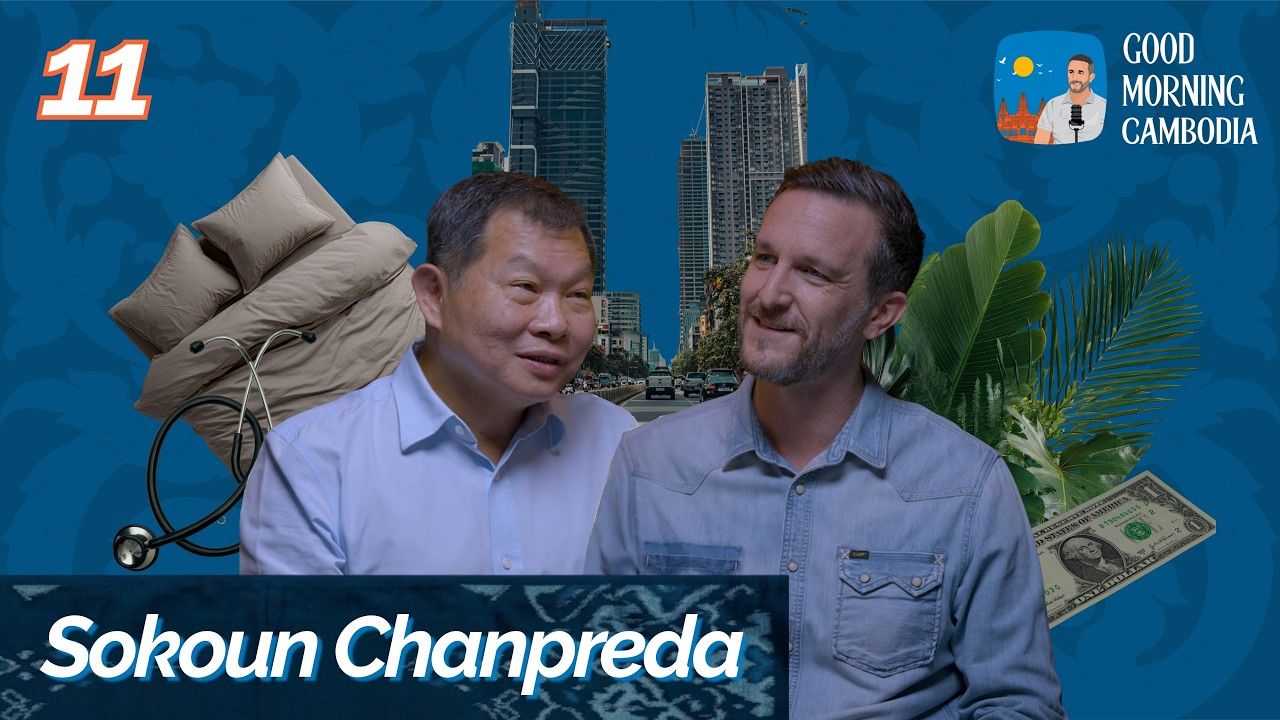
Jesse McCaul talks with hotelier Sokoun Chanpreda, who was born in Battambang, grew up in Thailand and came back to Cambodia in 1992 as a volunteer and worked with Hope Worldwide on a free hospital. He explains how he opened Hotel de la Paix in Siem Reap in 2005 and how Shinta Mani grew from staff housing and a training guesthouse into a hotel brand, including the Shinta Mani Wild tented camp in the jungle and newer projects in Nepal, Laos and on Koh Russey. They also discuss safety, Phnom Penh's food scene and Cambodia's young, English-speaking generation.
Where the stories happened
See them on the story map →Chapters
- 0:00Introduction
- 4:05Born in Battambang, raised in Thailand
- 5:40Returning to Cambodia as a volunteer in 1992
- 8:21Volunteering with Hope Worldwide's free hospital
- 11:09Early businesses and Hotel de la Paix
- 18:18How Shinta Mani began as staff housing
- 24:27Building Shinta Mani Wild in the jungle
- 33:40Expanding to Nepal, Laos and Koh Russey
- 44:01Misperceptions and Cambodia's young generation
- 46:31Phnom Penh's food scene and new opportunities
From the conversation
it's a 1992 is a ground zero country yeah just any there's a lot of opportunity and that's why I somehow end up into hospitality because of that. It's not because I have any master plan or vision to do this.
The tent is I would say 20 30% of the experience, right? It's the jungle. It's the it's the cruise in the river. It's the it's the foraging in the forest bringing forage food and cook in it.
No, from local like my assistant here, Rich speak perfect English from Cambodia. So, it's like it's the English level, the education, the new generation is amazing.
Read the full transcript
0:13 Yeah. Yeah. I think I think maybe yeah, like you say, a lot of people misunderstood and thinking Cambodia is really backward and not developed and doesn't is dangerous, things like that. Yeah. But actually it's it's one of the safest city. I mean you can walk anywhere and of course the people here are like I shared earlier it's one of the attraction is the the people here with the very sincere service and attitude. Yeah. Sharing about Yeah. Yeah. I think like what you mentioned you know it's Cambodia is safe. Yeah. Safe. Of course, it's not backwards, you know.
1:01 whatever you want is available in Cambodia. You want the simple market experience, you want to go on a boat and do a little fishing trip, you can do that. You want the high-end culinary experience, that's everything's available. Greetings from the kingdom of Cambodia.
1:21 We are alive and well right here in the middle of Cambodia, Phnom Penh, Cambodia. And we send greetings to all of you all around the world. for those of you that have some familiarity with Cambodia, we are saying hello. We're all doing well here. for those of you that maybe aren't really aware of Cambodia, welcome to our conversations and welcoming you to explore what Cambodia is all about and even for our Khmer noll for our Cambodian friends that are all around the world maybe not even living in Cambodia welcome to our table as well and we're looking forward to some great conversations. I believe that not just enthusiastic but intriguing and oftentimes even thought-provoking conversations as well. So welcome and it's great to be here today with brother and we say bongra and bangun it's an honor to have you here and good morning of course looking forward to enjoying a nice cup of tea with you this morning Bangkok brother Sokoun Chanpreda is a leader global leader really in luxury travel for several decades. And we'll jump into some talks and details of what you have accomplished and been up to for several decades. as well as of course some of your story, Bong, but yes, Bong Sokoun is a leader in luxury travel globally. But in more particular here in Cambodia, for many of you, you would be familiar with the Shinta Mani luxury hotels here in Cambodia. in fact in 2022 you were on the gold list of the Condé Nast Traveler gold list and of course many other international awards for many of your resorts and luxury hotels both here in Cambodia and of course globally as well. but Bong, you're Cambodian as well and this is your birthplace and this is amongst being an international business leader but this is this is your birthplace and this is one of your core focuses and your business and your industry as well.
4:05 Right. Right. Yeah. So welcome Bong. It's great to have you. Thank you. Yeah. And Bong, you were born in Cambodia, right? Up in Pailin Province. Is that correct?
4:19 I Well, my family is from Pailin. And when I was my birth time, my father told me that the Pailin was only a village of 3,000 people. And so I'm a village boy. Yeah. And so my mom has to go to Battambang to give birth. So actually I was born in Battambang. Ah because it was just a village there and there weren't appropriate facilities way back then. Yeah. But we well my dad also have relatives, sisters and family in Battambang as well.
4:52 Yeah. But we were from Pailin. Wow. Yeah. Yeah. Pailin for those that don't know Pailin's the kind of the gem province. Gemstone gemstones. Yeah. My dad's in the gemstone dealer at that time. So way back then. Yeah. Yeah. Yeah. Way back then. Yeah. So yeah. So you know born here in Cambodia, born in Battambang, which is the rice capital and then hometown was Pailin, which is the gemstone capital. Yeah. And since the civil war started in 1970, my parents moved to Thailand. Right. So I grew up in Thailand since 1970.
5:32 Okay. Yeah. Until I came back in 1992. So came back to Cambodia in 1992.
5:40 So away from 70 to 92. That was sweet. Yeah. Yeah. Yeah. Yeah. wasn't you know for obviously the you know the turmoil that Cambodia went through during that time for those that could get outside the country it was better of course and then but coming back into 1992 that was still quite early on yeah it's the same time as the UN came actually I did not plan to come back at all at that time yeah like most Cambodian right when we left Cambodia because of civil war why are we coming back, right? And of course when I was a student at Boston University, two of my best friend, one from Harvard and one from MIT, they're both American friends. Yeah.
6:26 And they say Cambodia is opening up. Let's go to Cambodia. Yeah. I say why? They say why not? Let's go for volunteer work. Yeah. For 3 months. And three months end up to 6 months. 6 months to three years in Cambodia that time. So I came as a volunteer worker and missionary worked as well.
6:45 Yeah. Yeah. So 92 to 95 in Cambodia. Yeah. So you had two American friends, classmates, colleagues. Yeah. Yeah. Just schoolmates. your neighbors. Yeah. Yeah. From they're from MIT and Harvard. So two of the sharpest guys. Yeah.
7:04 In the US say let's go to do a volunteer work. Yeah. Yeah. In Cambodia. Yeah. And so if they're willing to come here, why not, right? Yeah. Yeah. And that's that's I remember in the 90s that was the message. 1991 the United Nations came in. Yeah. And at that point it was the largest peacekeeping operation ever in the history of the United Nations at that point. Right. And so that was in some circles at least that was kind of the word on the street that look the United Nations is there now and it's you know starting to open up. some of the years of turmoil are pretty much finished up and now Cambodia's beginning in those days very much beginning very small beginnings but beginning to develop beginning to progress that time just ground zero at that time. Yeah, post war it first election. Yeah, it went very well and then since then but it's been growing a lot and yeah, I've been coming back and forth for the past 20 25 years. Yeah. Yeah. More than 25 years.
8:15 Well, yeah. It was on the 90s. Yeah. Over 30 years. 30 years now. Time flies.
8:21 25 years. Five years ago. Yeah. Yeah. Yeah. Yeah. Something like that. Yeah. Yeah. So you came back to your birthplace, your homeland back then and reconnected with the country, the people of course back in back in ' 91. Yeah. At that time there's nothing much here, you know, and so we're just doing whatever we can to support to help Cambodia at that time. Yeah. And we I'm also part of that NGO called Hope Worldwide. Y and my friends who are very well connected in the US.
9:04 Yeah. And they started the Sihanouk Hospital Center of HOPE. Of course. Yeah. Very free consultation, free medicine.
9:11 Yeah. And the goal at that time was to help to raise the standard of the doctor here. Right. Yeah. Because at that time still very undeveloped. But so since then it's been growing a lot. So everything has been developed so much more now. Yeah. Yeah. Yeah. The hope of Sihanouk Hospital I mean for decades now. Yeah. Yeah. 25 years. That's 25 years.
9:36 Yeah. Yeah. Yeah. Yeah. Yeah. Yeah. And I mean of course the you know the facilities, the team that they have assembled and then I'm sure into the hundreds of thousands of patients over the years. We treated around two million patients. It's 2 million. Yeah. Yeah. In the hospital in the 25 years.
9:54 But the actually the goal originally was for to raise the standard of the medical standard here. So we have doctors from all over the world from US, Europe, Australia came to here to volunteer to train to help raise the medical standard here. Yeah. And so that hospital was initiated and created through charitable donations right in the beginning and sustained for many years. Very well. I could not believe it at first that there's so much donation. It's like this is private. It's not governmental, right? You know, and it's just people connections, my friends connections get donations in cash and in kind. Yeah. Yeah. All over the world because it's free. So we have a lot of people, a lot of organization and individuals donate a lot. Yeah. Unbelievable. Incredible.
10:46 Over 2 million free hospital. Yeah. Treated now. Yeah, it's incredible and still doing quite well. Still going very well.
10:52 Actually, it's already we stopped that already since right around COVID time. Yeah. It's returned back to the ministry of health. Yeah. Okay. So, now it's become Yeah.
11:03 government. Yeah. Yeah. Yeah. Yeah. But everything that was established for all these years of course remains. They are the best doctors in Cambodia.
11:09 You know, doctors is has the best doctors is the one with the most experience, right? And the Sihanouk hospital has the doctors with most experience in Cambodia. Wow. Wow. Incredible. Incredible. And you know, I don't know about you personally. I arrived in 95 and you're you know, you're right. In those early days, if you came looking at the country from purely a business or investment perspective, it was kind of hard to figure out maybe where to start back then. But looking at it from what can I contribute to the country back then but also because Cambodia is just basically a new country since 1992. Yep. There's a lot there's so many opportunities. So many I mean I was I was I brought Siam Cement to Cambodia. The elephant cement. Yeah. Yeah. Cement manufacturing. Sam C elephant brand cement. So that time Yeah. It's there's so many I mean 3M asked me to be their agent here which I did not want 3M at that time not now there's no market yet time yeah and I started DHL yeah so this not many people know and it was sold back to the DHL company yeah that's a long time so it was an open slate that time you can do anything this it's a 1992 is a ground zero country yeah just any there's a lot of opportunity and that's why I somehow end up into hospitality because of that. It's not because I have any master plan or vision to do this. It's just the opportunity is there in 90 early 90s. Yeah. Yeah. But my hotel first hotel is in Siem Reap Hotel de la Paix. Yeah. That was 19 2004.
13:08 No, 2005 when we opened. Yeah. Yeah. 2005. But we're developing since 2002, right? Yeah. Yeah. Hotel de la Paix is very well known for anybody that has visited Cambodia or Siem Reap. Yeah. of course, now it's Park Hyatt. Now it's a Park Hyatt and you're still you're still very involved. Yeah.
13:29 Yeah. So that was could be fortunate and unfortunate depends on how you look at it. It's fortunate because it's a international brand. Park Hyatt is a very well-known brand internationally and a luxury brand but unfortunate is hotel is also quite a good brand too of course yeah and it has a I would say that we are proud that we one of the DNA of Hotel de la Paix at that time was promote art so we have a arts lounge and every two months one of the things that we're thinking at that time in Cambodia in two early 2000 was there's a lot of artists but all the artists focus on Angkor Wat Bayon Apsara and nothing else they all focus on one thing Angkor Wat but that's like a thousand years ago right 800 years ago so because the artist is you know they all struggle to survive so they have to do arts that sells only to the tourists right so which is so we thought maybe we have this arts lounge to promote art y outside Angkor Wat as well, right? So, we have a venue so that Cambodian artists can present the artwork and then also to have them exposed to international artists, right? Because right, art is all about exposure, having seen a lot of inspiration, things like that. So, we create the arts lounge so that Cambodian artists can show their show their their talents, their gift. Yeah. And also to be exposed to international art as well. So every two months we have different artists. I can say that a lot of popular or famous artists today has gone through the arts before. Yeah. Yeah.
15:21 Well, it's it's great exposure for them as well, you know, right? and you know a high-end luxury hotel where you have international travelers from all over the world and the artists are able to you know display their work to the world right there at the Hotel de la Paix or now the Park Hyatt. Yeah. Yeah. Yeah.
15:45 Well, now it's Park Hyatt. So, we're still looking for one day re resurrect the Hotel de la Paix brand. Yeah, a lot of people think Hotel de la Paix is from Europe and things like that because of the name. Actually, it's a local brand. It was hotel in the 1950s. It's in Cambodian, it's called Hotel Santaia Santa Pip, Hotel Peace. And because of the French colonial history, they named the Hotel de la Paix in French.
16:15 Ah. Yeah. And what a perfect name for Cambodia after the war to have hotel peace. Yeah. Hotel de la Paix in Yeah. Yeah. You need to local you need to still do something with that. It's a local brand. So it's a Yeah. It's it's at that time it's quite popular too. We when we first in 2005 we when we opened the hotel we put a iPad 2005 that was not iPad IP the iPod. Yeah. iPod touchpip for music in the room. That was a big deal back then. That was a big deal. Yeah, even the monk has it on in we have we have picture from hotel pay when the monk in temple listen to iPod pretty cool picture. Yeah, that's a big deal back then. Yeah. Yeah. Yeah. So that was 2005 that you began to jump into hospitality, hospitality, luxury travel. I if you can both locally here and then some of the things that you know you can share of what you're doing globally as well. Give us at least a summarized list of some of the different luxury travel resorts hotels that you're have been involved in or that you're currently involved in. I think it would be you know intriguing for those that are that are watching and listening today. Yeah. So when we when we convert Hotel de la Paix to Park Hyatt. So me and my friend Bill Bensley is a famous architect and interior design and landscape designer. We thought wow what a pity. We lost the Hotel de la Paix to Park Hyatt and we and we at that time we had Shinta Mani but Shinta Mani at that time was just a guest house. It was Shinta Mani was started as a accidental project. No master plan. It was it was supposed to be the expat housing for Hotel de la Paix. Ah so for your Yeah.
18:18 We rent we rented a guest house 16 room guest house. Oh it's a hotel small hotel and for our expat staff because at that time there's not much trained Cambodian staff at that time. So a lot of our department head GM all expat right so we rented this house for them but because of they're in Siem Reap yeah but because there's so many needs so we say oh let's do training and in that place and then one thing leads to another then we get let's train anybody you know people we have people coming up walk on the street that is in need we just bring them in and train them. you have good training available, why not why not include some other people as well? And we trained them and it became a became a training center and then became a and then so why don't we do a why don't we charge a fee as a guest house. So one thing leads to another. Yeah. If you have training why not offer some services to other travelers? Oh because the expat has not here yet. Let's and we don't need all 16 rooms. We need only a few. So when we open the rest of the room as a as a guest house. So one thing leads another and then we brand it as a Shinta Mani at that time as a as a is as a very small guest house for training y and for the Hotel de la Paix at that time. Yeah. So after that after we lost the l to park rebrand hotel to park. So Bill and me say let's let's convert this guest house to be something more nicer than what it is. Yeah. And of course, Bill is a world famous designer. So he and I told him said, "Let's just design something simple, humble, basic, three star, three, fourstar hotel." But he obviously cannot do that. He's
20:08 designed in his DNA. Yeah. He's designed. Wow. A really nice boutique hotel.
20:14 And so now you have And now it's an enorm and Shinta Mani wild in the jungle. So Shinta Mani Angkor that was the beginnings of that which is now a you know a well-known and award-winning you know boutique and there because of that training center we have a very strong foundation Shinta Mani Foundation that's ongoing for the past 25 years. Yeah. Yeah. 20 years. Yeah. So you're still through the foundation, you're still giving back like when you originally started. Yeah. More and more the foundation is becoming become an a huge entity in of itself. Yeah. Right. Right. Because of right now my partner Bill Bensley, he's a very a very passionate philanthropist. Yep.
21:08 Yeah. So he postco he during COVID he he started painting. Yep. And then postco he sell his sell his painting.
21:19 Yeah. And he sold I think right now more than more than half a million more than half a million dollar of paintings. Actually more. I'm not so sure how much right now but it's it's way more than that. And all his painting is donated to the foundation. Yeah. Wow. Wow. And as you know, and I've I've experienced this as well, Bong, that a little bit can go a long way in a place like Cambodia, right? and so it's one of the very meaningful and enjoyable parts of living, doing business, investment, whatever we do here in Cambodia, is that no matter how much somebody can give back, small amounts, large amounts, a little bit goes a long way in making a big difference here in Cambodia as well.
22:08 Right. Right. And also it also create a great culture in the company where people feel like people who worked with us feel like they also contribute by being with the money because of the foundation. And the beauty is not just the wealthy foreigners giving donation.
22:29 But the nice thing is when we see Cambodian people work together, start giving their time, giving volunteer work and doing things for the community. It's very encouraging. That culture amongst your Yeah. And that's the beauty of Cambodia, right? People really help each other and willing to give to other people and share. Yeah. Very nice. And that's also makes the hospitality very special here in Cambodia because the service the attitude is very sincere. Yes. Very sincere, very genuine and want to help, want to give, want to support and not just because of the job. Yes, it's a job. Yeah. But they do it very sincerely and that is the I think that is the attraction.
23:21 So people of course Shinta Mani is very well-designed hotel by Bill Bensley but more a lot of people comment on the people on the service here and how sincere they are, how caring they are and things like that. Yeah. Which is here in Cambodian culture. You just have to draw it out. And so what you've done is you've kind of redug those wells of Cambodian culture that exists here, put the bucket in and drawn it out. Yeah. I train them in hospitality. So in the in the by nature they're very serving, very humble, very willing, very thankful already if when and then with the properly trained it just go to the next level. I would say very very yeah very special here. That's why I think we got a lot of good comments and accolades for the hotel because of that as well. Yeah. And of course you also have Shinta Mani Wild. Yeah. Which is very special in the middle of the middle of nowhere.
24:27 In the middle of the Yeah. Middle of nowhere in middle of jungle. But I'll tell you it's a it's a gem right there in the middle of the jungle. And of course numerous you know international awards and recognitions, right? maybe talk a little bit about Shinta Mani Wild as well and what what you do there and you know what the vision has been.
24:52 Yeah. Because my partner my business partner Bill Bensley is a he's a he designed all the most luxury hotels in the world. Yeah. He designed a lot of four season hotel four season the tented camp. Yeah. The Capella in Ubud Capella Hanoi.
25:09 Yeah. and yeah a lot of four season hotel. So I thought well I have a I have a genius designer in my in my as a partner. Yeah. Why don't we do something with him that he's good at, you know? And at the meantime this opportunity came around in the in the jungle that the local government are looking for investor coming in to invest in the in that area. It's very remote. Nobody can nobody has been there at that time. Y I mean I it took me like invitation for two years. I did not go. It's like oh it's too remote, too remote, too far. Why would I go out there in the middle of the jungle? Then one day I said, "Okay, just get off." One day I was going to Sihanoukville because we have property there. Yeah. And we just detour a little bit.
26:04 And then it but we have to what they call that use that like what? Oh, like the like a like a like a machete or something. Yeah. Like a machete walk in through. Yeah. And then when we reach out the when we reach to the waterfalls like wow is this available for private development? Yeah. They say, "Yeah." So, and the CDC support and help get a concession. And then when I brought Bill there, we were like, "This is too good to be true." The nature, the river, very amazing. So, so yeah, let's So, we say, "Okay, we'll we'll do something here without him." And it's hard to imagine that something that like that could work. Yeah. cutting through the forest with a machete to think about the luxury at that level. It's not easy. It's a big risk. Big risk.
27:01 Wow. And so, yeah, from, you know, nothing there in the middle of the jungle to, you know, worldrenown, you know, luxury retreat. Right. Right. How many, just out of curiosity, how many how many rooms do you we have 15 tents. 15 luxury. Yeah. Yeah. So, it's 15 tents. And it's an experience. It's it's an experience, right? It's very much experience. People a lot of people want to stay one night. I say don't go one night. It's a it's a waste of waste of money, right? Right. And waste of time because it's not about the tent, right? The experience is not the tent, but the tent is excellent. It's beautiful. The most amazing tent, a luxury. The tent is very luxurious.
27:46 But it's not the attraction is not the tent. The tent is I would say 20 30% of the experience, right? It's the jungle. It's the it's the cruise in the river. It's the it's the foraging in the forest bringing forage food and cook in it.
28:06 And our food is excellent. We have a best very amazing chef and in the in the middle of nowhere. So we make nice quality food. we have a nice spa. Yeah. So, and then the whole idea is all inclusive. So, everything is free flow, the wine, everything. So, it's the whole experience. Experience the jungle, experience the nature. And also, you know, because the room rate is so high, like two, three, $2,500 per night, right? Those the people coming are all the rich and famous globally. And these people they need they need a break from their busy schedule in Hong Kong, Singapore, New York, Paris. They need a break.
28:52 And Shinta Mani Wild is a perfect break. You just get in touch with nature. And a lot of people So what's the value of $2,500 per night? It's the value of doing nothing in the nature. That is for the people who are super busy. They have no they hardly have a chance to do that in anywhere. If they go anywhere it's they're too busy to do this that but in the jungle.
29:17 Yep. It's a it's a it's a kind of detox from the busyiness world that I in so that they can relax. Yeah. Start to think about life, think about nature, think about relationship or having visionary for the business or whatever. It's a place where they can actually detox from the busyiness of the world and get to very peaceful.
29:45 And that's actually the value. Yeah. It's it's intangible value, right? Very intangible where it's hard to understand unless you're in that level to have to appreciate that value of just not nothing much except the nature. Where in the world can they go? You know, there's not too many places where they can just go to just disconnect, unplug.
30:09 Exactly. And you're in total nature. And that's the challenge with the top luxury level is to v to balance between total nature experience and total luxury experience, but not too luxurious that you miss the nature or not too n nature or nature that you miss the luxury. So that balance is very tricky to balance that like example we don't have a golf cart right you have to walk to the 10 5 minutes 10 minutes 15 minutes walk y you sweat y you pay for it you pay for the walk no but the whole thing is that you are you the luxury is the opposite right it's not just driving golf cart to your room right that's not well some People think that it's luxury. It's a different definition. These are people who are who have all that and going to the jungle, experiencing the nature, walking, sweating in the jungle, feeling the air, the watching the butterfly in the jungle. That's something that is that is very unique, hard to find. Hard to find. I mean, for people that have their they have their vehicles, they have their choppers, they have their team, you know, escorting them around wherever they go. That's for convenience sake and for efficiency sake wherever they're at Hong Kong, New York, London, Paris, you know, Sydney, whatever. But when they want to unplug from it all, right? Right. This is this is where they go. Even like the food experience is so unique.
31:44 Yeah. And most people think luxury food experience you need to have fragr. This is totally the opposite. We just bring fruit vegetation in the area, food in the local area and but of course we have the most amazing chef to cook the local food, the local chicken and that is the people from New York and London. They want to come to experience the real local food but you know well done cooking. Yeah. And that is experience that you cannot pay in New York. In New York we have two one star Michelin, two star Michelin, three star Michelin. How can we compete with that? That is and that and this is regular for them. For some people that's lunch and dinner for the rich and famous in globally.
32:40 That's normal food for them. That's where they have meetings is normal. Yeah. They're not here for the Michelin star food. They're here for the jungle food, for the local food. And that is the luxury. another level. Yeah. Yeah.
32:53 That is almost the opposite of most people luxury. Yeah. Incredible. And of course you know accompanied and surrounded by amazing Cambodian hospitality as well. Right. Right. Yeah. Like you mentioned and the and the amazing thing about Cambodia is that everyone speaks good English. Yes.
33:10 And that's the that's my problem is that I don't learn my Khmer because of that. I'm Cambodian but I did not know my Khmer that well. In fact a long time. In fact, your Cambodian is way much better than mine. A little bit. A little bit.
33:23 Yeah. And because and I'm in hospitality business and everyone speak good English. Yeah, of course. Very good English across the board. It's amazing. Yeah. And that also helped in the in the hospitality industry as well. Yeah. Incredible. Incredible.
33:40 I want to come back to you know talking a little bit about this and but briefly also maybe you know give us give us a little bit of a summarized list of some of the other international projects that you're involved in as well and you know Cambodia there's a there's a lot of misperceptions we're a small country of 17 million and even for locals here in Cambodia. any type of achievement or success is something for us as a nation to take a bit of pride in as well that hey look what our fellow Cambodians are doing you know so you know as much as you can maybe just a brief summary of some of the cool international projects that you were involved in as well. Shinta Mani where we have we have now Shinta Mani in Mustang in Nepal. Yeah really near the Himalayan mountains in the northwest of Nepal.
34:39 Yeah. It's amazing end of the earth destination. Yeah. The edge of the world. And just to reiterate even the brand Shinta Mani was founded here in Cambodia. you know the accommodation for your expatriate staff initially it was a accidental project in Siem Reap under Mustang in Nepal we have Shinta Mani in Ming Nepal we're going to have Shinta Mani in Luang Prabang in it's under design right now in the most amazing location also in Laos Luang Prabang also world heritage site yeah and that's under design now so we're expecting to open in 2026 six. Yeah. Yeah. Yeah. So that will be a very unique Shinta Mani as well in Luang Prabang. Yeah. Yeah. And of course we're looking outside Cambodia now. So I can say this is first brand that is going outside Cambodia. Yeah. Cambodian brand. Yeah. Well, absolutely. I mean you as a Cambodian of course and of course you have your you know international partners of course as well like you mentioned but you know you carry the Cambodian heart culture right and you know you got started here in Cambodia and have been able to see what could be done you know the best of Cambodian hospitality and now you're bringing that heart and that vision to the world as well which is very significant. That's that's glo expanding global internationally and also we just acquired postcoid hotel postcoavid purchase. Yeah. It's it's co sales. Yeah.
36:27 Buy one get one free kind of sales. It's the we bought two hotels from the Belmond group. Belmond was a international chain hotel and was bought by LVMH in 2000 in May 2019. Okay. So right before CO Yeah. 6 months before the COVID come they bought the whole group and you know and for them it's a it's a it's a big loss during co all the even even oursel we're we're just surviving postco now. Sure. But hospitality is the biggest hit industry in the in during COVID time. So postco LVMH decide to release they you know the not so in their mind not so good hotel.
37:15 Yeah. That's bleeding money. Yeah. And they decide to release and sell it in the in the like I say co amazing deal. Yeah. So we bought two hotels from them. One is La Residence d'Angkor in Siem Reap and La Residence Phou Vao in Luang Prabang. Resident actually as we talk it's happening in this month we hand over. Oh really? Three weeks. Wow. In two in three weeks time we hand over in October. Wow. Yeah. So we're taking but we're going to again revive the brand. We're keeping the name but we're going to revive the brand.
37:54 Yeah. make La Residence great again. Something like that. Yeah. Yeah. Yeah. But we're gonna we're gonna upgrade the brand and everything and it could be another local brand because La Res starts in Siem Reap too. Yeah. The first one. Yeah. In Siem Reap by originally called Pansea. Okay. By. Yeah. So the first one is in Siem Reap, the second one in Loan.
38:17 Yeah. And Yeah. But Belmond is an international chain but this is the two La Residence name hotel. Yeah. That we bought from them. Yeah. So we could as a Cambodian we could rebrand that and became a international brand as well. Yeah. Yeah. We Yeah. We have other opportunity for La Residence as well. Of course.
38:35 As well. And we also developing a new another concept hotel called Jati on the island of Koh Russey. Ah. Yeah. The bamboo island. Yeah. Yeah. It's a beautiful island. Yeah. and this is slate to be open in first quarter of next year. Yep. First quarter of 2025.
38:58 So for those that are looking for the beach island experience, I would say of course I'm biased. I'm saying this to myself. It's a it's a very romantic hotel and super familyfriendly. Yeah. So we actually took a lot of time to think about you know we people going to beach it's not just not just spa and bar right they want what is like I have three boys growing up raising three kids every year we go vacations like where do they want to go right it's not just about what mom and dad want but the challenge the challenge and the opportunity in Cambodia is that there's there's not much family, you know, focused kind of hotels, vacation hotel. A lot of people go to Thailand for that, you know. So, we thought we developed this and we think about every age group from infancy to toddler to pre-teen to teen, right? You have all activities in island. Yeah.
40:00 So we have of course the beach activities, beach volleyball. We have tennis court. Yep. Basketball court. We have pickle ball courts. Badminton court there. Right on the island. Right on the island. Boxing ring. Yeah. Yeah. And a mini a mini golf.
40:20 Really? Yeah. Mini golf. Yeah. And that was designed from the US and things like it's going to be all ages will have something to do. And then we have the jungle trekking, mountain what you call it climbing. Rock climbing. Rock climbing. Yeah. Things like that. So fishing, snowing. So activities it's is packed for every age group. Wow. Yeah. And the dad and mom can go to the spa, can go to the bar. Yeah. And the children can have all kinds of activities. And it's it's quite it's a nice I can say wow. Wow. four-star hotel. Like, wow.
40:59 Of course, Kah is beautiful. Bamboo Island. Yeah. And it's only 10 minutes boat ride from from the mainland, so it's not too far. Yeah. Yeah. Yeah. And it's 2 hours drive from Phnom Penh.
41:11 Yep. Two and a half hour. Yeah. Yeah. Yeah. Yeah. On the nice highway and Yeah. Yeah. Yeah. So, that's it's coming soon. Yeah.
41:18 And the hotel we're doing, Phnom Penh just opened postco is the Tribe. But Tribe is under the Accor brand and Accor management. Yep. And then we do tons of restaurants. Yes.
41:31 From French to Chinese to Italian to steakhouse. And we're going to open a I would say very nice Khmer restaurant in November called Bisor. I'm looking forward to Bisor is we it's Bisor real. Yeah. Yeah. Yeah. Real Kam. It's kind of iron nickname. is real but not so real but it's real. Right. Right. Right. Right. Right. It's the best of the best of real. Right.
42:01 Yes. Yeah. Yeah. Yeah. So it's Yeah. Oh, that's that's great. It's going to be a good experience.
42:07 Yeah. Yeah. Yeah. Bong. you know, there's there's there's there's many people and it could be our fellow Cambodians, our bomb Khmer that are living abroad even that maybe haven't ever really had a chance to come back to Cambodia as well as people that are living, you know, around the world that just aren't as familiar with Cambodia. And I think everything that you have described about what is available here initially in just paying Cambodia a visit tourism you know look you will you will have a very comfortable enjoyable time even just as a visitor as a as a tourist to Cambodia. and then secondly, of course, as a business leader, you you've you've you've jumped into the business world and you see Cambodia, as a good investment location. you know I mean everyone is looking for somewhere you know where if they're in the business world or entrepreneur or investor where they can you know have a good viable business environment and obviously for many years you've seen Cambodia with that regard as well there's a lot of misunderstandings misperceptions or even old news about Cambodia of like what the situation was during some of the growing pains of Cambodia back in the 90s or something. but now of course you're working with international luxury travelers. You're, you know, you're investing, you're, you know, building many of your businesses here in Cambodia as well.
44:01 what would you know what are some of the misunderstandings that you've come across that people have of Cambodia and what you know would you be able to speak into some of those misunderstandings that people have about Cambodia? yeah like you say a lot of people misunderstood and thinking Cambodia is really backward and not developed and doesn't is dangerous things like that. Yeah. But actually it's it's one of the safest city. I mean you can walk anywhere and of course the people here are like I shared earlier it's one of the attraction is the the people here with the very sincere service and attitude. Yeah.
44:46 And what else? sharing about Yeah. Yeah. I think like what you mentioned, you know, it's Cambodia is safe. Yes. Of course. it's not backwards, you know. whatever you want is available in Cambodia.
45:13 You want the simple market experience, you want to go on a boat and do a little fishing trip, you can do that. You want the high-end culinary experience, that's everything's available here. And also the people here, the new generation are developing. so quick, so fast that I'm blown away by the new generation of young people with very well educated perfect English.
45:37 People thought, "Oh, you study in the US or study out outside Cambodia." No, from local like my assistant here, Rich speak perfect English from Cambodia. So, it's like it's the English level, the education, the new generation is amazing. very and then Cambodian young generation are very ambitious. They're they're I mean ambitious in a good way in a positive way. They want to grow. They want to learn. They want to explore and yeah it's amazing that the new talent, the new gift is very refreshing the new generation. Yeah, we're a we're in addition to our local currency, you could also say we're a US dollarbased economy as well, which is really unique and interesting as well.
46:31 So there's a lot of Yeah, as investment, I think there's a lot of young new talents here can explore in all kinds of industries, not just hospitality, I think others as well. Hospitality also is a is a opportunity as well. Yeah. Yeah. Yeah. What are there any things that you have that you maybe know about Cambodia or that you've discovered about Cambodia that maybe a lot of the world would not be? Are there any like hidden little unknown facts that a lot of the world wouldn't know about Cambodia that would come to mind for you? well recently I've been living postcoid I've been living in Phnom Penh for now almost two years or two years and I I'm pleasantly surprised by the food industry here the offering right of course I most of the time I'm in Siem Reap for the past 25 years so I didn't visit Cambodia so much Phnom Penh so much but since we did this hotel in Phnom Penh in a tribe hotel and then postco I've been staying here the food industry here the offering here is just amazing and the value very good value too so good food good value and yeah almost like mini Bangkok yeah everything is available everything in Bangkok you have we have it here too in so I think the yeah the quality of food offering here is quite yeah quite amazing. Yeah. Yeah. You want to do local high-end cuisine, you want to do Chinese, you want to do Japanese, you want to do Greek, you want to do barbecue, you want to do Korean.
48:21 Everything. Yeah. Available here. Yeah. Yeah. Yeah. So I don't know what hidden what else what house hidden. I mean the hidden project is Shinta Mani wild in the course. Yeah. But I'm sure there's a hund location like that everywhere in this country.
48:37 Yeah. Yeah. Yeah. I mean I mean I heard a lot of people trying to offer me to do this location that location. I think for us one Shinta Mani Wild is enough.
48:48 I think so. Yeah. Yeah. Yeah. It's incredible. Bong, you know, as we kind of wrap up a bit here, as you know, we talk to our friends around the world, those that are that are watching, today, what would, you know, what would be maybe an invitation that you could give to those watching and listening from around the world, whether it's tourism, whether it's business, whether it's investment, what would be an invitation that you could give? I think overall Cambodia is still a new country. Mhm.
49:26 And because it's still new. It's a lot of opportunity still here available. So I don't know the other industry, you know, but there's a lot because it's just you know new. I think it's a lot of different kind of opportunity. That's what I think.
49:43 Yeah. Yeah. Yeah. Yeah. Yeah. So yeah. and hotel like for Shinta Mani we're we're exploring internationally but locally still have a lot of you know different areas that's not yet developed and have opportunity to develop. Yeah.
50:02 Yeah. Still a lot like Mondulkiri which I have not never been myself but I heard so many amazing thing there as well. It's a whole different environment up in the hills. There's a lot of opportunity. Yeah.
50:14 Yeah. There's still a lot because it's again this is a new country you know it's 30 since the election 1992 it's the only 30 year old and I let's say the new generation is amazing the new young generation here is re very refreshing amazingly refreshing so yeah I guess all industry can be can be explored as a new country yeah I reckon that as well I reckon that every you know as far as business investment every industry is worth exploring at minimum come pay us a visit come pay us a visit here in Cambodia I think people especially are we talking about Cambodian audience yeah Cambodian audience but global audience as well yeah I think if those Cambodian audience never been back yet you will be surprised you come here it's not it's Not the Cambodian you think it was. Yeah. It's it's a it's Yeah. It's it's surprising developed than you think. That's right. That's right. Yeah.
51:25 Even me coming here the past two years, I'm surprised all the time. I could not believe how developed it is now. Yeah. I could not believe it. Yeah. That's right. That's right. Especially Yeah. Especially the past five years. Even during COVID and postcoid, this city is so developed so quick. It's just amazing. Yeah. Yeah. Yeah. Yeah. I like to kind of explain some of my perspectives on Cambodia sometimes when I'm I'm having different conversations with people. And of course, your perspective is even broader because of course you were born here and then you came back very early on. but even for me when I arrived in 1995 that was the very beginning you know of just starting to develop and there wasn't much here back then.
52:16 Yeah. But if you can fast forward to now and you see the development in every sector that is available here it makes me very optimistic about the future of Cambodia. Sure. Because if Cambodia has developed this much in a relatively short time, what that tells me is that the next 5 years and the next 10 years and the next 15 years, we're going to continue to have incredible growth and development, especially the new generation. And I think the population I heard someone told me that the young the young generation is big very huge population percentage in Cambodia and they're growing and these are the new you know they're they're the country needs a lot of things to service this new generation of people. Yeah. Yeah. That's right. I don't have the exact numbers on me on hand right now, but it's something like between 65% to 70% of the population are like 30 years old and younger. Yeah. You know, so it's a very young workforce. Those numbers may need a little bit of adjustment, but it's something like that we have a very young, talented, eager, ambitious Yeah. workforce here. There's need a lot of things that need to service all this young generation growing up. Right. Yeah. That's right. That's right. Another interesting thing and we'll we can kind of wrap it up but is that Cambodian culture in general. Cambodians are very welcoming to foreigners whether visiting whether business ventures where we're not a closed society by any means. No, no, it's very open and I think business environment also very open very quite easy to set up business here. Yeah. Yeah. That's right. That's right. Yeah. Yeah.
54:11 Well, Bong, it was great. I Yeah, it was an enjoyable chat and conversation and you know, Bong, thank you for you know, everything that of course you do for the country and now you're even bringing Cambodia to the world as well, which is really exciting. Yeah. And yeah, looking forward to many more conversations. Of course, for those that are watching, like I said, come visit us. Come visit us. Pay a visit. there's no shortage of amazing places to not just stay, but to experience and enjoy. Right. Right. And yeah, come pay us a visit here in Cambodia. We'd love to be your host. Hope to see you soon. Yeah. Yeah. Okay.
54:59 Yeah. Thank you, V. Thank you. Yeah. Yeah. It was wonderful. Wonderful chatting this morning. Nice to Yeah.