
Daniel Simon: why Rosewood chose Phnom Penh
With Daniel Simon, Rosewood Phnom Penh
About this episode
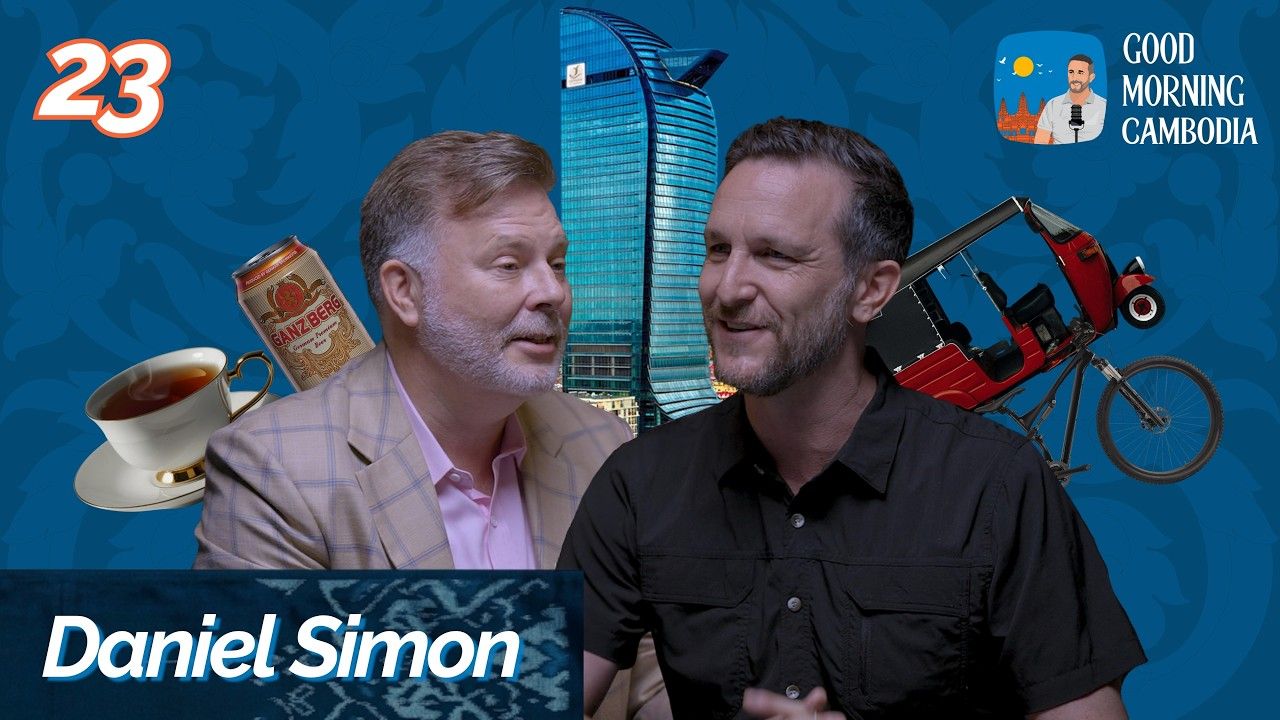
Jesse McCaul talks with Daniel Simon, the Swedish managing director of Rosewood Phnom Penh, about the Rosewood group, the business travelers and older couples who stay at the hotel, and a 12-night luxury route linking Phnom Penh with Shinta Mani Wild and Six Senses. Simon describes the hotel's paid internships for scholarship students from the Paul Dubrule hotel school in Siem Reap, the readiness to help he finds in Cambodia's business community, and the coast around Kep and Kampot. As vice chairman of the International Business Chamber, he also discusses efforts to attract manufacturers to Cambodia in 2025.
Where the stories happened
See them on the story map →Chapters
- 0:00Introduction
- 1:25The Rosewood group and its Phnom Penh hotel
- 5:43Who visits Cambodia and the luxury tour
- 11:33Business travelers and hotel guests
- 13:06From Sweden to Phnom Penh
- 20:30Training scholarship interns from Siem Reap
- 26:29A business community that helps each other
- 33:30Kep, Kampot and the Cambodian coast
- 38:43Manufacturing and investment outlook for 2025
- 44:17Restaurants and a closing invitation
From the conversation
I can pick up the phone today and call any managing director, CEO of any company in Cambodia and they'll take my call.
I never been to a country where people are more interested in education than here. Everybody's interested.
we then discovered or he then discovered that the rice came from that area and so now we are working with that farmer and three of his neighbors and we buying the rice from them directly to the hotel.
Read the full transcript
0:12 Greetings from the kingdom of Cambodia. We are live and well right here in the heart of Cambodia in the heart of Southeast Asia right here in Phnom Penh. And we are glad to have you with us and come into a bit of our world. what is Cambodia all about and what gets us up in the morning, what gets us excited on a daily basis. And so, we're glad to have you with us and looking forward to some very insightful and intriguing conversations, especially this morning, Daniel, Daniel Simon, the managing director of the Rosewood Hotel right here in the center of Phnom Penh. Daniel, it's great to have you with us. Well, thank you for having me. Yeah, looking forward to a nice cup of tea and a I believe what will be a very insightful conversation for all of our viewers and listeners around the world. Daniel, you're the managing director of the Rosewood Hotel, and we're going to jump into some of your story as well because you've you've seen the world. yeah, and now somehow someway you're here in Cambodia.
1:25 So, that's a that's something very interesting that we're going to jump into. Why Cambodia? And you know, you've seen the world. But let's maybe even just start with the Rosewood Hotel. maybe not everyone would be familiar with, you know, there's lots of hotels and what's what's the Rosewood group and what's that all about? So Rosewood is a hotel group that was founded in Dallas, Texas. Okay.
1:51 30 years ago or something like that. Yep. Mansion on Turtle Creek, which is still a hotel, a Rosewood hotel. M then we grew into the Middle East and Mexico in the US. Yep.
2:03 Other countries in the US and then in 2011 we were purchased by the Cheng family out of Hong Kong. Yep. And we have now grown rapidly Southeast Asia as we hotels here in Phnom Penh, Bangkok, Phuket, Luang Prabang. Y Guangzhou, Beijing and Hong Kong. And then obviously in the US and for those who travel into the Caribbean, we have several hotels in the Caribbean, Mexico, opening up in Japan in April. H paint a picture. Paint a picture for those that are with us. Yeah.
2:37 Yeah. So Rosewood is not a cookie cutter luxury hotel. All of our buildings, hotels are bespoke. So they try to find the sense of place. Y. So we are located in the Vattanac Capital Tower here starting from floor 25 to 39. 360 degree views of the capital.
2:56 Yep. five restaurants, two bars, spa, etc. And you mentioned luxury. I mean luxury. I mean we are we are on the top end of the luxury scale in Phnom Penh and in the world. I mean starting at 50 square meters. So we are catering to the new modern traveler. Yep. Y that comes to us. We are less expensive than our hotels in Crillon in Paris for example which €2,000 a night. We charge about 350 to 400 here. So it's more affordable.
3:27 Right. Right. Right. So yeah, the Rosewood brand is really a top tier luxury brand globally. It is. And we're trying to instead of saying we're not like I said at the beginning, we're not a cookie cutter hotel. So each location is trying to emphasize a local culture and really embed the local culture into the operation and the services that the guests will receive which is easy in Cambodia. I mean, we're living in a cultural we are the cultural capital here and it's just amazing seeing the associates how do they connect with the guest and describing the various statues we have in the hotel the to be taken for tours of Phnom Penh taking Royal Palace taking Silk Island etc. Just showcasing the really interesting things to do that you can do here in Phnom Penh. Yeah. Yeah. That's right. Okay. So, let's let's jump into this because you know, maybe some people are thinking high-end luxury hotel in Cambodia. I thought it was just like a bunch of thatch huts and jungle and villages and there's actually a high-end luxury hotel in Cambodia. I mean, high-end luxury hotels in Cambodia started in 200, sorry, 1919, I think 1929, sorry, with the Raffles, which is now the Raffles Hotel. The Royal. Yeah. Yeah. Royal. So, it's always been luxury here.
4:57 Okay. Just after like I think after the dark period of Cambodia, there was a need. So, in 2018, we opened up. Yeah. And there's several other luxury hotels opening up, I think, actually. Here in Phnom Penh. That's right. So the local community demands luxury and I and the tourists or the traveler the business traveler comes to pro comes to Phnom Penh demands it too right so we're just catering to what I think is going to be great future for Cambodia yeah okay so let's let's even look at that angle a little bit so there are actual travelers and visitors staying at this highend I mean people are coming to Cambodia what are they coming for what is this all about?
5:43 I mean the people who come to Cambodia are more an adventurous traveler. They've probably done Thailand already. They probably done Vietnam. They probably done Bali, Maldives and they're coming to see something that's to me it's untouched they might have or they pro more than likely heard of Siem Reap and an right yeah and they go there for a couple days but they tend to now fly into Phnom Penh and instead of flying into Phnom Penh and then taking a car to go in Siem Reap they decide to stay here for a few days and we've spent a lot of time and effort working with travel agents in North America Europe and other Asian capital cities to get people to understand that there is things to do in Phnom Penh that it's worth your while a visit. Right. We're also doing a what we call the luxury tour of Cambodia where you stay with us for a couple nights and then you go to a place called Shinta Mani Wild of course. Yeah. Yeah. And then you go to Shinta Mani Angkor.
6:40 And then you go to Six Senses. Yep. in Sihanoukville and then you come back for one night. the 12 nights and that gets allows you to see the kingdom in a deeper way compared to just going to Angkor Wat. Yeah. Yeah. See and so you actually have you have hotel guests, you have travelers. It's not an empty house. It's not an empty house.
7:04 There's people here every day and people are discovering Southeast Asia and they're now discovering Cambodia. M when you mentioned Cambodia oftentimes whether it's business and business there's a lot of people that especially recently I think we've all seen quite a significant pickup in the business travelers that are exploring what Cambodia has to offer on the business side but then even just on the travel side you mentioned that Cambodia I like the term you said it's it's maybe more for the adventure adventurous travelers. When you say adventurous, does that mean that they're facing, you know, dangers and their lives are at risk or expound on that a little bit more? No, no. What I'm saying about adventurous is that Camb is very safe.
7:58 I walk through the streets of Phnom Penh middle of the night and I'm not nobody costs me by meaning adventurous. A lot of travels by tuk-tuk. Yeah. a lot of travel is by train. Yeah.
8:13 Siem Reap the distance between Phnom Penh Siem Reap is 300 km. In a normal country that will take maybe two and a half to three hours. Here it takes five. Right. Right. things just take a little bit longer here sometimes. You just need to have patience. Y and you want to discover things. We're not as good as putting together websites and informational pages about what happens in Cambodia. We are working on it right now and I know the Ministry of Tourism is working on it, but you have to work a little bit harder at it.
8:45 Yeah. Yeah. You know, but once you get here, the people are very genuine, very friendly. They will go out of their way to look after you as a guest, as a visitor to the kingdom. Yeah. So maybe one way to kind of additionally describe that would be that whilst Cambodia is very safe, honestly no concerns. You don't you don't need to have any concerns. as well as very tourist friendly, there's so many destinations and there's a lot available. but maybe not as polished as what you could have in some places. And so Cambodia, look, everything's available. And you mentioned, you know, you have the tours and of course tours like that, you know, where they're visiting here and then Shinta Mani Wild and Shinta Mani Angkor and then they're going to the island of Six Senses, you know, and all that.
9:42 Obviously, that is a very wellput together package, seamless, you know, no no concerns. but for someone that maybe is not as much on a package tour, but they want to come and explore of what Cam what Cambodia has to offer, what it's all about, it's kind of like the Cambodian community, which is so warm and so lovely, so friendly, saying, "Hey, welcome to our country. Cool. You're here, you know, and what do you want to eat? What do you want to do? Welcome to our home." and so maybe not as polished as, oh, you're a foreign tourist. Okay. So, A, B, C, D. that's available in some, you know, packages and things like that. But if you're not going to do that kind of package tour, maybe not as polished, but very safe, very warm, very welcoming. Would that be a correct description? You think it is? And it's all available here. I mean, just go down to the bus station, you can just pick up a bus going anywhere in C anywhere in Cambodia, right? A lot of people do that, too, because it's so safe. And you know our the smartphones are available everywhere. You connect it. I think there's a few spots in the country still that you can't connect. Yeah. But everybody is very driven here. They're very accommodating. You can jump on a taxi and take a taxi to Koh Kong if you wanted to. You can jump on the local sleeper bus and take you take you to Siem Reap at night and you get to engage with the locals on the bus because that's how they go by bus. So, it's it's a very sharing and caring community and I mean I've been here now for three and a half years and I never had a bad altercation with anybody. Yeah. Yeah. Yeah. So, Daniel at your place Rosewood right here the top of the Vattanac Capital Tower there.
11:33 what type of what type of clientele do you see coming in? And I know that you can't describe them all. I know you have heads of states you know and all that as well but what type of what type of people are coming? Majority right now are business travelers. Business travelers. So those are coming from Asia, Europe and the US. A lot of the garment manufacturers you can name Target, you can name other companies they come here and they stay with us. Y and then you have people looking for business opportunities in the country. So they meet in the hotel, meet in the lobby, meet with various people, see what they can do. Yeah. And then obviously you have the traveler who comes here. Usually it's husband and wife and sometimes come. Usually the demographic for us for the traveler is 50 plus. So ones who left their kids at university and they're off to see the world, right? And they come in for a few days and they travel and they come back for a few days and they fly out. So and those from are from all over countries. because you have people from China, from the US, the UK, Australia. Right. Right. Cool. Cool. So, it sounds like and you know, you and I, we live here, we experience this day in and day out, but it sounds like Cambodia, not just Phnom Penh even, of course, but Cambodia as a whole is alive and well, and there's a lot of dynamic, exciting things happening here. Daniel, you're originally from Sweden. Sweden. Yes.
13:06 And you've you've lived in over 10 countries. Yes. I Yeah I lived in Soviet Union when it was the Soviet Union. I lived in Libya for a little bit. Wow. For a few years and then I moved to the US university.
13:23 Yeah. Worked in Houston, Texas for a while and then moved to Canada. Yep. And then back to the US for a couple years and then to Southeast Asia, Bali in 2001. Right. Right. Then Singapore, Thailand, sorry, Singapore, Japan, Australia, Japan again, and then I did a stint on a cruise ship for a couple years. Then I moved to Thailand. Was in Thailand for six years. Y victim of the co COVID pandemic and moved to Phnom Penh July 11th, 2021. Okay. Okay. So tell me your story related to Cambodia and when was your first visit and I was here like everybody else as a tourist in 2003 visit Angkor Wat came quite early quite early so you just opened up the Paul Dubrule hotel school in Siem Reap and then we moved then I was in Thailand for six years and right next door right next door I came here with my family and my wife's family in 2016.
14:31 Okay. So that was the second tour. Second tour Angkor Wat temple and then lived in Bangkok for a few years and then this opportunity came up and be honest with you I didn't know much about Phnom Penh when I came here but when I started asking around many of my friends had actually lived here. I didn't didn't realize that and they all spoke very highly of living in in Phnom Penh and some of them lived here in 2008 9 and 10 we were when we were not as developed as we are right now of course yeah and they spoke very highly about it about the city and the country especially about the people I mean the people always becomes an important thing and it was actually Jacques with all dreams I'm not sure if you know him he does surveys all the time and They surveyed tourists prior to their arrival into Cambodia and they asked them you know what's what's you most worried about etc and they said safety security food and then in the bottom was people and then when they left did another survey say what was what's the most positive or surprising thing about Cambodia was that people were number one how howos hospitable they are and state and security was in the bottom worrying ranker right so They were they were not were on once they left they said wow this is not you don't see policemen walking around with guns here the police don't carry guns in this country right so it's just there's a lot of them around too but you don't there's nothing to fear here I've never I personally never been pickpocketed like I happened to be in New York so you know it's just very positive everybody has been here speaks highly of it and we have friends of ours coming back for New Year's Eve now again for
16:21 the third time visit us but also to see the country and now they're going to they could go anywhere they could go anywhere for New Year's Eve right and they're coming here and they're choosing to come here for the third time yeah so you were living next door in Thailand you'd done the Angkor Wat tours the ancient temples and the ancient city up there which is amazing it's you know it's a bucket list trip of course and then brought relatives for that but even though you were living next door in Thailand as far as kind of the rest of Cambodia, Phnom Penh and everywhere else, you weren't that really familiar with it. No, because there was no I think we're we're not very good at putting a positive message out there about Cambodia and we haven't had the I think the infrastructure to do so either. you know, it's like Malaysia has Asia truly Asia, right? You know, Thailand is the land of thousands smiles, right? It's never been a big push on what Cambodia can do because we always been doing very well as being a second tier country. People come to Thailand for 14 days and they fly to Siem Reap for two days and they fly out, right? To be good. And Phnom Penh has never been a focus for tourists, right? But now we are. And we had a travel agent from a company called Ovation Travel come up to the come to Phnom Penh. Y for 3 days about a year ago and also her first time to Cambodia. Her husband said, "You cannot go to Siem Reap because you can only go to Siem Reap when I come to Cambodia." Yeah. And then she said, "I want to do a happy tour." So I don't want to go to see Tuol Sleng Prison, for example. Yeah. And we put together a three-day itinerary for her where she spent she was busy for three days. Yeah. and when she left I mean she spoke so
18:10 highly about this trip to journalists in the US other people that she's meeting we're getting business from that too now actually it's that personal experience that you connect right you go to Silk Island for example you go there on sorry you go there on a tuk-tuk and you have somebody guide you around and you just you sit down on your plastic chair and you talk to the ladies as they're weaving or selling their scarves and you hear their stories and you get You see them weaving the silk and all that. Yeah. You eat the local food and it's just that connection that you get which you can't get only a few places are left in the world now where you can get that personal connection. Yeah. Yeah. You know, we're not that uber developed tourist tourism industry and hopefully we never get there either because we need to keep that personal connection.
18:58 Yeah. with our visitors. Yeah. Yeah. Incredible. Incredible. So you were next door, you came over and now it's been the last three and a half going on four years here. What would you've been able to travel a bit? I have. I mean I've been Kep Kampot Cardamom Mountains only three times in the three and a half years.
19:28 And now we're going to explore some of the local temples next door here and hopefully go up north sometime next year just to spend some time and but you need to plan it out. So take you know three four days and go out and because I'm living as an expat I never you never know how long I will be here. So you want to try to explore as much as possible. Yeah. What have been some of the highlights so far? I mean we went to we went to I mean telling you what happens in Cambodia, right? So you went to Shinta Mani Wild. Yep.
20:01 Which is a luxurious experience. But when we drove out of Shinta Mani Wild, we had a flat tire. Yeah. Yeah. And so we pulled over and this little man comes across and he has this little cart that he actually cranks up the car, takes off the tire, fixes the tire. His wife comes over, gives us a bottle of water. We chitchat. I think it cost me $4, you know, but that just that personal experience that they had and actually spent time with us. Yeah. That's really positive.
20:30 Yeah. And you know some of the CSR or activities that we do here, right? So we tell me tell me more about that as well. Yeah.
20:41 So we have a program called the open door program for example. So in u Siem Reap there's a hotel school named after Paul Dubrule. Paul Dubrule is the founder of Accor. Y and it's it's a school more tertiary school, but what they do is that you have to take an exam to get in. Yep.
21:00 And once you once you pass the exam, which not everybody does, y get a bill and say, "Okay, it's going to cost you 3,000 or $4,000, right, for the school, and then you as a student say, I can't afford it." Right. Then they say, "Okay, here's a scholarship." Right. Right. so we have now we in our third year now. So we go up there because we go up to Siem Reap they go up there and we hire 10 to 16 scholarship students. Yep. for one year as interns so they because as part of their curriculum so they come down to us and they spend working in the restaurants in the front office etc.
21:37 And we pay them a full salary pay full service charge and we pay for their accommodation. Wow. Because these kids have never left Siem Reap before. So they're coming to the big city of Phnom Penh. Yeah, that's right. The parents are a little nervous, of course.
21:50 And usually these kids, they're so ambitious while they're going to school, they're also doing a second job so they can actually support their family. A lot of times their families can't afford anything. So by paying them full salary and full service charges, they can still look after their Right. Right. And our biggest fear was always that these kids will go back to Siem Reap. Right. Right. I mean it' be good for Siem Reap but over the last two years we're starting our third term now in January 90% of these kids have decided to stay with us. Wow. So you've been with them on this journey with them on this journey and it's it's just incredible how you know these kids they come basically from the rice paddies right farmers kids. farmer's kids and they come in, you know, and we had to teach them something to dress and how to fix their hair and things like that. but I mean, their genuine passion that they that they show our guests when they come in is like they have this intuitive instinct of just talking to them, right?
22:53 So, you know, we had an elderly guest the other day. She came out of the elevator with her cane. Yeah. And this young lady came over there and gave her arm to support her and walked to the breakfast room, right? Would that happen in Toronto, Canada? Probably not, right? But it's just that care that they have, right?
23:10 It's it's genuine. It's heartfelt. Genuine, right? It's like the other day we had we had a family wanted a babysitter for their kids, right? And they said, "Are they are Cambodians good with kids?" And I said, "Well, this probably the best country in the world to be with somebody because they just love their kids, right?" You know, so you just I mean, it just becomes just really nice experiences here. Yeah. Yeah. Yeah.
23:34 That's right. Yeah. You bring your you bring your kid into a restaurant and you don't you don't have to watch them. Staff, you don't know where they went necessarily because they're back in the kitchen and you know they're passing your kid around, you know. but that's yeah, it's very much part of the culture where in maybe some other cultures, you know, oh, you brought your kids to the restaurant, they're a nuisance. Can you make sure they stay quiet? You know, yeah. Yeah, it's very much part of it. That's cool. I resonate with that, Daniel. The part of, you know, being part of the journey of capacity building.
24:09 Y it has been one of the most fulfilling parts of my life, I think. and I've been able to be kind of in one location for a long time, 30 years now here in Cambodia. and I've been able to be part of that capacity building journey. But even in just a year, 12 months, 18 months, two years, you can see the results and it's it's very fulfilling. And it's exactly what you described. oftentimes not to generalize, but oftentimes it's farmers kids that you know they're living out in the rice fields. Yeah.
24:50 And they grew up on the farm. and then they want to better themselves. They want to provide for their younger siblings that are still back on the farm and they come into a place like Siem Reap or Phnom Penh or whatever to further their education and to find employment. And formal education is one thing, but then the practical side of holding their hands and developing them is something I' I've been able to be involved in to a pretty significant degree over all these years as well. And it's so fulfilling because this is I mean this is the human side of things, right? you know, we have our technical side of things and we have our agreements and our job contracts and we have all of that. But you know, Daniel, if you're my friend and if there's something that I can do to make your life better or, you know, to facilitate something just on a personal and then I see that, wow, it actually did help my friend Daniel out here and actually made a good impact in his life and his whole life trajectory is actually a little bit better than before. Wow. that's that's that's that's to a degree that's kind of what it's all about, you know, and there's such an opportunity to do that. And you have, you know, you have a five-star team there at the Rosewood, but I know that you have been very involved through the CSR work, but then even personally in developing them.
26:29 True. But I think that's that's something that's just permitted through Cambodia, right? I mean, when put a business spin on this. Yeah. when you come to Cambodia versus other countries, when you come to Cambodia, everybody's willing to help. Yeah. Okay. You and I, we met at a restaurant.
26:49 We chatted, you know. Y I can pick up the phone today and call any managing director, CEO of any company in Cambodia and they'll take my call. Yeah. I can call most government ministers and they will take my call. and they will give me good advice even though I'm calling a competitor. they will give me good advice. Y where in other countries I worked in that will not happen. First of all, government officials probably won't take your call. CEOs will have you talking to their secretary first and people are in your competition space other hotels will not support unless you are actually true personal friend of theirs. Right? So I just find that's something that just goes through the community. it's like a it's a north star or something like that because but it's always everybody's here to help everybody right I don't feel that anybody does tries to do any deliberate harm to anybody in business you know I know sometimes people just step away I'm not going to compete with my friends I'll step away but I just feel like everybody's here to support and I think that's why the business chambers here are so strong too where all you AmCham, IBC and AusCham, BritCham, EuroCham, all they're all very supportive. You can call them up and they will lend a lending hand.
28:11 Yeah, that's right. You know, yeah, they're Yeah. Somehow someway. And I guess we have to give recognition to the Cambodian culture because this is what the Cambodian culture is. It's a it's an accommodating, helpful, warm, friendly culture that Yeah, you're absolutely right. Even in the business community where of course there are you know competitors and we all have our various demands and busyness and all of that but somehow here in the in the fast-paced dynamic business community of Cambodia there is this camaraderie you know that hey you know we're we're all you know trying to do good things and here to support each other and you know, how can I support you? How can you support me? it feels good, doesn't it?
29:04 It feels good. I mean, it feels good, especially when you have I mean, we actually just transferred two associates overseas. So, local associates. We transferred one young lady to our Rosewood Hotel in Doha. Cambodian lady. Cambodian lady. Y. And we just transferred our executive housekeeper to the Rosewood in Miyakojima, Japan. Wow. Cambodian as well. Cambodian as well. So, expats come and go. Yeah. But this is the first time we've done this. So, and once we announce that they are moving now, we have more people interested, right? Can I go for a couple years? They know, of course, probably make a little bit more money, but also experience the world. Yeah. But they're interested, you know, they're interested to see how they can improve their life. And like you mentioned, education. I never been to a country where people are more interested in education than here. Everybody's interested. How can I learn more? Right. What can I do to learn more?
30:02 Yeah. And Excel courses, Chinese courses, whatever it is, but they want to learn more. They want to better themselves. Yeah, that's right. Would you say as an executive again different places are you know they're they're they're structured differently. some places you come in, you do your hiring, put them to work and here would you say as an executive that sometimes there's a bit more handholding a little bit more handholding to be done? there is much more handholding to be done primarily because they didn't grow up as we did, right? They didn't most majority of people did not grow up with tables and chairs in their homes or teacups and teapotss like this. You have to teach them those basics. Y that's right. but it's and then you're there with them through the whole process, right? I walk the hotel two or three times a day and I spend a lot of time with my associates.
31:06 Yeah. But it's is it's always a pleasant experience because we always had a good conversation. They're willing to chat. We talk about things. They ask me, "How do I learn this?" Or the most frequent question is bong sir, you know, how did you get to where you're at?
31:24 Where did you start? You know, how do I become a general manager, managing director, right? Etc. Right? So we talked them through that process and they're always surprised because I meet all the new associates on their first day at work and I talk usually group of 10 or so and I talk to them about my experience and I start tell them I always find if there's a steward or dishwasher in the room right I said I started like you did that's what I did when I went to university I didn't have any money y I had to make some money the fastest job easiest job to get was to become a dishwasher and that's what I did I washed dishes for the first six months Yeah. And that sort of puts you in their the same level as they are. They understand that it's nothing wrong with starting at a low level because there's always the big opportunity to grow up. Yeah. Right. Yeah. That's right. And in addition to that, like you mentioned, there's the eagerness to learn as well. So handholding is not handholding grudgingly. it's it's handholding to people that are very eager to learn to develop themselves and suddenly there's there's a switch this there's a switch goes on in their heads and they just explode right in the sense positive they just their career just goes miles a minute and we have several of those. Right. So my executive team in the hotel used to be only expats.
32:50 Right. Right. And now we have two. Soon I hope to have three. Yeah.
32:55 We are now 50/50 women and men managers in hotel. But just trying to push that envelope. And we bring in locals to groom them, right? We want to localize as much as we can because it's good for the country. It's good for the company to grow them.
33:13 But it's going to take some time. Yeah. Like you said, you handhold them on a daily basis. You coach them. You train them. And sometimes they coach and train us too, right? You look at them and says, "Wow, I was like that 30 years ago. Actually, I was the one who was so genuinely positive to the guest experience." Yeah.
33:30 Yeah. Cool. What do you reckon for those that you know are outside of Cambodia, maybe less familiar with Cambodia or even our Cambodian brothers and sisters that are outside of Cambodia that maybe haven't had a chance to visit Cambodia for a long time or even you know almost ever? what would be some hidden gems you reckon of Cambodia that maybe people outside the country wouldn't be as familiar with? I would go to places like Kep Kampot. What is Kep and Kampot? What's that all about? I mean Kep and Kampot beach towns Kampot the famous Kampot pepper, right? I mean it's interesting in France they would sell the French pepper. Well, the pepper came from Cambodia, right? It was just relabeled. great crab in Kep.
34:21 you go to the islands of Sihanoukville. You have some really good diving, snorkeling. Yeah. Water temperatures are perfect.
34:33 and you go north, you just experience the waterfalls, etc. Right. I mean, there's stories now they're going to be going to reimplement tigers into the country. I heard, right? So we there's going to be some nice things to do here. now you name it you can do it. The thing is I think not everything is available in town in the country yet. It will be but I think that just the beach towns nobody talks about that. Yeah. So when you were you know in all your years of life even in the region next door never you'd never heard of Kampot which is a 2 and a half hour three-hour drive from Phnom Penh here. You never heard of it? No. Yeah. Yeah. And you since you heard about other places like in Thailand. Yeah. I mean people but I could easily gone here and it's I mean the water is perfect. and we have some have some international resorts there obviously like Six Senses for example or SA but then some also some beautiful small resorts local boutique owned by owned by Cambodians or some of them owned by foreigners. Yeah.
35:44 but it's just I think it's what Bali was 30 years ago. Interesting. I think our coastline here in Cambodia can say it's Bali 30 years ago. Interesting. Yeah. Yeah. Yeah. So undiscovered. Undiscovered. You can rent you can rent a motorcycle. You put a helmet on, wear a helmet and drive around, right? And just see it. If you're not very good at driving motorcycle, rent a car with a driver. And but it's just and it's affordable. You can do these things here which you couldn't afford to do in other countries. And when we say undiscovered, it doesn't mean undeveloped. It doesn't mean that you're going to have to go sleep in the middle of a rice field somewhere or something like that. you know, there are there are hotels out there and there are the cell phone towers and things like that. No, it's very but it's like for example, my executive chef, he loves to drive off-road motorcycles. So, last year he and his son went on a off-road motorcycle tour. Cool. So, they're driving off-road. I'm not sure exactly where in Cambodia they were driving.
36:46 And as they're driving over the river, something went wrong with his motorcycles broke down. Y the guide looked at it. He say I need to get a spare part but it's going to take me an hour and a half to go to the local shop and get come back. he introduced them to the farmers that were that were living next to where the motorcycle was standing and the farmers u introduced them to some local food. Yeah.
37:10 local beer and other things, right? But it was just genuinely hospitality there. we then discovered or he then discovered that the rice came from that area and so now we are working with that farmer and three of his neighbors and we buying the rice from them directly to the hotel. Seriously.
37:30 Yeah. Seriously. So those are the things that you can do here, right? You just you're not walking down Fifth Avenue, New York, but you're doing these things here. That's what it means. But you have to sort of little bit more ambitious. That's cool. So, he was on this dirt bike excursion with his with his son and rural areas obviously, you know, and the motorcycle breaks down, but there's no danger involved. Again, there's nothing to be fearful. There's nothing to panic about.
38:01 Okay, you're out in the rur rural area. You're not in a town. The closest town's an hour and a half away to get something to fix your motorcycle. They do break down from time to time, but don't worry, we got uncle farmer or grandpa farmer or whoever it is. He's right here. He's going to take care of you guys and I'm going to go get some spare parts. And in the meantime, he's going to, you know, I think they lent them their hammocks, too, right? So, just sleeping in their hammock. Yeah. So, lay in the hammock, have some drinks, have a little bite to eat. And then fix a little bit of conversation and realizing, hey, they actually have a good quality agriculture product here that we actually use regularly. and it turns into this business collaboration as well. Incredible. Yeah. Yeah. Yeah. It's a good story.
38:43 Yeah. That's very cool. That's very cool. Daniel, you're you're I know you're involved in lots of different types of conversations as well. And obviously, just like you mentioned, you know, the business community here and all that. as we head into 2025 here, what have been some of kind of the outlooks and these conversations that you've been involved in for Cambodia in 2025.
39:21 So I'm also I'm also the vice chairman of IBC, International Business Chamber, vice president and our discussions is more about how can we bring in companies from overseas and can manufacture something here? How can we open up the doors for them? Yeah. How can we connect with them prior to them once sort of the thoughts starts clicking their heads about maybe coming to Cambodia? How can we grab a hold of them and we as a you're your as a chamber as a chamber the international business chamber which is both expat and Cambodian both business leaders how can we then bring them along right how can we introduce them to the CDC if they need to be Cambodian department of commerce development council things like that so how can we how can we do that there is I mean there is talking manufacturing is what we need here in the country. We have a lot of agriculture but it's low man low hanging fruit. Yeah. But how can we get manufacturing in here and how can we be interested in it? There is going to be a investment conference here in the first week of March I believe. Yes. That's right. Dates have not been finalized yet but we sort of repeat what we did last was done last year by the Cambodian Chamber of Commerce. Yep. So just things like this and I think what we all need to realize is that it's going to take time, right? But we need to start the process now. Yeah.
40:50 To open it up and you know we have some very good trade deals with West and China and every everywhere else, right? And we're sort of the if you look at a map, we're the heart of Southeast Asia, right? We connected Thailand, Vietnam, cross the water to Singapore and off we go. Yeah. So in some of those conversations related to manufacturing, I know that's not your industry, but as vice president of the International Business Chamber and these conversations, what does, you know, in those conversations again, what does the landscape look like for manufacturers coming in? It looks good. I mean, they're looking for opportunities because they've done these people are not the first time around the blocks. They've probably done something in China already. They probably done something in Vietnam. Yeah. Maybe in Thailand, too. Yeah. So, they come in also with experience. So, they walk in and they know what they're looking for. And a lot of them are looking for rough diamonds, right? They can be looking for a factory that's already here but is mismanaged, etc. or locations where they think that they can open up a factory. train their train their associates to produce a good quality product and that's sort of the so we're trying to help them out most of the other chambers I'm not going to just talk our hatcham does the same thing EuroCham does the same thing you know how can we then educate the employees to get them ready for this new these new opportunities right we were talking before the show about some of the different manufacturers that we're aware of and there's many others that we're actually not even aware of to be honest. but mention that a bit as well some of the I mean there's one American gentleman who manufactures wooden floor here. Yep.
42:43 for the export market for the export market. Then there's a local company that manufactures cans. So beer cans, soda cans, whatever cans, right? That's a large investment. Large investment. Hundreds of millions of dollars, but they have a majority share of the market. Yeah. So, I just read about it yesterday. I didn't I never thought about it. I thought we imported our cans, but it's great that we produce them here. We assemble solar panels, for example.
43:09 We are heavily focused on the garment industry at the moment. But, you know, and I know RMA is assembling Ford cars here for right. So, there are things you can do here and a lot of things that are done here we don't actually see because it gets exported straight away. Yeah, we are one of the biggest manufacturers of assemblers of bicycles in the world. I think number four or something like that in the world.
43:34 So there are things that can be done here. Yeah. You know, you need to have the will and and the whereabouts and things can be done. Yeah, I agree. I reckon that 2025 we will see not just interest but I see I think I reckon we'll see a lot of activity with regards to manufacturing here in Cambodia. So I reckon we're seeing a lot more travelers and guests in the especially in the garment space. Yep. But also in the jewelry space at the moment coming in here and manufacturing not the big jewelry pieces but the smaller ones here in Cambodia. Yeah, that's right. Yeah.
44:17 Well, Daniel, it's great to be able to have a nice cup of tea. I always enjoy your facilities there, of course, the Rosewood. And we've connected outside of the Rosewood, of course, as well. you do have beautiful facilities, not just the hotel facilities, but you have how many restaurants again did you say? I have four restaurants and two bars. Tell me a bit about the restaurants and the bars just briefly. Oh, I mean so we have obviously we have Chinese restaurant.
44:47 Then we have a French local Brasserie Louis which is food and French beast food. Yep. Then we have Isa, our Japanese izakaya on the 37th floor with a Sora Sky Bar Sky deck cantilevered out over the city. Yep. And above that we have cuts our steak and seafood grill and the largest wine selection in Cambodia. Yep. and it's probably the most premium restaurant in the city in the country at the moment. but we connect with all guests from all walks of life that come in to the hotel and we open for everybody and it's it's a nice hotel to have. I always feel very proud when I walk into it. Yep. Especially when you wait for a couple weeks on vacation, you come back and say, "Wow, yeah, it is a beautiful location." Yeah. but end of the day, it's always easy to have a have money and build a location like ours.
45:40 Yeah. Or other hotels in the city. but it's the heart and it's the people that's the heart that make I think makes this hotel very special. Yeah. Cool. Any final remarks to our viewers today? Maybe even an invitation to our you know our world here in Cambodia. I mean, I think that Cambodia is one of those countries you have to visit and you have to visit them sooner than later. because there's always the big fear that we become so popular that we'll have to do some reductions in tourists and things like that when that day comes. But come now visit.
46:18 It's a beautiful country. It's a good place to just visit or do business. everybody's here for you to ensure that you have a great experience in the kingdom. Yeah. Awesome, Daniel. Thanks, Jesse. Love it. All right. Well, thank you for joining us again today and I do believe and hope that the conversations have been insightful, intriguing, and we're looking forward to being with you very soon. Kang chap right here on Good Morning Cambodia.