Kevin Jack and Rachel Pilloff: when a stranger becomes family
With Kevin Jack and Rachel Pilloff
About this episode
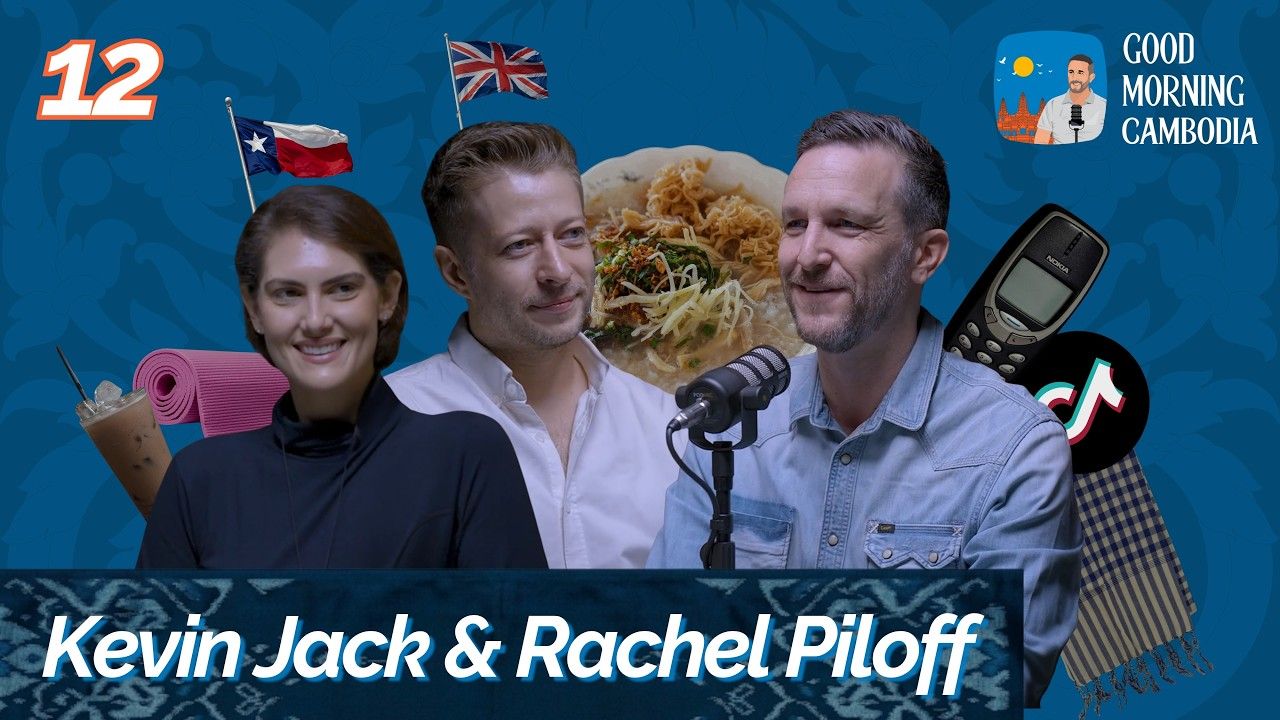
Jesse McCaul talks with Kevin Jack and Rachel Pilloff, two of the team behind Good Morning Cambodia, about why they came to Cambodia and why they stayed. Kevin describes falling ill with dengue fever soon after moving to Phnom Penh, when a café owner known as Mama, his landlady and people he had never met looked after him at home and in hospital, and Rachel explains how she went from graduating in Texas in 2020 to teaching, school administration and producing the show. The three also discuss Cambodia's growth, KHQR banking, the returning diaspora and plans to turn Good Morning Cambodia into a hub with events and consulting services.
Where the stories happened
See them on the story map →Chapters
- 0:00Introduction
- 7:20Kevin falls ill with dengue fever
- 12:03Community, loneliness and failure
- 17:51Rachel's move from Texas to Cambodia
- 25:35Why Cambodia feels dynamic
- 31:14A chance business offer in Mondulkiri
- 35:55Economic growth, KHQR and smartphones
- 39:46Openness, Angkor and the returning diaspora
- 53:53Plans for the Good Morning Cambodia hub
- 1:00:05Unity and entrepreneurship in Cambodia
From the conversation
I would wake up from my sort of days in bed and there'd be some new guy sat at the end of the bed that I'd never met before.
I've picked up again and I've moved forward and I've learned so much more from those failures and I've been able to do that because I've had a group of people around me supporting me to keep me going
I came in as a digital nomad thinking this country is going to be affordable and because of my education offer a lot of opportunity. And in retrospect, you know, I kind of see that I came in a little bit selfish
Read the full transcript
0:11 So mama from Greenwall would come in the morning and bring me bobor and water and feed me and then my landlady would come in the evening and do the same. And they kept me going until I could get to hospital until I could get some treatment. And so when I hear of the needs of Khmer people, regardless of how much need there is, I found there's always this willingness to give. I started setting up a number of businesses in COVID, which obviously isn't isn't the easiest thing to do. But the experiences I had during that time, the experiences I had with those businesses and the support I had from the people around me are what's helped me with Astral Soup.
0:50 So, I'm kind of a I consider myself a little bit of a late bloomer. I didn't go to university till I was 25 years old. I was so entrepreneurial that I kept on pushing that because I had so many ideas I wanted to pursue before going to higher education. I think that was the fuel that allowed me and provided the courage I needed to make a big leap like leaving my home country and traveling abroad to see what opportunities lie.
1:18 Good morning from the Kingdom of Cambodia. Greetings from all of us here on the Good Morning Cambodia show. And we are privileged to have you with us wherever you are in this great wide world of ours. And welcome in a little bit to our world here. And we're right here in the center of Cambodia right in Phnom Penh, Cambodia.
1:43 Phnom Penh is two words. It means Mrs. Penh's Hill and those are the origins of Phnom Penh right on the four rivers right in the heart of Cambodia and we're glad to have you with us this episode of the Good Morning Cambodia show. We're going to bring you into a bit more of our founders and our team and what we're doing here in Cambodia. So, thank you for being with us today. And Kevin and Rachel, it's great to have you guys as well. Kevin, Jack, Rachel Pilloff from the great Kingdom of the UK, the Kingdom of Texas, and from the great Republic of Texas, right?
2:29 it's great to have you guys here and we're going to kind of bring everyone into our world a bit today as to of course some of the amazing things happening here in Cambodia as well as some of our individual stories which I believe are very intriguing as well as kind of what's going on even with Good Morning Cambodia and other things around Good Morning Cambodia. So great to have the team here today. Thanks for having us, Jesse. Absolutely.
3:02 Yeah. Good way to good way to start the morning. And I mean, we are usually here. We're just behind the camera. That's right. I'm over there.
3:09 Exactly. Exactly. And of course, we have our whole amazing studio team here today as well. Right behind the cameras, which we will be showcasing later, right? We'll Awesome.
3:20 kind of bring everybody around. Show them show them what's going on over there. It's awesome. It's awesome. Yeah. No, what a good way to start the week and to start the day. Some good positive not just positive vibes, but positive conversation. You know, I always I've always believed that look, in this big world of ours and even in life, sure, there's challenges, there's heartbreaks, there's tragedies, there's all of that. but I've always believed that there's more good going on than bad going on. And it's good to focus in on the good.
4:01 Look, I mean, there's there's plenty of stuff. And maybe I'll even kind of do a little side note. When I when I first arrived here in Cambodia, oh my goodness, needs galore. Needs everywhere. and you know coming from the United States and having you know I wasn't you know that well off but I had some resources available and I had some ideas and I had some things I could do but where do you start you know I mean there was just needs galore and to be honest if you look there's still needs everywhere not just here but around the world but you can't solve it all you can't do it all and so you choose a few things that you can focus in on that you can do.
4:47 but you also have to celebrate the wins for sure. And I've I've learned that in my years as an executive as well. I remember when I was in a young executive very focused on, you know, what's further down the road. And oftentimes as a leader, you see a bit further down the road than kind of the rest of your team sometimes. And so I'm leading the team and we're, you know, we got some good accomplishments this week and this month. but as a young leader, I wasn't very good at celebrating the wins. It was like, okay, yeah, we got that good. Okay, but don't forget next week and next month we still got this KPI and we still got this target and thankfully, I think it was even so my team, they pulled me aside. They're like, "Hey, boss, we probably should like celebrate. We just accomplished some good things." And oh yeah, yeah, I forgot. I was just so focused. was down the celebrate the wins. And so this is one of the things that we do, right? We celebrate the wins of Cambodia right here on the Good Morning Cambodia show.
5:46 So I've talked too much. You guys pick up where I left off. That's that's great. I totally agree.
5:52 I think Good Morning Cambodia is all about sharing good news and giving the world a lot of positivity about what's happening here and inviting them to be a part of that as well. Yeah. Yeah. Yeah. That's right. And there's plenty of good news, positive news, real and we're not we're by no means are we trying to inflate anything. but there's some there's some and as you know our friends around the world have enjoyed our various episodes. I'm sure you've seen and heard so many amazing, intriguing wins, reasons to celebrate, right? One of the things I would say is before I arrived in Cambodia, most of the news that I read or I think I think in my lifetime before I came to Cambodia, I'd seen three news stories about Cambodia. Okay. All three of them being negative.
6:43 All three of them being negative. Yeah. so coming to Cambodia and having not that much information to go on, but this fairly kind of negative image that's been created in my head, that was something that I wanted to challenge. And I think that is something that needs challenging because my experience we talk about you know the needs that were you know that you find when you come to Cambodia but actually I was in need when I not long after arriving in Cambodia I got very sick with dengue fever and rather than me being able to give to someone I needed help. I didn't know people very well.
7:20 I want to I want to zoom into that a little bit. Yeah, because this is 6 and a half years ago. So, pre-COVID and you came here, you didn't really know that many people, right? No, I knew at this point maybe four or five people. I'd moved into a village. I was planning to go to PAT to do some volunteer work. but I had I'd been in India before. I had dysentery so it kept me in Phnom Penh for a little while.
7:48 Oh my goodness. Yeah. And then shortly after that I got dengue fever. Okay. Okay. So you were you were you were here and you were kind of in a community rural community setting.
7:58 Well actually I was in Phnom Penh but in Phnom Penh you've got lots of what we call sangkat districts and within a lot of these districts you actually have a village vibe. So even though you're in the big city you really feel like you're part of a village and part of the community. So I'd been in this community near to Wat Phnom for about 2 months. Okay. and came down with dengue fever. I didn't know what was going on. Yeah, dengue fever is mosquito-borne. Yeah.
8:27 And it's not for adults it's not generally it's not like life-threatening or anything. and throughout Southeast Asia dengue there is some dengue fever. Now it's not it's not nearly as prevalent as it used to be but even places like Singapore and stuff like that are very modern cities they struggle. My immune system was very much weakened at this point having had dysentery. you know I had been quite ill for a number of months and I was just on the up when this happened. So I didn't really know what was wrong. I was very sick. I was in my house. I tried to get out to go and get some water and some of my neighbors saw me on the street looking very sick. that you didn't really know your neighbors even that well, did you?
9:11 Not that well. I knew the person I was renting the apartment I'd taken from and there I called her mama Greenwall, but she ran Mama Greenwall cuz she ran the cafe that was next to my house. well, it's called Greenwall Cafe. So, we just And everyone calls her mama. You're not allowed to know her name. It's just Mama. Okay. Okay.
9:30 and she saw me walking down the street and she came up to me, Kevin, what's wrong? Told me to go home and then brought me water. this is an old lady and she told my land lady. Then they would take it in turns. So mama from Greenwall would come in the morning and bring me bobor and water and feed me and then my land lady would come in the evening and do the same. And they kept me going until I could get to hospital until I could get some treatment. And so when I hear of the needs of Khmer people, regardless of how much need there is, I found there's always this willingness to give. And that yeah, for me put an emphasis on me giving back. So I try to to focus on these things and that's meant that I've really focused on the here and now of Cambodia rather than the past, you know.
10:17 Right. Right. That's that's that's amazing. And that's that's really the way I think so many of us desire and believe that humanity is supposed to be. That's the way humanity is supposed to be. And I'm not, you know, I'm not I'm not being critical of any society or any culture because there's a lot of demands out there and when you're, you know, when you're living in suburbia or wherever and there's all these demands and you just don't know, you're not accustomed even how to help people necessarily.
10:53 and you just say, "Well, that's that's, you know, these guys and that's that's the government's job or insulated." Yeah. Yeah. But here it's normal lifestyle, isn't it? That we got some, you know, British guy living in our little community and he's sick and so you know, not even sure how we spell his name exactly and you know what exactly he's doing here, but he seems like you know, another human being like us and so let's make sure we can take good care of him.
11:25 That was the thing. They couldn't stand the idea that I might be sick and on my own. When I went to hospital, I needed someone to be in hospital with me the whole time I was in hospital. Right? So, the few people I did know, they started sending various family members that I'd never met. I would wake up from my sort of days in bed and there'd be some new guy sat at the end of the bed that I'd never met before.
11:46 New caregiver, new caregiver, volunteer caregiver from your community that you didn't know from. These people weren't even from my community. Now, now we're stretching out to friends and, you know, distant connections that I've just made here who are reaching out to family members who have got some spare time to come in. Yeah.
12:03 And I remember reading a book, I think it was the beginning of 2018, maybe end of 2017. It was called lost connections and it was looking at how, you know, in the western world there's this sort of increase in mental health problems. A lot of people are suffering from depression and anxiety and a lot of that is due to a lack of connections to the lost connections within their community. Now, I felt pulled into a community in a way that I don't think I've ever felt in England really, you know, and I've got great friends and family, but to have so many strangers that couldn't stand to see me on my own to be prepared to come and stay a night in hospital to help wash me, you know, to look after me when I was really at this point where I was very weak.
12:45 Yeah. How could I not give something back after that? That's incredible. I heard I heard and this is this is this is a little bit outside of Cambodia, but I believe that it goes along with what we have experienced here in Cambodia.
13:01 there's we talk about east and west but there's also there's also and and maybe there's even some books or articles I'm sure there are out there and they talk about temperate versus tropical and the difference in cultures the global north. Yeah. Yeah. And so there are difference in cultures. And I remember quite a while ago I heard a story or a situation where there was a North American executive American executive and he was running his corporation like a shiny whistle, you I mean, he had it, you know, it was a it was a smooth running machine and it was very structured and very focused. And I think I think in his town there was another possibly maybe a Hispanic brother that was also running a similar type of business, but he was running it very kind of more family style and lacking a bit of structure and all of that. And so anyway, somehow the two of them in the same industry became friends. And so you have this very structured business and then you have a more kind of lack less structure but more relational orientated.
14:30 And long story short, the two of them ended up learning a ton from each other. Yeah. So if I remember the details, the Hispanic business owner, he learned a lot more about, you know, importance of, you know, planning and clear execution, you know, and all of that, reporting and all of that. He learned that.
14:52 But the other business owner, he learned a lot more about the value of relationships and taking time to connect and to build relationships and what we call build community. And I think this is one of the things that for so many of us that have originated from outside of Cambodia somewhere including you know many of our guests we have of course many local guests as well but many of our guests that have originated from outside of Cambodia that we find so unique and refreshing and not to minimize the business opportunities here and the dynamism here of everything that's happening. and all the opportunities that are here, but even just the relational aspect the genuiness and the opportunity to build those relational aspects which I think is still kind of the core of humanity. and like you said, Kevin, that people often times can be even suffering emotionally or mentally in other cultures because there's such a lack of that.
16:09 Sometimes you don't know your neighbor in the West anymore. You can live upstairs or downstairs from someone and never see them. That's the thing. Yeah. Like coming back to the lost connections.
16:18 Yeah. Really, when you connect with people, it stops you feeling isolated. It stops you sinking deeper into any kind of mental health issue. And so one of the things I feel about this country is that you're forced out into being around one another. You know, the weather's always nice. And so it's hard to fall into kind of feeling sorry for yourself when there's so much that you can connect with and actually make a difference with. Whereas I think that a lot of people in the west can kind of feel like I don't know if I'm going to actually make much of a difference if I try this or if I fail it's going to really kind of hold me back. Honestly, one of the things I've really experienced here is that I was afraid to fail before. It's something I've always hated in my life, you know.
17:02 Many people I like I'm almost, you know, shamefully embarrassed whenever I don't do anything perfect, you know. So like I would sometimes avoid doing things so as not to fail. I've failed in business here. Mhm.
17:15 I've picked up again and I've moved forward and I've learned so much more from those failures and I've been able to do that because I've had a group of people around me supporting me to keep me going so that I'm not feeling sorry for myself when I fail. I just look at what I might have done where I might need to improve things and how I can push forward. And it's not like any I've had any huge massive failures that have kind of torn my life apart. But, you know, when you are in business and you're an entrepreneur trying to kind of set up more than one business, not everything's going to take off. I started setting up a number of businesses in COVID, which obviously isn't isn't the easiest thing to do. Not easy. Not easy.
17:51 The experiences I had during that time, the experiences I had with those businesses, and the support I had from the people around me, are what's helped me with Astral Soup, which is what Rachel and I do together, and with GMC, which is what we're all doing together, and some of the other businesses that we're working on as a group. So, Jesse and Kevin, y'all both have brought up so many points to my motivations for not only deciding to live abroad, but how I do business and what I'm looking for, in creating a working environment for myself and the people I work with because home was, outside of Austin, Texas, right, originally born and raised, right? That's right. That's right. so I'm kind of a I consider myself a little bit of a late bloomer. I didn't go to university till I was 25 years old. I was so entrepreneurial that I kept on pushing that because I had so many ideas I wanted to pursue before going to higher education. But everything kind of added up and I eventually decided that I would attend Texas State University in San Marcos and it was 2020 when I graduated right in the middle of COVID and they told me that I would not have an internship available and that I needed to basically figure it out myself. Wow.
19:11 And so after so that's in the middle of 2020. Yeah. So you can imagine the frustrations I had and also with the lockdowns and things really feeling stunted and especially when already I felt like a little behind y and you have this entrepreneurial drive to you as well right that just causes a kind of a boom doesn't it and so I think that was the fuel that allowed me and provided the courage I needed to make a big leap like leaving my home country and traveling abroad to see what opportunities lie you know further a big deal it is. But I mean I don't I'm not trying to critique the West. We've said before everybody has their way of doing things.
19:52 but I really felt with my creativity and my spirit that it would take a unique company culture for me to really thrive and to be able to share the gifts the way I wanted to and do things, you know, on shared terms but ultimately my own. Right. Right. And when I met Kevin, when I had been in Cambodia for about a year, it was like every conversation we had hit on so many points that I was looking for. And it really seemed like a natural decision for us to partner up and see where we could go with our business ideas. Y originally starting with digital marketing, eventually expanding into production, and then now I get the privilege and the honor of not only being the set manager, but also an executive producer on Good Morning Cambodia. And to thank you everybody for being an amazing team here.
20:40 We're a great team. We're a great team. Yes. Yes. and also another executive producer, director, one of our brains that can come up with concepts that it's like Kevin is really great because it's like everything I know is kind of in this disconnected form and then but I know I know it right but then Kevin can somehow bring it all together and make it a cohesive idea, you know, and then prompt each other and grow that idea. So that's why it's been amazing to work on this show. But everything that you guys said about Cambodia's warm spirit and the welcoming people and this culture that is so openhearted. I didn't expect that to be the reason why, right? I came in as a digital nomad thinking this country is going to be affordable and because of my education offer a lot of opportunity. And in retrospect, you know, I kind of see that I came in a little bit selfish, you know, and I think a lot of expats that come here are surprised at how you fall in love with Cambodia and how your previous motivations seem to take a secondary importance to the love that is found here.
22:00 I think that's very honest though, isn't it? You know people aren't just run you know maybe we have missionaries who are going to do good things in different countries but most people who are expats are coming to change their life or to give themsel opportunities and what is it that keeps you in a place because I think this is a question that we hit on a lot with good morning Cambodia is why Cambodia. Yeah that's right and there's the reason why to go to Cambodia but there's another reason to stay in Cambodia. Yeah that's right. That's right. Yeah.
22:30 Yeah. So that was in the middle or that was in 2020. So I left May 2022. 22. Okay.
22:38 I arrived in Cambodia October, end of October 2022. So Okay. spent some time traveling and then decided after India. Kevin and I have some interesting crossovers that we went to India first. Okay. And then India is incredible but it doesn't have the same type of support system for expats.
23:02 and so living based on your experience that you had there. Yeah. For me. so long term I decided that I was going to explore other options and so when I came end of 2022 here I became a teacher as a lot of people do and I'm really really glad that happened because when I became a teacher I got to work with young Khmer people and see how brilliant and how hungry for knowledge they were how open they ask questions all day long they're so involved they're so curious ious about the different cultures and the international teachers and but you know I told you how my brain works. I was only a teacher for six months because within six months I had developed all these systems in my head about how I could improve the school and then so the following term I was elevated to an administrator and then over a year and a half I was able to do some really good work to turn the school just in a better direction just by giving my heart into it and that's that actually I mean the success that I had during that time allowed me to position myself to where I could speak about, you know, investment, about how to develop businesses in Cambodia, how to market and attract not only Cambodian people, but international people as well. And that's that was kind of the gateway that led me to the conversations I had with Kevin. So, Cambodia has a way of providing a road, you know, there's a there's been a lot of people like yourself Yeah. that come that have come here. Yep. And kind of paved a path. Yeah.
24:45 And I before we started filming, I said something about how you were kind of one of the original OGs that came in to help rebuild the country and then Kevin's the pre-COVID, you know, and then I'm part of the newer wave that's post-COVID. and both of you guys from just my perspective have done a lot of work to make it to where when I came in people already had an endearing approach to expats because of the fact y'all have had the experiences and kind of spread the good word that expats are receptive to that love and will return it. Yeah. Yeah. Awesome. Awesome. So, the three of us, we connected at a at an event it was a while ago, a little over a year ago, I think.
25:35 Yeah. And in the midst of the event, we're we're talking and then had some follow-up meetings and we talked about yeah the need and the opportunity to highlight so many of the good things that are that are that are part of our daily life and business interactions here. one of the words that I think we all use is Cambodia is very dynamic and whether that's in the development of the country. I mean in okay we're you know in a year span how many new coffee shops or restaurants or even you know resorts or destinations have opened up in a year's time right it's it's that's that's what I call dynamic rather than stagnantizable there's multitudes of dynamism here I would A there's a dynamism to the people, you know, like they really if you look at go to a farm, go to a factory and look at how people repair things, you know, the these are artisal people who are dynamic. You know, they might they'll find a way to fix something with what's around them. Look at a krama for example. A krama is a scarf, but it can be used to tie your child to your back when you're riding.
27:12 It can be a pillow. It can be a scarf. It can be something to keep you warm. This dynamic attitude doesn't just, you know, it's not just starting with a scarf. This really does filter through all walks of life. And when you talk about how much the place has changed and how many buildings have gone up, we watched a film earlier this year.
27:31 it was the perfect motion. Perfect motion. And it had some drone shots or some helicopter footage over Phnom Penh in 2018 around the time when I arrived. Okay. Yep. Yep.
27:42 And I looked at it and I was like, "Oh, wow." like I because it's all been happening around me. I haven't noticed this city is alive for business and you know I know that I'm I'm involved in that industry in the business industry here. I see some of these things happening but still it amazes me when I look back six years ago and think how much things have come on and how much growth there still is. Sometimes living here, you know, you might hear people say, "Oh, you know, we're we're getting to a point where if things are growing too much, we need to slow down a little bit." But go and look at the major cities around Asia. Yeah.
28:17 And Phnom Penh, although very developed, there's still a lot of growth there. And with growth comes a lot of opportunity. I know because I'm involved with them. But there's a lot of interesting projects that are happening now that are going to be coming online over the next five to 20 years that are really going to change the city and make it a world a world a global destination for the elite and for people all over the world to come and do business but also to experience great hospitality.
28:47 Yeah. Yeah. Yeah. I want to use that word very intentionally that Cambodia as a whole whether it's the people whether it's the culture whether it's the development and progress whether it's the business community or even just the lifestyle is very dynamic and I use that word as opposed to I guess you could maybe say stagnant that look there are there are so many things happening and look everyone's got different personalities.
29:22 Some people prefer to just kind of get to their quiet place and focus in and there's plenty of opportunity to do that as well. But if you want to hop out and explore the art scene, there's probably some kind of, you know, art gallery presentation, something here this coming weekend. or if you want to go and jump in with the locals and go attend a hip-hop concert, then there's probably that happening just a couple days down the road. Or if you, you know, want to, join a cycling club, there's probably some of those going on every day, you know. Or if you're into sports, then they have that going on. Or if you want to, you know, jump into some small, medium, or high level business conversations, you name it. You want to jump into the startup community, it's right over here. high level ASEAN or Asia-Pacific meetings happening over here. I feel about that as well is that in a lot of countries there's an emphasis on young people, you know, like if you think about Australia, it's like there's a cap at 30.
30:28 I feel that for a lot of people in the west who may be looking at changing their career or looking at a change in lifestyle, those opportunities aren't limited to being sort of 30 and younger, you know, like you could come here at 50, 60 years old and you can still find something to get involved with, change your lifestyle. But more than anything, I think that you have a much better opportunity at having a social life here when you're older than you would in the West. I think that there's a lot more to do in terms of people still being active. There is an expat scene. There's a lot of locals who want to make friends with Westerners and to develop business with Westerners. So, it gives you that opportunity to get out in a way that I didn't really feel in London.
31:10 I can give you an example. Yes. Yes. Examples are good.
31:14 So, I totally agree about Phnom Penh. but also I want to speak to Mondulkiri, a province that I had the pleasure of visiting. so where's Mondulkiri for those that aren't familiar? It's what you would say about six hours east northeast.
31:34 it's in the mountains. It's amazing. It's beautiful, but I want to stay on topic. You'll have to go see it for yourself if you want to know.
31:41 after I had completed my itinerary, I'm waiting for the bus to go home. Yep. Road's great, bus is great, everything. And I'm studying Khmer as one who lives in Cambodia does. Some conversational Khmer and all that.
31:56 That's right. And I'm sounding out a word and one of the other gentlemen that is waiting for the bus hears me and offers assistance on pronunciation. Right. And we get to talking and within about 15 minutes he's basically told me his story that he's a businessman in Phnom Penh, but he lives only part-time here so he can enjoy the countryside in Mondulkiri and that he actually owns several properties there.
32:20 Oh, okay. And I said, 'Well, that's fantastic. And he goes, "I used to have one just down the street that a yoga teacher, an expat used to run, but they they've moved on and it's open. If you want to take it over, I will help you get that started." And I said, "What?" And he goes, "Let's exchange telegrams. I'll give you all the information and if you're interested, you just message me back. No problem." I said, "That's fantastic." Is this in the first 15 minutes of That's what I'm saying. It's exactly like and this man is also embodying what we're saying about being able to thrive in Phnom Penh in a social scene in a business scene but also be able to enjoy having a secondary or tertiary home, right? And then bringing in expats to help expand those business models through international community and tourism. Like that's that's a 15minute conversation.
33:07 It's incredible. Yeah. Yeah. That's incredible. I didn't know. I mean, this is the first time I it was brought to my attention that Rachel's got this, you know, secret real estate empire of hers up north that she's been running on behind the scenes here.
33:20 My goodness. We need you to contribute to the show. Would you want to donate to the Good Morning Cambodia show here? She's going to sponsor us. We'll talk about sponsorship later. I'll give you a chance to convince me.
33:32 No, but I know what your point is. is that look in 15 minutes a very welcoming Cambodian businessman would say hey well you seem like a nice person you seem like a capable person here's business opportunity ABC why don't you contact me and maybe we can do it and I mean this guy met you 15 minutes ago right and that's but I mean he saw that one I had truly enjoyed my time there because I was in great spirits I was making an effort to learn the Khmer language to connect deeper with the Cambodian people. Right. And then whenever he offered assistance, I was very grateful for that. Right.
34:13 So, so there were three entry points into a friendship before we even started that conversation. And that's I think there's I'm not exactly sure how to speak to that, but it's that's a special thing. And I believe I believe Cambodia fosters that special thing. And that's why we have so much good news to talk about because it's happening everywhere. Yeah. Yeah. That's right. That's right. That's awesome. Thanks. Yeah. Thanks for sharing that.
34:36 Of course, Rachel. So, that kind of brings us back to where we were when we were meeting at that event and we were trying to kind of Yeah. Well, we were having a discussion about our experiences and what we feel and challenging this kind of standard dogmatic narrative that's been formed around Cambodia. And that was when you Jesse started talking to me about the podcast idea that you had.
35:02 so then the kind of conversation opened up a little bit more, didn't it? And there are members and stakeholders for GMC that aren't present here today. I just want to make sure that th those people don't feel like they're being forgotten about because it's taken a whole team to get us here. but the conversation kind of went along the lines of how do we change this narrative? You know, how do we showcase what we're seeing on a day-to-day basis and what's the best way to affect people? So yeah, you know, like I could talk about this for maybe 3 hours, but let's discuss it because I was looking at it as this way of challenging the orthodoxy and the dogma that you do see in certain mainstream media that just seems to be looking at a particularly negative angle, whereas my experiences never seem to adhere to that, right?
35:55 But also a bit more than that, we were looking at the opportunities, weren't we? We were looking at example like you just said these opportunities that come up and that are available here. The fact that there's been growth in the GDP consistently at 7% for 15 to 20 years now. That's right.
36:14 That is not something that can be found in very many places around the world. It is the fastest growing economy in Southeast Asia I believe. Yeah. I believe we still are. Yeah.
36:24 Yeah. Yeah. And I think that is something for me that I want to showcase. I want people to see that we're open for business here. We're doing modern business here. If you look at the KHQR system, the banking system that we have, it is better. Banking is easier and better and faster here in Cambodia than it is in England or America.
36:46 You know, we you can do business really fast and really fluidly. That is something that no one's talking about, right? you know and it's it's an amazing thing that we really should be looking at too that's not just Phnom Penh there is wellestablished banks money transfers course and all of that with so the entire country technological take up in Cambodia has been incredible you know the last 10 years if you go to England you see a 65 year old lady there's a high likelihood she will not have a smartphone she might maybe at a push have a old Nokia, you know, mobile phone. Go to the province here and find an 80-year-old lady and she'll probably have a smartphone and she'll probably account.
37:33 She probably follows you, Jesse. How many followers on Tik Tok, Jesse? I think 300 something thousand. Yeah. Yeah. About 280,000 of them old ladies.
37:45 Yeah, probably. Probably. I saw that there was this elderly Cambodia lady that she has a Tik Tok account and I mean just viewing by appearances she was up there in years and she had this massive following. She just she get in there and she'll rant and rave about some different things and it's kind of humorous and she ended up having this huge following and she was out like literally out in the middle of some village somewhere.
38:11 See that's a great thing and you just would not get that in the West and I kind of love that. It's a really weird juxaposition because you Yeah, you can be out in a really rural community. Yes. like I've been out with the Bunong people up in Mondulkiri and yeah they've got smartphones and I met this guy. He was he was my guide and he was singing Sam Cooke songs. This was like a 25year-old guy who has grown up in the jungle in Mondulkiri part of a Bunong tribe. He spoke five languages and he stood on a stump singing Sam Cooke songs. Now Sam Cooke's one of my favorite singers of all time. So I was just like, how does this guy know this stuff? Amazing.
38:51 Yeah. Yeah. The power of the internet really, isn't it? I think that is something that has really impacted Cambodian society and everyone's engaged with heavily and it's and it's making a big difference. New people, younger people that we bring into our business, you can really see how they've changed. They this is why I wanted to put a bit of emphasis on the dynamic nature of the people here and not just the growth in the economy because these young the young generation coming up here they're capable and they're really helping to push business forward. They're coming up with new skills, new ideas and that's the new Cambodia. You talked briefly earlier about the Khmer hiphop scene. Amazing thing that is really unique.
39:31 It's got a real vibe to it and something that deserves sharing worldwide as well as Khmer martial arts as well of course. Yeah. Yeah. Yeah. Looking forward to jumping into those episodes.
39:40 Yeah. I will definitely be talking about that down the line at some point. Yeah. But sorry to interrupt.
39:46 No, no. I think I think if we if we think about kind of Cambodia, the way Cambodia is situated culturally, mindset wise, openness to the rest of the world. wise Cambodian culture and heritage of course is something to be treasured and preserved and you know that's important obviously any country's culture and heritage you absolutely have to value it. you have to make sure that you preserve you know the very important parts of a country's culture and heritage which Cambodia has done it. I mean not just you know the ancient buildings and the ancient cities but there's you know food and dress and musical instruments and there's in particular different manners and things like that are still very much part of the Cambodian culture but it seems like Cambodia has also for a long time always been very openminded to and receptive to much of the rest of the world as well. as opposed to maybe one word you could say is overly nationalistic maybe and I'm not sure if that's the best choice of words but let's go ahead and use that word that I don't believe that Cambodia has been or is for sure at now overly nationalistic where you're no longer open or receptive to any other ways of doing things any other culture is anything because you know how could anything even be acceptable? Not about better or worse even, but how could anything even be acceptable because this is the way we do it here and you know we are not even going to give the time of day to anything outside of the way we do it here. That's what I would say would be overly nationalistic and Cambodia doesn't have that.
42:06 I would say almost the polar opposite. I would like sometimes I've told people that they should be more proud maybe a little bit more. Right. Right.
42:13 Yeah. Yeah, I believe that we must speak at least a little bit to Angkor Wat and the original Angkor Kingdom and how international it was. It was the largest city in the world 1100 years ago and people from China, Japan, all of Southeast Asia would do business there. I'm not a historical expert or anything, but I mean this was the space. This was the place. It was bigger than London at the time. And so it seems that they have stayed true to not only their creativity with the arts but also their acceptance and involvement in other cultures for over a century.
42:52 Yeah, I think you can see that on the walls of Angkor Wat as well where you see this combination of both Buddhism and Hinduism on the on the walls. Yeah. Well, you see carvings of you had you had you know Chinese mercenaries carved into these walls. you had the Cham, you had different you so you even have different ethnicities.
43:14 Yeah. So you've got this melting pot of cultures and that is something many people would think of Cambodia and they would think that it is a completely homogeneous country you know there's you know maybe there's just a handful of expats sort of lingering around but it's actually a really Phnom Penh's a dynamic city you know and actually there's people from all around the world here but spread out throughout the country as well you can jump over to Cremap and you'll have Egyptian food and all kinds of different things But you'll meet people from all these different places and they're welcomed and that's creating this kind of synthesis in society where all these different cultures mix together, ideas come from different countries and these bonds form, relationships form. I think an interesting thing is that there are going to be a lot of mixed children in this city going forward because there are expats and locals together and people moving outside of the country and coming back in with new ideas and knowledge and that synthesis is really an interesting point for us to be at especially business-wise.
44:18 Yeah. Well, I think in addition to that, obviously the tragedy that Cambodia went through in the 1970s created a large Khmer diaspora. but many of those Cambodians have now returned to Cambodia. And so they you know escaped the tragedies that were happening here in the 1970s and went to reside whether it be in France or Belgium or Australia or New Zealand or the US or Canada or UK or you name it. I mean all over the world.
44:56 I had the privilege of being childhood friends with the diaspora family really. Yeah. And I had no idea that one day I would. They live in the US still and I'm the one that went to Kim. Are you still connected to them?
45:08 Yeah, I'm on Facebook. I see, you know, big milestones and stuff, but it was, you know, I was in, you know, grade school, you know, going in and mom's name was and I thought that was like her real name, own, but then now I'm in Cambodia and I know that's like honorific and she would make Cambodian food and all these things. And so you knew that when you were a little kid in school? Yeah. Right.
45:30 So many of them have and kind of back to the you know the dynamic culture here as well as the receptivity here. that is magnified by many of the Khmer diaspora. Khmers living abroad now returning and their Khmer they were born here. They left for a period of time, many of them for a significant period of time. They come back here to Cambodia, but they've also been a bit changed as well because, you know, they were living in New York or they were living in Paris or they're living in London or they're living in Auckland or wherever and they bring some of that back with them. And so, you know, I think that's another important term maybe is kind of there's a there's a receptivity here. And that's where you talked about, you know, your guide, you know, singing western songs, you know, and there's a there's such a receptivity to the big world that we live in. Not closed-minded, but open-minded that, hey, you know, I'm Cambodian and I'm proud of my country and I'm proud of my culture. Hey, but you know curious as well, you know, and I like this brand of clothing and I like to eat some pizza over here or I like to eat some sushi over here, you know, and it's it's created just a very playful nature is what I would say. And that playfulness allows for receptivity because nothing's taken too seriously, you know. And I think that you kind of you touched on the tragedies that happened in the ' 70s here. And I think it's probably good for us to address this because for me since I came to Cambodia, one of the things I have wanted to do is to challenge the standard narrative that does form around Cambodia that which which is quite heavily focused on that period. You know, there's a fair amount of tourist spots in terms of S21 where
47:32 where that's kind of the focus. And for me, I've I've actually not been to any of these because I wanted to look at the country in a different place. And it's not so much that I feel like we should avoid this conversation completely, but I just feel like there are so many conversations to be had that haven't been had before we will even consider talking about that. And perhaps we're not the right people to as well.
47:57 You know, perhaps we're not the experts to be talking about these things. And so that's why I would rather focus on the things that I see ahead of us and what I see around me right now rather than focusing on something that I can't talk about from a deeply knowledgeable perspective and that I don't think I really find it hard to imagine how that happened when I see the people in Cambodia because they're so kind. Yeah. So yeah, that I just I feel it's worth touching on why we don't actually go into that and that's not a big talking point because there's a lot going on right now and I feel they're the talking points that we want to hone in on.
48:36 Yeah. Yeah. And I think I mean look, Cambodia did have a tragic past and this is not really the platform to spend much time talking about that. but it was a it was a tragic past but I believe our focus is much more kind of on the glorious future of Cambodia because Cambodia has had a restart and it was tragic and it's it's incredible that the will and determination and the perseverance of human beings, but in particular the Cambodians could rise out of those tragic circumstances and have what we have now, including our team here, you know, who's who's filming us and but I think Cambodia has done a great job of organically repositioning itself just from a consumer nomad outside perspective. When I was doing my research about where I wanted to kind of land, so to speak, Cambodia already had a lot of digital nomads, content creators, YouTubers who had already broken the news.
49:59 Like Cambodia is great. Like there's so many wonderful things here and the I think the you know the pros and cons list. I think the cons list at the top the very first one which is supposed to be the mo most important is sometimes they have power outages. Now, now in Texas, we have power outages. We've got candles in the cupboard for when that happens. So, I was like, "What?" I was like, "So, it's a great place and so it's like my research revealed that the scenes the scenes are already moved on, you know, it's the and it was more like how were the roads, you know, we how many times have we talked about the roads on this show, Jesse?
50:42 You newbies in this country don't know nothing about power outages and roads. Let me tell you back in the '90s when I first got here about power this is child's play is to be honest I can't remember the last power outage here. I think back in like 2019 we had a little problem where there were a few rolling power outages but very few issues. Yeah. Genuinely I can't remember that.
51:06 I was prepared for a weekly situation. Like I bought a flashlight when I got here. I've used it once. I've used it once. I was like, "Where's the adventure I was promised?"
51:17 You newbies don't know nothing about power outages. Let me tell you the stories when I arrived in 1995. Yeah. But anyway, yeah. No, the lifestyle here there everything's available, very easy to live a comfortable life here.
51:35 Yeah. The trajectory that Cambodia has actually been on over the last 30 32 years is quite I think quite impressive. I think a lot of people would look you know we get a lot of media organizations who might look at it and kind of focus in on certain aspects of what's been going on. But anyone who's truly studied politics or sociology or the development of countries would know that there is a process that you have to go through. And actually the process here has led to a very stable country which has allowed for investment to come in which has allowed for development. And I think that we're seeing that in a very steady and considered manner. It's not it's not all kind of you know throw money at this throw money at that and there's no planning. There is some organization going on here and full sentence and more because I think this would be a great time to have a living example of that and show a little bit of our studio, our amazing teammates and how organized, how organized this is, how professional and then also about when you were talking about actually I want I make this obser observation is almost Every time we do the show, you talk about our Cambodian brothers and sisters that are outside the country and wanting to inform them specifically about how things have changed because obviously they have a personal connection with this country and they would love to hear the good news coming.
53:04 but also I believe that many of the diaspora I met are very entrepreneurial. They're very business-minded. In fact, we as an Astral Soup team work with a few of them here in Phnom Penh and I have been nothing but impressed with the level of international mindedness paired with homegrown Cambodia Cambodian values and what that can do for a business. I mean we've even had that conversation together. and so that gets me on to, now that we're developing GMC, we've reached a point to where we can tell the world, tell diaspora, and tell the local Cambodian community that we're ready to bring on partnerships and we're ready to expand.
53:44 So, what does that look like as far as sponsorships? What does that look like? What kind of events we would do? Like, how are we going to kind of present this and allow people to get involved?
53:53 Kevin, why don't you maybe talk a little bit about that on some of the things that we're working on with as far as GMC and how we can work with, you know, our friends around the world, our viewership around the world as well. Okay. So yeah, we're developing not just the singular podcast, but we are developing a website and ecosystem that will eventually become a podcast hub so that we can share information about some of the other things that are going on in the country like we talked about earlier my martial arts my music in general. just so that you can kind of we can be a oneshop place for everything Cambodia.
54:34 If you want to know about Cambodia because you're planning on coming here for a visit or if you're looking to find a new investment destination or somewhere to move to change your lifestyle to retire, we want to be that place where you can come, you can get the information that you need and you can be connected to the people that will help you set up yourself here in Cambodia. So that's through investment, it's through tourism, it's through the ability to buy property, to invest in businesses. That's part of it. Yep. I think I think you laid out. I mean, I think in addition to that, we're talking about you know, some different events and gatherings as well for both people here locally, but in particular, yes, really GMC, we're focused on so many of you around the world. is really who we want to touch bases with, connect with, and of course, if there's any thing that you're looking to do within the country of Cambodia, we're your friends, and we'd love to be one of your first points of contact as well.
55:40 So, yeah, that's that I think that's really important to touch on the events. So, we will be running some seminars and some awards ceremonies to focus on what businesses within Cambodia are doing well so that we can showcase those on our website, but also seminars where you can connect with people who are experts in different fields. So, let's say you're looking to invest in agriculture in Cambodia. The three of us here, we have our expertise and we can support around that. We've worked with a lot of agricultural companies, but we can also connect you with the people that have the on the ground knowledge of, you know, making biochar here in Cambodia, which I'm sure between the three of us, we would struggle with, but we could do the other stuff around that. And we also offer consulting services, which I think is an important thing. You know, we are not just a podcast. We're a team of entrepreneurs, investors, and business people. And we have a law well between us there's a law firm there's a marketing agency web development and a few other businesses that we yeah so as GMC we also offer consulting services and this allows us to connect you with the people that you might need to help you set up a business here or just to kind of check out whether Cambodia is the place for you. we can support basically along any lines whether that's marketing, web development, finding the right business, we can support with that and that's something that we'll be looking to kind of share through these events that we put on throughout the year. I don't think the first one will be until probably March next year.
57:14 Mhm. So, knowing, Jesse and Kevin, one of the things that I really admire about both of them is their ability to collaborate and bring on, different partners and things that seem to enhance the entire community. I don't know how many we've signed this year, Kevin, with Astral Soup, but, let's just say my hard drive needs some extra space. but this is this is just one of the most fantastic things about working in this kind of environment is because every single person I meet here has a great idea up their sleeve. Y and whether that's an individual, whether that's a business, whether that's an entire community of businesses.
57:59 and I'm I'm personally like hungry to connect and promote and find ways to highlight these people, these businesses, these ideas in Cambodia. And I think GMC has really positioned we have positioned GMC as a platform of collaboration and so speaking to sponsors I would love to have a bottle of water here. That's my favorite bottle of water. I would love to have you know a moment to share great coffee. I would love to be able to say hey there's a place in town that's changed my life and this is why. Yeah. so we're very open to sponsorship right now, collaborations and partnerships. So if you're interested in becoming a partner of GMC, please click the link below.
58:49 Good job, Rachel. Good job. I'm getting the hang of it, aren't I? I think that Yeah, there's something more to sponsorship here as well than just money, you know? Like I think it's really important that we offer a good return on investment to our sponsors. We want to get local brands outside of the country. So, people who are looking to take that step to get an international audience, but we also want to focus on what's working in this country and local people, you know, seeing product placements here or just people coming into the country, being able to connect with say a bank and get the right banking experience.
59:28 Yep. You know, these things are fundamental and it is collaborative like you say. I think it's a really good word to use and I think is a word that is important for us to use as well as dynamism is the collaboration aspect of Cambodia because there is a lot of collaboration you know like different companies will jump on and work with one another. We've we've formed quite a almost a conglomerate now with you know the various businesses that we have all sort of working together and cooperating. you know, it's there's no need to compete and to try and, you know, fight each other for scraps when working together brings more reward.
1:00:05 Yeah, absolutely. One of the things and maybe in closing here, one of the things that Cambodia as Cambodia has been rebuilt that has become a new national core value I believe and maybe a bit new because when certain messages and politics and things like that get too deep into a country, countries can be divided. communities, societies can be divided. And so I use that word new because I do believe it is a bit new. that over you know my time here in Cambodia 30 years now I believe one of the new national core values or values is unity and which includes you know collaboration rather than you know just tearing each other apart and all that and so that's that is pervasive across the much of the country or maybe the whole country that look people aren't looking to pick fights with anyone. People aren't looking to smash each other, destroy each other. you know, we all have our individual little lanes that we run in, of course, but let's, you know, let's at minimum all get along together. And then, you know, never know, there may be some cool ways to collaborate. And that's that's that's kind of the almost a kind of a national value now of Cambodia.
1:01:40 Yeah. The fact of the matter is we the three of us all come from countries that have a lot of political divisiveness at the moment. and for me it's something that I love is not being part of that, being separate from that and not feeling like every conversation is going to lead to something that's controversial or may lead to a fallout. There's so much Yeah. the unity focus on what we have in common rather than, you know, where we may not see eye to eye.
1:02:14 And honestly, that's another huge thing that keeps me here because I don't have that sense of combativeness in conversation or that people are so misaligned. It's kind of like we're on this path. And that's one of the things people's lives in Cambodia are getting better. And I'm sorry to kind of hijack here, but there is something that I really kind of feel like I want to say. pe people in the west I think they look at their parents and how their parents' lives went and they think I'm not sure my life is going to reach the standards of my parents' lives where here in Cambodia I think every child grows up thinking or expecting that they will improve on their parents' lives and that gives you hope and that hope is pervasive in society here and people are more capitalist here than they are in America or in England, people own capital here, right? More people own capital here than in the West, I would say. So, you know, after like the late 80s, people started getting a bit of land, people started building houses, people started building businesses and all of that's progressed for 30 years. So, you actually have a higher rate of people owning stuff and being able to develop their family, develop their business.
1:03:31 You talked about the entrepreneurial mindset of the diaspora. Cambodia is one of the most entrepreneurial countries I've ever been to, you know, and I've I've traveled around the world. Everyone wants to do something. Everyone wants to do a business and a lot of people have home businesses so they can live and work around their family, which is something that I not really experienced in England. There's real div like, you know, work is work and family is family.
1:03:55 Whereas here, you can have a shop house. You can keep that shop house open 16 hours a day, but you're around your family all the time. There's something special about that to me. And Kevin, that inspires my closing statement. My final thoughts. Yes.
1:04:10 that you get the benefit or to experience the benefits of living amongst and collaborating with highly creative entrepreneurial people, but also have, as some of our guests have put it, a blue ocean, a blue sky where all there is possibilities. All there is opportunities. So, I mean, that's that's that's a perfect storm. Yeah. And that's why we're so excited because we want people to understand like that this doesn't come around ver you know more than a you know a couple times every hundred years you know where you get the opportunity to be a part of something like that's right this phase in Cambodia. So thank you for bringing me closer to your to your vision. It's wonderful to be here.
1:04:58 Oh it's great. Well for those of you that have been with us we appreciate your time. We're going to here shortly we'll turn around the cameras and we want to introduce our whole team and our studio here as well to you. But thank you for being with us and we're looking forward to having many more insightful, intriguing conversations and we're your friends here in Cambodia and we do hope that in addition to that we can even be maybe one of the initial points of contact for any of you that are exploring Cambodia whether it be business investment or even other areas of Cambodia. Have a great day wherever you are and we're looking forward to connecting with you here again shortly. Good morning, Cambodia.