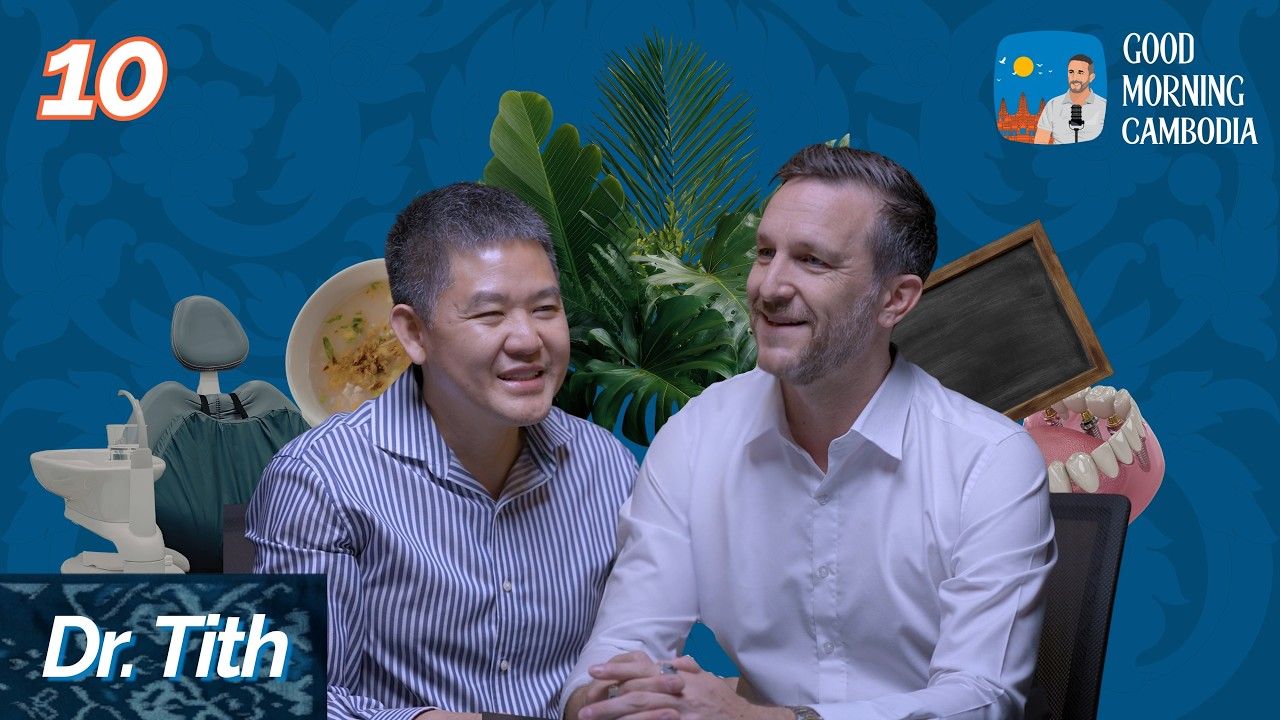
Dr. Tith Hong Yoeu: from a wartime jungle childhood to a dental hospital
With Dr. Tith Hong Yoeu, Roomchang Dental Hospital
About this episode
Jesse McCaul talks with Dr. Tith Hong Yoeu, founder and chairman of Roomchang Dental Hospital, which has five locations in Phnom Penh, 38 dentists and patients from many countries. Dr. Tith describes being born in 1974 in Khmer Rouge-controlled territory, spending his first six years in the jungle and starting school with no books or electricity, then studying dentistry in Phnom Penh from 1990 and training in Malaysia and Germany, where he learned implant dentistry. They also discuss how word of mouth among foreign residents built the practice and why Cambodia has become a destination for dental tourism.
Where the stories happened
See them on the story map →Chapters
- 0:00Introduction
- 8:04Roomchang Dental Hospital and its services
- 17:51Born under the Khmer Rouge in 1974
- 21:22Six years of childhood in the jungle
- 32:01Starting school with no books or electricity
- 37:41Studying dentistry in Phnom Penh from 1990
- 39:58Opening a small private dental clinic
- 45:11Training in Vietnam, Malaysia and Germany
- 51:15Bringing dental implants to Cambodia
- 1:01:21Dental tourism and a welcome to visitors
From the conversation
So I never know the word rice until I come back and then after then mother cook the rice and give to me. I say what is this? What is this?
After I joined two year in Malaysia for this foundation, I have a opportunity to join the program in Germany in Frankfurt in year 2000. So that is a chance for me to start to learn about the dental implants.
You go to restaurant, you can eat the very good noodle, very nice, and have one big coffee. Then how much? $5.
Read the full transcript
0:12 My life is in the grow in the jungle. Yeah. Then yeah, I never see the building that make from the brick and have the white paint. I only see the double story small house, wooden house. Yeah. Wooden house.
0:30 Only brick building I saw is a pagoda. Okay. So there was one pagoda somewhere around there. Yeah. Yeah. In the in that village have one pagoda. Yeah.
0:41 So only one I can see all white color painting. Yeah. Make from brick and that's a big deal, right? You know when you're living in the jungle as a little kid. Yeah. To see one brick building.
0:52 Yeah. That is fantastic. Yeah. Yeah. Yeah.
0:56 But unfortunately Yeah. It may be during 1997. Yeah. This pagoda was demolished. Oh, really?
1:06 Yeah. Because they think that they need the stone and brick to bring to make the water dam. Then they don't have technology to cut the stone or excavate from the ground. They had to take it from existing buildings to build a water dam.
1:24 So they had to knock the building. So this part would now collapse. Yeah. Yeah. But very unfortunate.
1:30 I remember because you remember it clearly as a little kid. Very clear. Yeah. In the late morning. Yep. There's a big sound boom.
1:39 Yeah. Then I run and then the building collapse and then some of the Khmer Rouge's workforce drop and stay under the collapsed building and I think over 20 people die. Seriously? When I go there they try to carry bring. Yeah.
2:01 So this is what I remember when you remember you probably you were five six years old. No I just like three four years old. Three four years old. Okay. Yeah. Yeah, because I see the dead people blood. Yeah. Yeah. So very serious.
2:16 Wow. And that is the end of the brick building I see in my hometown. That no more brick buildings only village and wooden houses. Yeah.
2:25 No, no wooden house. It's a cottage because cottage thatch hut. Yeah. That hut. Yeah. Yeah. Yeah. Yeah. Made from palm. Palm. Right. Right. Branches and Yeah. Yeah. So yeah, it's very hard.
2:38 Yeah. But not only me. Yeah. All people in the country is the same.
2:45 but basically from 1975 until 1979 the entire country became a giant concentration camp and this the killing field. Yeah. Yeah. The killing field. The entire country. And so this devastated the country and every Cambodian. you were a little baby and a little kid. Yeah. But then of course the generation before you, your parents' generation, every generation of your parents' age went through this as adults. And then of course, you know, your generation went through it as kids.
3:21 And then your children's generation, that's a different generation now. They were born in a peaceful time, which we enjoy now of course as well. Yeah. And now we call the peace we can live happily. We can do whatever you want to do in the legal way. Yeah.
3:39 Yeah. That's right. We have peace and stability and it's a big blessing. It's a big blessing that we have peace and stability.
3:46 So you grew up in that for six years you said in the jungle setting. In the jungle and then from there from there the Khmer Rouge fall down the regime began to collapse. Yeah. Yeah.
3:58 Yeah. Then I moved back from the jungle to my hometown Kampong Thom, Stoung district. Yeah. Stoung district.
4:04 And the first day I arrived, I saw the brick building two-story. Wow. Oh, that is the first thing I see. Wow.
4:13 And I laugh and jump. Wow. You're so excited to see a two-story brick building. Yeah. I am until I fall down from the cow cart.
4:23 Really? So you're jumping on the cow cart until you fell off the cow cart. I surprise. Never see the two mommy daddy. Look.
4:30 Yeah. Yeah. Wow. Wow. Wow. Not it's not many building. Right. Right.
4:34 But on the on the road number six. So we have some old building from before the war. Yeah. That's right. I'm very surprised.
4:43 Yeah. Yeah. I never forget about this. This is the time I start to see the building. Yeah. Yeah. With the white paint.
4:50 Yeah. Yeah. It has painting on it. Has paint. A white paint on it made from bricks. Yeah. I don't know what is brick and at that time. I never know.
5:00 You're living in the jungle. Yeah. Yeah. Yeah. I know about the brick. So I just know the white paint, but I don't know the word brick and stone. I don't know what is different.
5:07 You don't know what's under the paint, right? You saw the paint. As a little boy, you saw the paint on the outside, but you didn't know what's under the paint. Stones or bricks. Yeah. Yeah.
5:14 And one interesting I never forget is I cannot say by rice. Rice. Yeah. Yeah. Yeah. Yeah. Because I never eat rice.
5:25 Oh yeah. I only ate Because you're not living in the regions where they grow rice. You're living in the jungle. That's why what you say like everyone live in the concentration camp. Yeah.
5:36 Because the whole village have only one canteen, right? Yeah. And this can And you don't feed yourself. You're fed by the state. Yeah. Fed by the state.
5:48 Yeah. And the head of the canteen is the big lady. Yeah. She is very powerful. Yeah.
5:54 Then she talk, she put the food for anyone who come with the bowl holding the bowl like this. Then she pour. Yeah. If she's not happy, she can punish you or tell to the security to bring you to kill.
6:09 Yeah. That is a dark time of Cambodia during the Khmer Rouge. Greetings from the kingdom of Cambodia. Greetings to all of you around the world wherever you may be. I hope you're having a great day, a great week, and I believe good things are in store for all of us, including us right here in the Kingdom of Cambodia. Welcome to the Good Morning Cambodia show, and we are privileged to be in your cell phones, in your living rooms, wherever you are, and talk about some exciting things that you may not been have been aware of right here in the Kingdom of Cambodia. And today we're privileged to have Dr. Tith Hong Yoeu, the chairman and the founder of Roomchang Dental Hospital. and we're going to talk a bit about Roomchang Dental Hospital, but one of the largest and leading dental hospitals in Southeast Asia with hundred clients coming from hundreds of nations around the world and we're here in Cambodia.
7:18 And so this is a going to be a wonderful conversation. Dr. Tith, it's wonderful to have you today. Thank you so much for inviting me to be here today. Thank you so much.
7:29 Thank you. Thank you, doctor. And it's great to be able to have you here. looking forward to great conversation and I think it's going to be very interesting for our viewers and for our listeners today because I don't think a lot of people around the world expected to hear that one of Southeast Asia's largest and leading dental hospitals with clients coming from hundreds of nations is right here in Phnom Penh, Cambodia. I think that's a bit of a surprise for our viewers today. Right.
8:04 So, doctor, tell us a little bit about Roomchang Dental Hospital. Now, we'll talk about the history here maybe in a few minutes, but tell us about Roomchang Dental Hospital now. I mean, you have locations, how many employees do you have, you have what types of services? And let's talk about that a little bit. Thank you Jesse for giving me a chance to talk about Roomchang Dental Hospital. Yep.
8:30 Yeah. at the moment Roomchang Hospital have five location. Five locations. Yep.
8:38 We operate all in Phnom Penh the capital city here. Y and we have over 30 dentists. 30 dentists. But we have about almost 200 staff together who support the dental service. Wow.
8:54 Yeah. So we provide the very high-end quality dental services that it's very difficult to find in the world that the one center can provide all full specialist work in one center. So when you talk about the, you know, the the specialist dental work, like maybe give us a picture of some of the services because like you said, you're not just a dental clinic, you're a dental hospital. Yeah.
9:21 what is kind of the spectrum of services that you would provide? Yeah, we provide from pediatric dentistry like the for the children. So we care about the children first. Yep. Because they are the future. That's right.
9:41 Yeah. And then if the children You have six children by the way. Yeah. Right. So we do care about children have toothache and gum disease.
9:50 They cannot sleep well, they cannot eat well and there also cannot study well. Right. Yeah. And beside that they also can affect their grow. So that they cannot be a healthy children and in the future they will lose opportunity in the social competition.
10:12 So that's pediatric dentistry. Dentistry. Yeah. Beside that we have a endodontic department who is very special to stop the pain. Mhm.
10:24 So if you have big pain, yeah, you go. Yeah. We have the team who expertise for pain management then they classify in mostly in endodontic work that can remove the nerve, treat the infection and stop the pain. Do you like that or you want to keep your pain?
10:43 Yeah, I don't like that man. I don't like that. Yeah. Yeah. Beside that we also have another department doing the braces. we call orthodontic department. Yeah.
10:54 Yeah. This department take care the teeth from for the children and also adult or old people who have the crocketed. Yeah. Uvents and when you have unevented they have a lot of effect like the gum disease. Yes. So bad oral hygiene the decay. Yeah.
11:15 And speaking not very clears. Sure. Yeah. Eating not well. Yeah. and also affect the form and shape of your face.
11:26 So you not look handsome like you today because I go to the dentist regularly and so that's why I have to look good. So orthodontic also our focus on our services to care everyone to have in a good function. Yeah. And after that we have the aesthetic department who doing for like the dental whitening dentals crown and veneers to make people smile better. Yeah. Look beautiful all those department and also this proenic department also do the crown and bridge for the patient to rebuild the function so they can eat well. Yeah. Not only smile well but also eat well. Yeah. Right. enjoy life as well.
12:14 Yeah. And another part we also have department for the oral implant and reconstruction. Yep. So most people who lost the teeth from decay from gum disease or from accident, right?
12:32 Yeah. They not only lost the teeth but they also lost the bone. The bone was damaged and disappear from the jaw. Right. So we have this team of expert who can do from bone graft soft tissue graft and then we can put the implant in the jaw.
12:53 Yeah. To replace the missing tooth because the implant is function as a natural root of the tooth. Right. So after that we have work to rebuild the super structure like building the crown and bridge over the implant instead of natural tooth. So this is yeah highly specialized dental work obviously. Yeah. Yeah. Yeah. So at at this department we are very strong and we build maybe almost a thousand or more of the patient.
13:25 Yeah. Who never hope to have a chance to eat good food again. Wow. Yeah.
13:33 Wow. Wow. And beside that from when you talk about patients it's of course you're based here in Cambodia but your patients are from around the world. Yeah. Yeah. Yeah. We have this department are very special and very famous. That's why we have customer flying from Australia, New Zealand, Europe. Yeah. Africa, China. Even China we also get patient. Yeah. Korea also.
13:59 Even Korea are very famous in dentistry. We still have patient from Korea come to us. We have Japanese and we have America. Yeah.
14:08 Last few month we have a group from u San Francisco. They are senior expert in construction. Yep. Yep.
14:18 And then they study about so they bring their friend a group of friend come for implant reconstruction. Really? Yeah. H all the way from San Francisco. Yeah.
14:27 Yeah. because they see the record they met their friend who used to be here before and they keep talking good about us. So we collect customer from America. Yeah. Good. Very good. Very good. Yeah.
14:42 That's that's incredible. So you have a team of over 40 dentists and experts. 38 dentist. 38. Okay. And then of course you have a staff team of over 200.
14:54 Yeah. And I know that many or maybe most of your dentists and experts many of them were trained abroad as well. Is that right? Yeah. We have people our dentist who get master degree y from Thailand from Germany. Yeah.
15:16 From Japan. Yep. Yeah. Yeah. So really what Roomchang Dental Hospital is providing is worldclass dental treatment right here in I believe so that our service are very up to date in the cutting edge technology. Yeah. And provide the high quality. We only introduce to the patient for the real benefit of the patient.
15:44 Right. Yeah. We don't show the fancy dentistry. We don't want to make money that is not longlasting that is harmful in the future for the patient. Yeah.
15:55 So a lot of practice they want to show many their different services just to attract for the money. Yeah. From the patient. Yeah.
16:04 And then those patient who suffer they never dare to go back to the same dentist they came to us. Ah yeah. So we learn from those mistake. Right. And we explain to the patient, educate them to not to go for that kind of service again. And also we educate them not to tell the friend and family member to come to go for that kind of fancy dentistry.
16:31 Right. Right. Because in the first day they happy because they look different. They can smile happily.
16:38 Yeah. Yeah, but in the long run they will be in pain in trouble and it cost them thousand of dollar. Yeah. To rebuild it when they make the mistake.
16:48 So a lot of people take kind of shortcuts or cut corners with their dental treatment thinking it's okay look good or whatever. But then the long-term effects can be very detrimental. And so you have many of those people ending up coming to you as well, right? Yeah. So at Roomchang we are the center who not only take care the new customer like fresh customer but we also redo the cases for those patient who have trouble from outside clinic. Right.
17:23 Yeah. I mean outside clinic not only outside clinic in Cambodia but also around the world. Around the world. Yeah. Some patient have surgery or some prosthetic or some other dental treatment from outside the country. They are in trouble. They come to us, we rebuild for them. Yeah.
17:44 Yeah. We retreat them in a very professional manners for the long-term result. Yeah. Yeah.
17:51 Dr. This is I believe for those that are that are watching today I believe that this would come as a surprise to many people and so I want to hear a bit of your story and you're Cambodian Khmer and tell me tell me a bit of your story. I know that Roomchang was started in 1996, right? So almost 30 years now. but before that even what was what was your story and then as part of your story obviously now Roomchang was you know your vision and your baby and now it's grown very large very significant what was your story before that even yes I was born just the beginning of the Khmer Rouge in 1974 okay then my mother told me that the day I come out. Yeah.
18:50 Yeah. There's no attendant. She's alone. No nurses.
18:56 No nurses. Yeah. Yeah. Because the family member left home to the rice field to collect the rice and then the a few hour later she tried to call the people walk on the street and they called the nurse come.
19:12 Yeah. But the nurse who arrived is in the black uniform because in that territory is already controlled by Khmer Rouge in early stage than the Phnom Penh in 1975. You were born right in the middle of the civil war before Phnom Penh fell before the whole country. Yeah. Before the occupied Phnom Penh.
19:34 But you were in Khmer Rouge controlled territory. Right. Right. And the everyone had gone out to the rice fields. Your mom was 9 months pregnant and baby was ready to be born. Baby born. No hospital.
19:51 No hospital rouge. Yeah. No market. Yeah. No market. No hospital. Yeah.
19:58 Wow. Wow. Which province was that by the way? In Stoung. Kampong Thom.
20:03 Oh. Yeah. Yeah. Yeah. Yeah. Kampong Thom was kind of where that was Khmer Rouge controlled territory before Phnom Penh fell. Yeah. Right. Right.
20:11 Yeah. So 1974. Yeah. Yeah.
20:15 And my mom say that few hours the nurse come. Yeah. And then Yeah. She picked me up, shower me. Yeah.
20:24 Yeah. She's in black uniform. Yeah. Yeah. And then after that she disappear. Yeah. And Yeah. It's very tough.
20:33 That was it. No, no, no hospital, no clinic. No, no. Came after you were born already, cleaned you a bit, gave you back to mom. Yeah, that's it.
20:43 Yeah. So, my mom had to wait until dark night, then the family member come back. Yeah. My father, my sister, brother come back from the rice field and cook for her. Yeah.
20:56 So, she didn't have any family members or anything to take care of her until the night time. The Khmer Rouge forced people to go out and work in the fields. Yeah, I understand. Yes. So, I told her that I born to work hard.
21:09 So, you told her that from the time you're born, you're ready to work hard, right? To survive. To survive. Yeah.
21:16 Yeah. So, you went through the Khmer Rouge as a as a baby. As a baby, right? Yeah.
21:22 So, after one week, the situation is very bad. Yeah. And my parents think that we cannot live in this hometown. Yeah. So we have to move to the jungle.
21:35 Move to the jungle. Yeah. So we after you were born for one week. One week. Yeah. Wow. So we go up to the jungle. Yeah.
21:43 Yeah. And we I grow up there. Really? Yeah.
21:47 So after you were one week old, your parents ran away from the conflict areas. Conflict areas. Yeah. And moved to the jungle.
21:55 Jungle in a smaller village years. No. For six years. For six years. Yeah.
22:00 So my life I didn't know this. I mean we know each other and we're you know we're friends and I know your family but I didn't know this part of the story. Yeah. My life is in the grow in the jungle. Yeah.
22:11 Then yeah I never see the building that make from the brick and have the white paint. Yeah. I only see the double story small house wooden house. Yeah. Wooden house. Yeah.
22:26 Only brick building I saw is a pagoda. Okay. So there was one pagoda somewhere around there. Yeah. Yeah. In the in the that village have one pagoda. Yeah.
22:36 So only one I can see all white color painting. Yeah. Make from brick and that's a big deal, right? You know when you're living in the jungle as a little kid. Yeah. To see one brick building.
22:48 Yeah. That is fantastic. Yeah. Yeah. Yeah. Yeah. Yeah.
22:51 But unfortunately Yeah. Maybe during 1997 Yeah. This pagoda was demolished. Oh, really?
23:02 Yeah. Because they think that they need the stone and brick to bring to make the water dam. Then they don't have technology to cut the stone or excavate from the ground. So they had to take it from existing buildings to build a water dam.
23:19 So they had to knock the building. So this part would collapse. Yeah. Yeah. But very unfortunate. I remember cuz you remember it clearly as a little kid.
23:28 Very clear. Yeah. In the late morning. Yep. There's a big sound. Boom. Yeah.
23:35 Then I run and then the building collapse and then some of the Khmer Rouge's workforce drop and stay under the collapsed building and I think over 20 people die. Serious. When I go there, they try to carry bring. Yeah. So this is what I remember when Wow. You remember this as you probably five, six years old?
24:01 No, I just like 3, four years old. Three, four years old. Okay. Yeah. Yeah. Because I see the dead people blood. Yeah.
24:09 Yeah. So very serious. Wow. And that is the end of the brick building I see in my hometown.
24:15 So that no more brick buildings, only village and wooden houses. Yeah. Yeah. No, no wooden house. It's a cottage. We call cottage thatch. Thatch hut. Yeah. Thatch hut. Yeah. Yeah. Yeah. Made from palm.
24:28 Palm. Right. Right. Branches and Yeah. Yeah. So, yeah. Khmer Rouge time is very hard. Yeah.
24:34 But not only me, all people in the country is the same. Except the Khmer Rouge commanders. Yeah. Yeah.
24:43 Who live in the comfortable life eating good food. But I never have enough food to eat. Yeah. For those that are watching and you may have different levels of familiarity with the Khmer Rouge.
24:57 Rouge is the French word for red. Khmer is the Cambodian people. it was what historians say was the most radical or extreme communist regime ever implemented in a country. And you can do your own research on all of that. but basically from 1975 until 1979 the entire country became a giant concentration camp and the killing field.
25:26 Yeah. Yeah. The killing field the entire country. And so this devastated the country and every Cambodian you were a little baby and a little kid. Yeah. But then of course the generation before you, your parents' generation, every generation of your parents' age went through this as adults. And then of course, you know, your generation went through it as kids. And then your children's generation, that's a different generation now. They were born in a peaceful time, which we enjoy now, of course, as well.
26:00 Yeah. Now, because of the peace, we can live happily. They can do whatever you want to do in the legal way. Yeah.
26:09 Yeah. We have peace and stability and it's a big blessing. It's a big blessing to have peace and stability. So you grew up in that for six years you said in the jungle setting in the jungle and then from there from there the Khmer Rouge fall down the regime began to collapse. Yeah. Yeah.
26:27 Yeah. Then I moved back from the jungle to my hometown Kampong Thom, Stoung district. Yeah. Stoung district. Yeah.
26:34 And the first day I arrive, I saw the brick building two-story. Wow. Oh, that is the first thing I see. And I laugh and jump.
26:46 Wow. You're so excited to see a twostory brick building. Yeah. I am until I fall down from the cow cart. So, you're jumping on the cow cart.
26:56 I surprise. Never see the two-story building. Many. Yeah. Yeah. Wow. Wow.
27:01 Wow. Not it's not many building, right? Right. Yeah. But on the on the road number six, so we have some old building from before the war. Yeah, that's right. I'm very surprised.
27:13 Yeah. Yeah. I never forget about this. This is the time I start to see the building. Yeah. Yeah. With the white paint.
27:20 Yeah. Yeah. Has painting on it. Paint a white paint on it. Bricks. Yeah.
27:25 I don't know what is brick at that time. I never know. You're living in the jungle. Yeah.
27:31 Yeah. Yeah. I know about the brick. So, I just know the white paint, but I don't know the word brick and stone. I don't know what is different.
27:37 You don't know what's under the paint, right? You saw the as a little boy. You saw the paint on the outside, but you didn't know what's under the paint. Stones or bricks.
27:44 And one interesting I never forget is I cannot say by rice. Rice. Yeah. Yeah. Yeah. Yeah. Because I never eat rice.
27:55 Oh, yeah. I only Because you're not living in the regions where they grow rice. You're living in the jungle. In the region they grow plenty of rice.
28:03 Yeah. But the Khmer Rouge never give rice to people to eat. They only gives porridge. Porridge. Yeah.
28:11 Yeah. So they instead of like if you give rice maybe for 10 people they have to give 10 kong 10 can. Yeah. But if you give porridge maybe you give only three for 10 people. Right. Right.
28:24 So you put in the big pot, put the water, put the rice in. Yeah. Then boil. Yeah. And then maybe cut some morning glory drop in. Yeah. And then make and then put for you.
28:37 And that's what you were fed by the Khmer Rouge, right? Not rice because rice was too valuable to and it was limited. There wasn't enough. no, actually they have enough but they want to make people hard, right?
28:52 And then they keep the rice maybe they export to exchange for something, right? Yeah. So we don't have enough rice. Yeah.
28:58 So I never know the word rice until I come back and then after then mother cook the rice and give to me. I say what is this? What is this? Your mom said this is rice. The steamed rice steamed rice. Yeah. I never know all funny thing.
29:18 Wow. So these things are stuck in your memory. Yeah. Childhood. Yeah.
29:21 Right. You're in the Khmer Rouge the natural resource we are there the fish in the water everywhere you have water you have fish right but you cannot catch yeah because the it belongs to the state the state not to the individual. Yeah. Yeah. You cannot if you catch the fish then you cook and they have the smoke come out the smell they find they treat you as enemy then they can punish you or kill you straight away. Yeah. Because stealing from the state.
29:50 Yeah. stealing from even though it's just a wild fish pond but it doesn't belong to you. Yeah. That's why what you say like everyone live in the concentration camp. Yeah.
30:00 Because the whole village have only one canteen, right? Yeah. And this can and you don't feed yourself. You're fed by the state. Yeah. Fed by the state.
30:12 Yeah. And the head of the canteen is the big lady. Yeah. She is very powerful. Yeah. Yeah.
30:18 Then she cook, she put the food for anyone who come with the bowl, holding the bowl like this. Then she pour if she's not happy, she can punish you or tell to the security to bring you to kill. Yeah. That is a dark time of Cambodia during the Khmer Rouge. Yeah.
30:38 You know, for those that are watching people like Dr. and really the whole Cambodian population are very thankful for this time of peace that we have now. And we can say now that Cambodia is very stable and very peaceful. and war is a terrible thing. conflict is a terrible thing. And we don't to be honest if you look at now even conflict even political divisions and things like that we don't have that anymore. we have great national unity.
31:19 Unity and peace and stability and our you know Cambodian community very supportive of each other now you know and this is a real blessing that that Cambodia has compared to the terrible times. Yeah. 40 years ago. Yeah. 40 years ago that every Cambodian from that generation experienced and that we must never have again. Right.
31:45 And so, you know, from the government to the entire population are very intentional about protecting and maintaining the peace that we have now. Correct. Yeah. That's right.
32:01 So, you moved back to your homeland, Kampong Thom Province. Yeah. And continued to grow up there. Yeah. Start the school growing up.
32:10 Yeah. And Yeah. So, that was your first time in school, of course. Yeah. No school.
32:14 Yeah. So I'm very hungry to learn. Yeah, I can read and write only in one week private coaching by my relative. How old were you when you moved back to like six year? Okay. So six years old. Yeah.
32:32 Your first chance to go to school. To school, right? You were very hungry to learn. And you had your relative helping you learn how to read and write. Yeah. In one week.
32:41 One week I can read and write. So when I go to school, I already know how to read and write even though you'd never been to school before. Yeah. 11.
32:49 Yeah. Yeah. Wow. Wow. And so you started you're able to go to school and begin your education.
32:57 Yeah. And then and yeah in that time we don't have study material. Yeah. Yeah. Only one blackboard writing board some chalk maybe someone that had a little bit of education to teach a little bit. No. Yes. No school books, no electricity.
33:15 No electricity. Yeah. So if there's no sun, no class. No sun, no class. Yeah. Yeah. Yeah. Raining, no class. Yeah. Big rain, no class. Yeah. Yeah. Yeah. Yeah. Of course. Yeah.
33:31 Yeah. And the school also no brick wall. Only the coconut and the palm leaf. Yeah. recover just like a little hut like cover you from the sunlight but and then a little wooden blackboard you know some chalk and even the teachers the teachers aren't necessarily professional teachers but they're just people that have a little bit of education enjoy educating right correct and teacher at that time he is very what to say very strict mean well very strict very strict and he always use the long button yeah and fight yeah to hit yeah to hit so yeah so if you if you don't pay attention you answer wrong yeah so one time I play with other student he angry he punched me one then he start to punch again I jump and broke through the wall the wall of the school because they That's like palm leaf. Yeah. And coconut leaf.
34:45 Yes. Jump through the wall. Wow. So that is the education in Cambodia during the time after the war. But we they come through all this hard thing and they young generation now are very lucky. Yeah.
35:02 Yeah. They have school propers teachers and study material. Yeah. Yeah. they should focus to study hard and brings knowledge for themsel and they can use it to to improve really now I mean every district every community has schools available right I mean really pretty much the whole country has electricity clean water I mean there's still some regions that are being developed a little bit but really mostly if we talk about the whole country Yeah. Electricity, education, health services.
35:40 There's there's plenty of areas to improve of course. but if we look at compared to that time Yeah. to now really the whole country has electricity. I mean cell phone service you know and you know water and schools and even properly trained teachers. So the development of Cambodia has been very fast to be honest. Very fast.
36:09 Yeah. So you went through you know you just basic education there in Kampong Thom. Yeah. Until how old?
36:20 Until I'm 16. I finished high school from the province. Yeah. Yeah.
36:25 Then I have the first chance to come to Phnom Penh. Okay. So 16 you finished Yeah. your education, high school there. Yeah. In Kampong Thom. Yeah.
36:36 And then you had the chance to come down south. Yeah. To the city. To the city. The university. What year? What year was that?
36:43 That is 1990. 1990. So that was kind of at the end of the Vietnamese regime. Yeah. Yeah.
36:53 So the Vietnamese were pulling out. Yeah. Yeah. And the United Nations were getting ready to come in.
37:00 Yeah. Prepare to come in. Yeah. Under the negotiation for peace agreement. Yeah. That's right.
37:05 And one year later, the UN's they call UNAMIC. Yeah. Yeah. Start to come to prepare for the to come. Yeah. That's right.
37:16 Yeah. So the United Nations Transitional Authority in Cambodia from 1991 until 1993 which at that time it was the largest peacekeeping operation ever by the United Nations at that time. And so that was what brought in the beginnings of peace and stability. It took a few years to become more stable but that was the beginning. Right.
37:41 so you came to Phnom Penh 16 years old to go to university. What subject were you going to study? And there's a there was no private universities back then. It was only the government there's only a few government universities.
37:55 Yeah. So I had to apply to different university for in exam. Yep. Yeah. For the finally I passed to dental school.
38:02 Ah so I studied dentistry. Who were the teachers Cambodians or were they were they foreigners or back in 1990? Yeah, the teacher is those seniors dentist who graduate before. Okay.
38:19 Yeah. Mostly just after Khmer Rouge. Yeah. Then they graduate become dentist and they teach the young generation.
38:27 Yeah. And after 1991 when the United Nation come I start to have volunteer teacher from by NGO right from America from New Zealand from Europe come to teach. Yeah. That was starting in 1991.
38:47 Okay. So you enrolled in dentistry school in 1990. Yeah. And then as the United Nations started to come in, you started to have volunteers from nonprofits.
39:00 Nonprofit from around the world, but especially Australia, US, yeah, New Zealand. And New Zealand, right? Those were kind of some of the big ones. I remember I came after that. I came 1995. But I remember that even during that time there were many dental professionals Australia, New Zealand, US that were coming over and they were teaching in the dentistry school as volunteers.
39:25 Yeah. So you were you were still in school 1991 they started to come. Yeah. Yeah. So I learned a lot from them. Yeah.
39:34 Also from my teacher of course to have a basic dental knowledge. Yeah. Yeah. Yeah. So is that four years?
39:43 Five years. Five years. Okay. Five years. So 1990 to 1995. 95. Yes.
39:50 Yeah. That's when I arrived. I arrived April 1995 is when I arrived. And so you finished university.
39:58 Become a young dentist. Became a young dentist. You became a young dentist. And you started your own dental clinic. At that time it was just a clinic.
40:08 Small dental clinic. small dental clinic with my sister-in-law. Yeah. So she al so dentist senior dentist like four three four year before me. Yeah.
40:20 So we start to improve the private dental practice. Yeah. So I set up the patient appointment. Yeah. In the daytime. Yeah.
40:31 That many patient not happy because in Cambodia the private party usually work in early morning. Right. or late evening. Right.
40:42 Because most of dentist they take their time to go to work for government at daytime. Right. Right. So I come I say okay I want to be a professional dentist. Yeah. So I'm start to arrange for appointment.
40:58 I start to do patient record. Yeah. Yeah. So some patient complain that I should work in the early morning like wake up 5:00 and start to work or I can stay late up to 9:00 at night time. I say I don't have enough power.
41:17 I work from 7 to 5 is enough. Yeah. Sometime up to 6:00 in the evening. Yeah. I work very hard day and night saving money.
41:27 Yeah. All money come pay for electricity for operation and extra money. Yeah. Save to buy new equipment.
41:37 Yeah. Like the good autoclave, good dentals, machine. Yeah. So we upgrade little by little. Yeah.
41:48 Yeah. It take me four, five years. Then we start to combine more product in. Yeah.
41:54 So you started this as a as your vision was a professional dental clinic, right? Right. And that this would be your profession and your small business. And back then, if I'm not wrong, a lot of dentists, they would work government jobs, right?
42:11 And then on the side, they would practice dentistry, right? That's why it'd be like at night time, early morning before they go to work in their government jobs. But you took a bit of a risk on the business side. said, "I'm going to try to do this as on my own and not, you know, not work a full-time job anywhere else.
42:31 Just focus as a professional private dental practitioner." Yeah. Yeah. Not many people took that risk back then. Yeah. Yeah. Yeah.
42:41 So from 1996 until now where you have Roomchang Dental Hospital, right? 40 almost 40 dental experts have been trained around the world and 200 staff and multiple locations and clients from hundreds of countries now one of the leading and largest dental hospitals in Southeast Asia. Yeah. How did that happen from 1996 until now? What's what's what's that story Dr.
43:10 Yeah. I think the accumment lay down from my vision that after I graduate I already recognize and accept that the dental education that I receive not enough. Okay. And so you had five years but you recognize it's it's not enough. Yeah.
43:32 Yeah. And also most of the dental service that provide in Cambodia very low grades quality services very basic at that time. Yeah. Very basic. Yeah. And also not very perfect. Yeah. Right. Right.
43:52 Just to stop the pain or reduce but then but yeah that is the hard time. Right. So from this understanding y I commit myself to keep can education. Yeah. So you weren't satisfied with the level of practice and even knowledge or experience education that you had or even that was here in Cambodia you realize there's much more that could be done that should be should be done. Right. Yeah. And in that time we don't have internet.
44:30 Yeah. Yeah. So we don't have much information, right? But I read the old magazine that was donated from the NGO or from lecturer who come from abroad. Yeah.
44:42 The dental magazine. Yeah. So I understand about the trend of dentistry. I understand about the material, the equipment.
44:50 Then I can compare. Oh, we are using this, they are using this. Yeah. So much different. Yeah. This is the way I think that Yeah. We must try to follow the trend. Right. Right.
45:01 So I cannot stop here or I cannot for stay comfortable in this way. Yeah. Even I can make some money but it's not my satisfaction. Right.
45:11 And then because there's a gap between what is being practiced and what a lot of the outside world outside world are doing. Yeah. So I start to explore. I go to visit Vietnam. I asked professor in Vietnam to do the attachments, clinical attachment.
45:31 I learned some from them. Yep. Yeah. And then I reflect to the information I get from international dental journal something, right?
45:41 I found that in Vietnam there so limited, right? They're a little bit at that time they were a little bit better than Cambodia, but still. Yeah. But not in the front line of dentistry.
45:52 Right. Right. And then I went to Malaysia in 1997. Yep.
45:58 Then I visit university. Then I make some friend. Yeah. Then I learned that their dentistry are very modern in that time. Yeah. Because they get the uncle British system.
46:13 Yeah. So the education is very high. Yeah. That's right.
46:16 And I say okay, I must come back again and learn more. Mhm. Then I talk with the dean of Malaya University and he offer me for 2 year internship in so I start to go in and out some I come to work to make money to feed myself. You come back here work a bit then go few week come back few week go. Yeah right. Right. And then yeah I learned a lot from that.
46:42 I have a good foundations. I never forget and thankful to the Malaysians Dental Association and Unity people who teach me. Right. Right. Great. Yeah. Very good. Yeah.
46:56 Wow. And then that was 199 98 to 2000. 2000. So almost two years back and forth.
47:02 Yeah. At the same time I start to improve the clinic. Yeah. We renovate to a big practice. Not very big but two chair with a separate room clean hygiene. Right.
47:15 Then I start continue to look for study opportunity. Not easy. Not easy running and growing a small business, right? Furthering your education at the same time trying to make sure you feed yourself and feed your family too and then try to improve the clinic a little bit. Not easy.
47:38 Not easy. Yeah. At the same time, I also not only want to grow myself, but I try to go to knock the door of my friends. Yep. Yeah.
47:51 Around the country to say that you cannot stay like this. Yeah. You must go outside to see, right? Yeah. I brought them to go to conference in Malaysia, Singapore, Europe.
48:02 Yeah. I say let's see. Yeah. We if you want to make dentistry and come there in a professional way. Yeah. You must go and see and learn.
48:13 Yeah. Maybe if you cannot take everything at least you can change your mind. Then maybe next generation. Yeah.
48:21 Yeah. You can shape them to a right way. Right. So you begin to gather fellow dentists and dental professionals around the country say hey come you know conference in Malaysia, conference in Europe.
48:34 We can learn this. We can meet these people, we can you know. Yeah. Because most of Cambodia in that generation they are limited in English. They cannot speak English. Right. Right.
48:46 Yeah. So they Yeah. They are scared for traveling. Right. Right. So I'm become a leader. Right. You spoke English at that time.
48:55 Yeah. Yeah. I brought them to do hotel booking. ticket air ticket book reservation.
49:03 Right. Right. bring them how to step on escalator stand for immigration. You were the you were the big brother.
49:12 I some of my friend in Singapore say I'm the king of monkey brought the monkey to the city. Yeah, they never Yeah, I remember. Yeah, I mean because I like I said I arrived here in 1995, right? There were no escalators.
49:30 Yeah, no escalator in. And I remember I mean actually there was there was one at Olympic Market but it didn't work. And then the first one was at Sorya Shopping Center. Shopping mall. Yeah.
49:43 And that was a big deal, right? Like there's escalator. How do you how do you ride on this? How do you not fall off?
49:52 You know, so you were bringing people outside the country first time on an airplane. Yeah. you know big you know modern placeia Europe escalators fly on the sky they expect to see the human when they fly on the airplane where they in jail no in jail that is a lot of interest story about that but yeah I think I made the right decision that the my goal to improve myself in education and then I spread information and try to gather more profession in company. Yeah.
50:38 To grow. Yeah. At the same path that I did, right? Yeah. I also do speech and in university.
50:46 I Yeah. Yeah. And I encourage them that Yeah. We have a lot of job to do in dentistry, right?
50:52 Yeah. We need to do the right way. Y and you need to learn. Yeah. To learn in the new trends. Yeah. Some techniques, some method, you should forget about it.
51:03 It's too old. Yeah. Sometime even you know how to do it but you can find the material or tool because they are out of date. Right. So focus on the new trend.
51:15 Yeah. After I joined two year in Malaysia for this foundation, I have a opportunity to join the program in Germany in Frankfurt in year 2000. So that is a chance for me to start to learn about the dental implants. Yeah.
51:33 Right. And then when I come back I start to do implant in Cambodia. Yeah. Many senior dentist here say oh implant is out of date.
51:43 Yeah. Some they say in France they call foreign body. Yeah. Yeah. It's not good this and that.
51:51 Yeah. But I think oh cannot be because in Germany they in the very hot topic right for industrial for profession right to do research development. Yeah. Every day keeping moving forward.
52:08 Yeah. So I just saying that I don't want to challenge. I just keep quiet. I still focus on doing the job. Yeah.
52:17 Yep. Yeah. Then we have patient come trust me. I should be thankful to those patient who trust me because nobody were was doing implants in Cambodia that time. Right.
52:28 Yeah. I'm first to come and start to do it. Right. Yeah. But those work that I did Yeah. from 24 years ago today.
52:39 Yeah, it's still very good. Yeah, it look like news. I never regret for any mistake I did. Yeah, the patient sacrifice and those patient who have good work from me, they keep eating, smiling, talking then they bring in new patient for me all these years later now. Yeah.
52:59 Right. Right. That's why Roomchang have very good reputation. Yeah.
53:03 Yeah. So when I start as a private practice, I also gain very good reputation among the NGO and the non-government organizations, the nonprofit organization and the UN's representative here like UNDP and UNICEF or WHO all this all their people family member come to look for me. Yeah. set appointment sometime have to wait for me one week two week right so I get very good support from foreign community who live and work in Cambodia right and from their word of mouth they spread to their family member in their hometown even outside the countries so United Nations obviously their professionals are from all around the world based here in Cambodia at that time and they would tell they would there and their families would treatment and then they would tell their relatives right at home as well.
54:07 Yeah. That's why I get a very strong support from foreigner. Yeah. More than local people at the beginning.
54:14 Yeah. Yeah. Yeah. Yeah. Yeah. Yeah.
54:16 Yeah. Yeah. They Well, they recognize they would be able to see and discern Yeah. Yeah.
54:23 The difference in quality and they realize and professionalism and they realize what you're doing is what they're used to and what they need and what they want. Yeah. Yeah. So after some years then the government officers Yeah. the top government officer family members start to come and understand and they accept my services. So I keep growing Roomchang.
54:53 Yeah. Yeah. Yeah. At the same time I also improving my education from Germany. Yeah. And yeah I'm a quick learners.
55:01 So those I go to Germany learn. I try to read to see the detail. I come back I do and the result come the same way that they do. Right.
55:11 Yeah. So I send the record to professor for inspection. Right. Professor always satify. Yeah. say, "Oh, you do very good. You do the same like me and encourage me to keep brail." Yeah. Yeah. Yeah. Yeah. That's right.
55:27 Yeah. That's right. Then I can do a lot of the complicated clinical calls work. Yeah. Like the bone augmentation.
55:36 Yeah. Yeah. Bone transfer from here to put here. From here, put here. Yeah. Since year 2001, 2002.
55:44 Yeah. And now when sometime I patient come for checkup I review you the follow that is 2002 oh 22 year what I do I did and then check oh now I did this wow 20 years ago I already pray to do all this yeah you're not these are these are very complicated procedures and you were doing this you know 22 23 years ago yeah that's Why is good for me to reflect this to my colleague? Of course. Yeah. Some colleague who joined with me five year, 10 year. Yeah.
56:24 And now they already like 30 or early 30. Yeah. I told them, "Yeah, now you should focus and start it. You cannot wait until you get old and you can do it, right?" Yeah. You look to me and that time I'm alone in Cambodia.
56:43 Yeah. I'm very brave. I do it. And then if you compare the age in that time I just 26 27 years old and I can perform a lot of complicated procedure successfully.
56:54 Right. Yeah. No, no comp complication. Yeah.
56:58 Very successful in the right way because I focus on study. Yeah. Yeah. Then I follow the right step.
57:07 Yeah. Right. Yeah. So you don't need to wait. Yeah. If you are 30, you already old already. Old enough. Yeah. Yeah. Yeah. Yeah. That's right.
57:16 That's right. That's right. So that's why my team are very brave. Yeah. Now my junior dentist start one year, two year, then they start to observe and they start to do Yeah.
57:27 complicated work. Right. Right. Then yeah all under control.
57:31 Right. If they not very confident, they are for supervision from me or from our colleague. Right. Yeah. Yeah.
57:39 Yeah. So this is what Roomchang do. Right. Right. And of course now you're no longer just a one chair, two chair dental clinic anymore. You know, you're dental hospital. Yeah. Total chair. I think we have about like 70 or 80 chair from all the branch.
57:59 80 chairs. Yeah. Yeah. Yeah. Yeah. We are very big operation. Yeah. That's right.
58:03 And our dentist not only work for one chair, some dentist use three, four chair at a time. Yeah. Yeah. That's right. That's right. Yeah.
58:10 Yeah. They are very active. Yeah. Yeah. Yeah.
58:14 How does it feel all of all of these years later, you know, that you can look back and I know that the future is bright as well and there's many more things that you want to do in the future. I know that. Yeah. But even just at this point looking back, how does it feel?
58:31 Yeah. Sometime I laugh myself. I say how Yeah. the way I walk very far.
58:39 Yeah. I can talk the whole day and night for all the story. Of course. Of course. From different angle.
58:48 Yeah. Sometime from the patient perspective to the clinical result. Yeah. Yeah. Also sometime from the business point of view. Yeah. Yeah. How to get money. Sure.
59:01 Yeah. Yeah, because you built it I mean from very small and yeah it was a big it was a risk at that time. It was a risk that wasn't the normal way that the that dentists would do it because it's easier to just kind of take a salary from somewhere and then do a little bit on the side in that times. yeah I'm born in the family who start doing the business.
59:26 Yeah. So I have no guru. Yeah. Yeah. Yeah.
59:31 Yeah. Yeah. Yeah. Yeah. Yeah. You had no teacher, no DJ. Yeah. It's supposed to be like I just carry a SWAT and go.
59:39 Yeah. Yeah. Yeah. Yeah. Yeah. That's right. Yeah.
59:42 So, yeah, it's it's very good life experience for myself. Yeah. And also it's good for those who like to hear from me and learn. Yeah. Maybe not every step but part of it they can use it right for their young generations to adopt and follow some step that I can share. Yeah, that is that's a good point. Yeah.
1:00:14 Your parents and I don't know if your parents are still alive or if they've passed away. my father passed away 15 years ago. Okay. 16 years ago.
1:00:28 Yeah. And my mother just passed away last this August. Yeah. Okay. Sorry to hear that. Yeah. Yeah.
1:00:36 And I'm sure that they were very proud of you after everything they went through and the challenges of having a baby and the wartime and no proper schooling in the beginning. They were very proud of everything that you did. Yeah. My family, my parent, my brother, sister all happy. Yeah. They support me. Yeah. Yeah. Yeah. Yeah. Yeah.
1:01:04 And also my colleague everyone support. So that's why we can operate in this private practice. Yeah. In the right way. Yeah. And very reliable. Yeah. Yeah.
1:01:21 So I think I think you know for those that may be watching or listening I think that for some this may be kind of a an eyeopening conversation because a lot of people doctor they're not so familiar with Cambodia or the news that they receive about Cambodia. is very old news. Yeah. From like over 20 years ago, and that's not the time that we're living in now, you know. And so for those that are outside, of Cambodia, whether it's maybe even Arbono and Khmer that might be around the world somewhere in the US or France or Australia or somewhere or for those that you know you could be anywhere in the world to kind of understand a bit more and kind of see the picture a bit more that Now this Cambodia now Yeah.
1:02:31 what we have to offer in dentistry. Yeah. But also actually in many other sectors as well. And on our show we've talked about this show. We've talked about tourism. We've talked about business.
1:02:44 We've talked about investment. We've talked about so many things. The new Cambodia has so much to offer not just the local community but actually to offer the world, right? We can offer the goods dental tourist pack package. Yeah.
1:03:01 That if you have dental treatment in your developed country. Yeah. Yeah. The cost is expensive.
1:03:11 It's very high in developed countries. Yeah. Also you are difficult to make appointment. Yeah. Because the working culture is different right.
1:03:22 Yeah. in your developed countries the dentist work by the time and not easy to break appointment to take care even you are in pain right yeah or in any urgent problem but if you come to Roomchang yeah we can support you 24 hours yeah yeah if you have any pain problem we will wake up in the mid night to fix for you, not to let you pain the whole night. Yeah, that's a unique working culture right there. That's not very common. Yeah. Yeah. Yeah.
1:04:02 Right. And if you come to Roomchang, you want to have quick appointment. Yep. We will set up because we have a team, right?
1:04:11 So if one branch is full, we can transfer you to other branch. Then you will get the appointment and solve the urgent problem, right? Then we will study what is your need for long-term dental health. Right?
1:04:28 Then we will come out with the treatment planning and we sit down to discuss your problem. We will tell you about each problem and what is the treatment procedures. Yep. And the timing how many time how long you need to come, how often you need to come.
1:04:51 Right. And also the cost. Yeah. How much it will cost. Yep.
1:04:55 Yeah. And we are very honed we do it. We mention Yeah. Yeah.
1:05:02 We focus on that result. Yeah. Doctor, do you have do you have patients and clients that will come in, do their dental treatment, and then also add on like a holiday to their trip as well? Do you do you have is that quite common?
1:05:21 Yes, sure. Sure. Yeah. Before the COVID at we have the room building on the street 184, the main hospital.
1:05:29 Yep. Yep. And then along this road from behind the palace Yeah. to the Monivong. Yeah.
1:05:37 A lot of boutique hotel. Yeah, that's right. Yeah. Because a lot of foreigner from Australia, from Europe, they come to Roomchang and they like to stay around there and they walk along this road. So your dental hospital was there and because you had so many international patients, a lot of boutique hotels started to open up along the whole road for your for your for your patients.
1:06:03 Yeah. For my patient and those who operate the hotel is not Cambodia. They are foreigner. Oh, really? Yeah. Yeah. Yeah. So these guys are from France. These guys are from Korea. These guys are Australia.
1:06:17 And they would bring in the family member, friend, stay in their boutique hotel, dental treatment, and then after that enjoy some enjoy sighting. Yeah. Go to the beach, go to the mountain, go to see beautiful temple. Yeah.
1:06:33 Yeah. So yeah, before COVID we have very good unique road was your ecosystem. Yeah. Yeah.
1:06:41 Yeah. Yeah. Obviously now you have different branches and you still have you know people coming from around the world that it's not just that one road anymore and after COVID yeah all to research collab yeah right but now start to regain yeah now we start to have booking on email or on phone call take message from overse yeah we'll be picking up back yeah I've had I've had relatives from the states I had my aunt I don't think my uncle did it but at least my aunt she came twice in one year. Yeah.
1:07:21 to receive dental treatment at your hospital. Yeah. Yeah. So she came to visit but then she was in need of some some yeah some professional dental treatment and so she twice in one year I believe she came.
1:07:40 Yeah. And then you know she traveled around a bit as well. Yeah. Yeah. Yeah.
1:07:45 Yeah. We can the help to improve the healthcare services in Cambodia. Yeah. That most of the affordable people and they go overseas for medical treatment. Yeah.
1:08:09 most mostly to Thailand, Singapore or Europe. Yeah. Yeah. But most of them who get the medical care in outside from outside, they came to Roomchang for dental care.
1:08:25 Yeah. And they always say only Roomchang is the good place that can provide international standard. Yeah. Yeah.
1:08:34 And they always encourage me. Yeah. Why not you do the general hospital the same standard like Roomchang? Yeah. Yeah. Yeah.
1:08:45 And you know for those that are watching or listening it's true in Cambodia at this point we don't really have any or much medical tourism but what we call dental tourism very strong is very strong in Cambodia. And I would say if I'm not wrong, you're the expert. I'm not the expert. But if I'm not wrong, I would say it's it's a couple factors. Yeah.
1:09:15 One is even you doctor, you know, you've been kind of like you're still young, but you're the grandfather of industry here in Cambodia, one of the grandfathers. but then also the fact that in the early 1990s like you mentioned there were many American, Australian, New Zealand dental professionals that volunteered their time to train at the dental schools here. Yeah. Yeah.
1:09:44 And so they brought you know very professional training from their countries and that laid the foundation for dentistry. one there was we recognized the previous generations of Cambodian dentists of course but that time was a very important time right and that's why I would say those are a couple of the factors yourself as well as that generation or that time of international dentists coming sacrificing their time training the university students the dental students and fast forward to today Cambodia is well recognized as a prominent dental tourism destination. Yeah, absolutely. Yeah, that's my amateur opinion and understanding doctor, but yeah, we have people from hundreds of countries around. Right. Right.
1:10:47 Yeah. You can imagine that at room we take care ambassador like from China, from Russia, from US. Yeah. And yeah, many ambassadors came to us.
1:11:03 Yeah. Yeah. And then the no need to fly back to their country. No need. Yeah.
1:11:07 And then they brought in their family member to us. Even flying from Beijing to dental treatment. See this says something. This says something. Yeah. Right.
1:11:20 Yeah. So, yeah, we build a rising for them. They happy. Yeah.
1:11:27 This is this is incredible. And I think I think for those that are listening and watching today, I believe it's very eye opening, doctor, and I know that we could continue on and on. You know, we're good friends and we always have good conversations and there's so many other angles that we could talk about. but I think we'll have, you know, I'm I'm sure that we'll have part two, part three, part four where we can continue to talk about some of these different angles.
1:11:53 Yeah. As well. maybe, you know, as we kind of wrap up here, doctor, what would you like to say, share with the outside world? about yourself, Roomchang, or about Cambodia?
1:12:13 Yes. I would say that welcome to Cambodia. Yeah. Our country is a young country.
1:12:23 Y in term of peace, stability that just gain during less than 30 years. Y but our young generation people are very hardworking and committed to grow to catch up the trend of modernization. Y yeah and also in term of professions yeah our young professional also start to do in different field in the right way. Yeah, that's right.
1:12:58 Yeah. And most people who educated in Cambodia speak English. So it's very good for tourist to come. Yeah.
1:13:06 You can communicate. Yeah. In English. Yeah. And please bring more US dollar. Yes.
1:13:14 Because you can you can use US dollar in anywhere or the country. Yeah. Cambodia is a dual currency. So we have our riel US dollar everywhere. I'm not encourage you to use US dollar for everything.
1:13:28 Yeah. But if you come as tourist, no problem. Bring US dollar. Exactly. Yeah.
1:13:32 You can you can pay to take the bus or tuk-tuk or taxi restaurants, restaurant. Yeah. Yeah. In US dollar, no problem. Yeah. That's right.
1:13:45 So bring more US dollar to build economic income with it. That's right. Yeah. You can spend it here. You can spend it here to prevent Cambodia from falling back to the to the nightmare again.
1:13:58 Yeah, that's right. You can spend your US dollars. And also the cost income there also not expensive. That's right.
1:14:05 Yeah. Yeah. I don't say you have to go to fancy restaurant that cost very high because of service and tech. Yeah.
1:14:12 But if you eat as general people Yeah. the food is not expensive. Yeah. Traveling also very low cost. Yeah. Yeah.
1:14:24 Yeah. Yeah. So your dollar or your $10 or your $100, it can go a lot further than it could in many countries. Yeah.
1:14:32 If you have a $100 in US, you go to restaurant, just eat the burger. Yeah. And then after the billip, the guy say tip. Yeah. Then 100 gone. Yeah. That's right. That's right.
1:14:44 Yeah. Yeah. 100. You go to restaurant, you can eat the very good noodle, very nice, and have one big coffee. Then how much? $5.
1:14:53 Yeah. Yeah. Yeah. That's what I was going to say. For $100, you can have 20 meals here.
1:15:00 Yeah. Please bring more money. That's right. To spend in G there. That's right. We welcome you. We welcome.
1:15:06 Yeah. And stay longer. Yeah, that's right. Because we have many place for you to visit. You can see the village to see how the civilization from the countryside to the city. Yep.
1:15:20 You can visit tourist areas. You can see the mountain. Yeah. In the highland area like Mondulkiri, Ratanakiri. It's beautiful there.
1:15:30 Yeah. Or go to the beach. Yeah. Beautiful beach. Yeah. By sand. Clear natural. Yeah. Yeah. Right. Right.
1:15:39 But you can meet very friendly people here. Friendly people. Very friendly. English speaking population. Right. Very, very helpful. That's right. Good smile. Big smile.
1:15:50 Yeah. That's right. That's right. And if you don't have a good smile, you can get some dental work and have a good smile, too. They can help you for a beautiful smile. That's right.
1:15:59 Yeah. Oh, I can tell you one thing that many western come they have a long what do you say? Like a beard. Yeah. Yeah. Beard. A mustache. Mustache.
1:16:10 Yeah. Like and then they come for dental treatment after complete. Yeah. They go to the hotel. They say, "Oh, come back to me." Really?
1:16:20 And say, "Dr. Tith, you see?" Yeah. They say, "Oh, so they've been hiding their dental problems problem for years." For years. Yeah. Wow.
1:16:30 Yeah. So I say, "Oh, sir, how can you keep the teeth like this?" Yeah. Then you already understand about your weakness, your apparent that you lost your chance in the public speaking, right? You try to be high all the time.
1:16:48 Why not you come to have treatment long ago? Yeah. Yeah. But he say you know that the procedure that they introduced when I visit dentist in my hometown.
1:17:00 Yeah. Yeah. They say I need four five year to finish and then the cost is like 40 50,000. Yeah.
1:17:10 Yeah. But when they come to us we will work hard maybe 3 month to 6 month. Yeah. Yeah.
1:17:16 Then yeah it depend on complication. Right. Right. And we rebuild we finish nicely. Yeah.
1:17:22 And we see that this happen in the long term result stability. Yeah. So they just pay maybe 5,000 to 10,000. Right.
1:17:35 So they can change their smile. They change their new life. Yeah. And I remember one man say after I say oh and I took the photo selfie I sent to my daughter. My daughter tries.
1:17:48 Really? Yeah. because he say that my daughter never see me without the mustache the B. So I think many people in developed country. Yeah.
1:18:03 So they cannot afford to pay for dental care and it takes like sometimes it's going to be a fouryear you know series of procedures. Yeah. Right. And the procedure they do very slow because of the timing. Yeah.
1:18:17 And then it cost them so much right and also they are busy also those patient also they work as in the construction or in other services that very difficult to take day off. Yeah. Yeah. Otherwise they lost the job. Yeah. Yeah.
1:18:33 So yeah I think it's a good point that those friend people who need dental services. Yep. Yeah. And you want to save cost and reliable quality. Yeah. Please come to Roomchang. Yeah.
1:18:48 Yeah. Our hospital have very well equipped. Yeah. Like very modern. Yeah. We are in the cutting technology. Yeah. That's right. Yeah. Yeah.
1:18:58 So and right here in the middle of the Kingdom of Cambodia, right? Yeah. Yeah. In the heart of Phnom Penh.
1:19:04 In the heart of Phnom Penh. In the heart of Phnom Penh. Dr. It's been an incredible conversation and I'd love to continue talking much more later on. And I think there's many more things that we can discuss.
1:19:18 Thank you for everything that you have done, you know, for Cambodia and the dental industry and you've pioneered in this industry. Thank you for what you have at Roomchang Dental Hospital, of course, as well. Yeah. And I think you have a lot of people around the world that are also saying thank you. And for those of you that are outside of Cambodia, come and visit. Come and visit us, come experience. And you're always welcome here. Right. Yeah.
1:19:53 Thank you, Bong Nadin. Yeah. For giving me a chance to speak out to show about dentistry. Yeah. In Cambodia. Yeah.
1:20:03 Yeah. And also I'm happy to welcome all friend from the corner of the world to visit Cambodia and if you need dental treatment yeah please do not hesitate to come to Roomchang. Thank you so much. That's right.
1:20:19 Thank you so much Larru and thank you to all of you and I hope that this has been an intriguing conversation. We're looking forward to talking with you more, bringing you many more intriguing conversations right here on Good Morning Cambodia. And we'll talk to you chap very soon here.