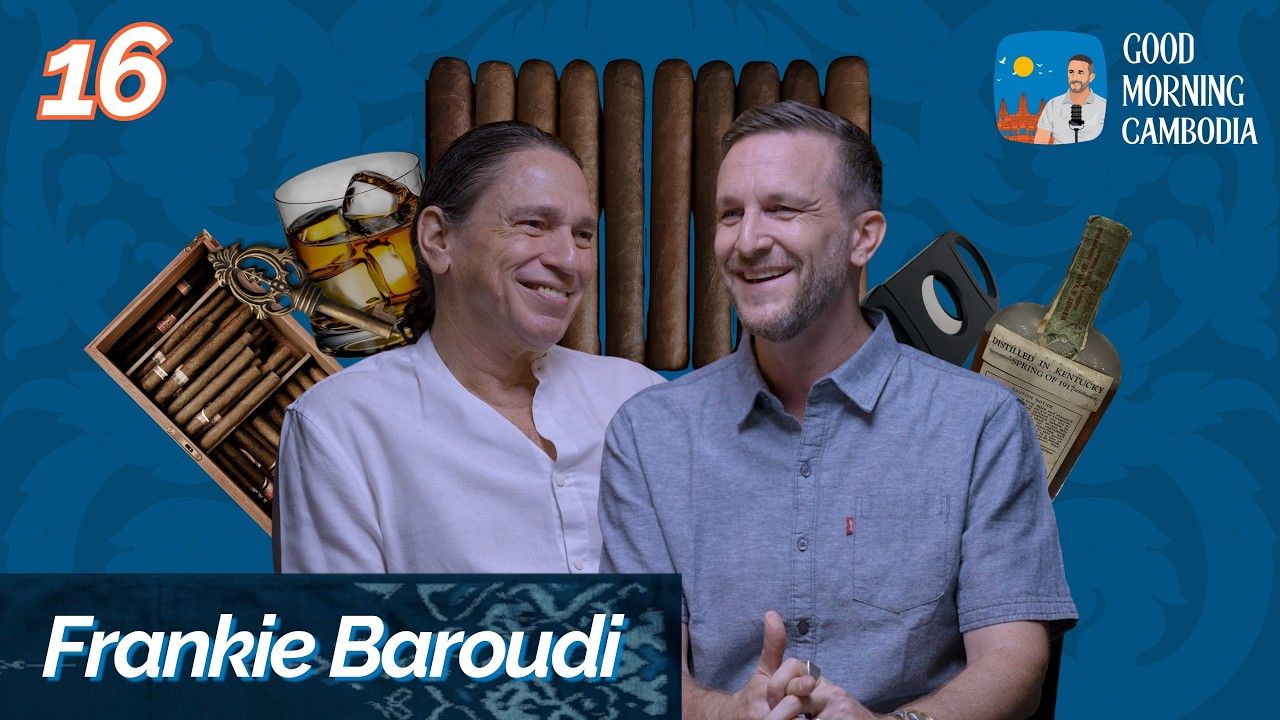
Frankie Baroudi: Cuban cigars, rare spirits and making Cambodia home
With Frankie Baroudi
About this episode
Jesse McCaul talks with Frankie Baroudi, an American collector of rare Cuban cigars and spirits with a global business, who first visited Cambodia 13 years ago and has made it his home base for about five years. Frankie tells how a USC roommate's inherited cellar started his collecting and describes some 80 trips to Cuba, then explains what drew him to Cambodia: the people, the low cost of trying new business ideas, and short, cheap flights around the region. He also talks about investing in a mango farm, a garment operation, a nightclub and a restaurant, and about trips to the islands, Angkor Wat, Kep and Mondulkiri.
Where the stories happened
See them on the story map →Chapters
- 0:00Introduction
- 1:55Engineering at USC and early computing
- 5:03A college roommate's cellar of Cuban cigars
- 11:04Eighty trips to Cuba
- 14:01Choosing Cambodia as a home base
- 16:36What draws him to the Cambodian people
- 25:23Investing in a mango farm and a nightclub
- 28:57Cost of living and cheap regional flights
- 30:38Islands, temples and road trips
- 37:30An invitation to discover Cambodia
From the conversation
Yet you look them in the eye and you don't see somebody looking for your wallet.
I looked out a hundred yards in front of me was only sand with crabs running all over the place and the most beautiful beach ever. 50 bucks a night.
And we, you know, mud up to our kneecaps and I mean, so the adventure awesome. We got towed out twice, you know, with the with the tractors, you know, from the 1940s.
Read the full transcript
0:12 Greetings from the kingdom of Cambodia. We are alive and well and yeah we send our warm regards to all of you all around the world both our papa and Khmer around the world of course and as well as all of you joining us today welcome to the good morning Cambodia show and it's an honor to be with you and looking forward to some wonderful conversations. s uplifting, positive, I reckon decently high energy as well. And it's honor to have you Frankie Baroudi here with us this morning. Yeah, Frank. And it's it's great to have you here. Frankie Frank, I usually call you Frankie and I think around you're known as Frankie.
1:08 Frankie is a global businessman u originally from the United States and we're going to jump into parts of your story, but Frankie is one of the world's leading collectors in rare Cuban cigars as well as rare spirits and whiskies as well as a investor in a few different industries, several different industries here in Cambodia as well. And the unique thing is whilst your business is global, Frankie, but Cambodia is where you've chosen to be your home. And I'm in love with the place. Yeah.
1:55 That simple. For many reasons. Yeah. And this is what we got to get into because this is there's there's several intriguing parts of this. Obviously first of all your story and your industry is intriguing and then of course I want to understand a bit more of why out of anywhere on this big old earth why Cambodia you know so we we'll jump into that here in a bit but it's great you know to have you here Frankie and your story you know the bits that I know of your story and you know being friends for the last many years here. you're originally from the states USC University of Southern California graduate there in engineering but your industry now is completely different and in addition to just being to being a global business that you run. but you could say you're kind of what you have in your hands is towards the pinnacle of the rare cigar and rare spirits industry here. And I want to you know I want to hear a bit more of that story before we jump into you know business investment and life in Cambodia. Sure. No, I you know was always in the computer world back in the in the early 70s and I graduated from high school in 1976 and went I really had a vision on what I wanted to do with my career in life. I was great with numbers. I did really great with the SAT scores and all that and got a full ride at USC like you mentioned in Los Angeles and I was from San Diego so it was an easy twohour drive back then now it's four or five traffic but I specialized in electrical engineering and computer science get a couple degrees a couple master's degrees in both of those as well as undergraduate and then started to work in Los Angeles in that world and that was before the
4:16 IBM PC and I was really on the cutting edge, but my heart really wasn't into it. I hung out about seven years in that world working for some amazing companies. Good career and for you in those early years, I'm sure as well. Yeah. And rode the crest and made a lot of money. When Apple came out, I was working with the teams that actually put the windowing and everything that Apple is today. They were all working for Xerox at the research center and I was involved in that. So I did well enough to seven years later say you know I've had enough of this. I'm I want to work for myself. That's the only way in America you can really do your own thing and make large success. It's never going to happen working for somebody else's company. Yeah.
5:03 So, but in the course of my education, I was l lucky to u have a roommate that was an amazing guy. he taught me about all kinds of higherend things because at USC you're either a very amazing athlete. Yeah. you were born with a platinum or gold spoon. Yeah. because very well very expensive college to get into even back then. Yeah. Back then it was $89 a unit. Now it's like $8,000 a unit. It's just nuts. Yeah. but or you knew how to take tests.
5:45 I knew how to take tests, so I get a full ride there. But my roommate first semester in Birnkrant, which was, you know, one of the one of the dorms. Yeah. You know, was a was a revolutionary thing in my life. what happened? What happened with your roommate with within about four months? He w I remember this so clearly. He was putting on a tuxedo. I called it a penguin suit because I'd never had a tuxedo. It was from modest means. Yeah. And I said, "What's going on with the with the penguin suit?" He goes, "Ah, well, my grandfather just died, so I'm got to go to the service." And I said, "Oh, I'm sorry." You know, he said, "Hey, don't be don't be too sorry. when I come back, we're going to go and I'll show you what he left me." And I had no idea what that meant, right? He's just a normal guy. You know, we're in college. Both love cars.
6:36 College mate. Yeah. My buddy. Yeah. And so he comes back and we he takes his clothes off and you know, his suit off and puts normal stuff and we take a drive to San Marino. Y San Marino is about 15 minutes away from USC on the Hollywood Freeway up and over Pasadena Freeway. And we come rolling up to this estate.
6:57 It's got like a quarter of a mile entrance with 300-y old pine trees and just going, "Wow, what's this?" San Marino, if you don't know, it's like the Beverly Hills of Pasadena. Mhm. old money. Y and we come rolling up to a home that was 30 40,000 square feet. Wow. And amazing. I just I'm already out of my element. I don't know what's going on. Y. He said, "Ah, you've seen nothing yet." Then we go back around the pool area and and we go down some steps into a basement. Yeah.
7:32 And he says, "Yes, this is where I'm going to put my mu music studio and so forth. It's about six size six times the size of this room." Yeah. And he goes, "Uh, you know, every once in a while we smoke cigars." I said, "Yeah, you know, you're the first guy I ever smoked a cigar with." He goes, "Well, this is where the stash came from." Yeah. And he opens these giant double doors with a big key this size on the side and opens these doors. Yeah. And there's a room about this size actually.
8:03 Yeah. Yeah. Yeah. of only pre-embargo. Wow. Pre-embargo.
8:09 Pre-embargo. Cuban cigars from the 1920s, 30s, 40s, 50s and all the biggest names. All just shocking. And I didn't know what I was looking at. All I said I mean the room is filled with these, right? Filled. Yeah. And it was like, God, the cigar label art on these is beautiful because that they use the old style printing and magnificent.
8:31 Yeah. And so I was just, okay, well, this is really cool. Big come over here. And then he goes the next set of double doors, same kind of key. And he's got a room of 40,000 pre prohibition whiskies. Yeah. and all the finest of everything. 40,000 bottles of first growths also all wines and he had the 21s the 45s the 60 the 61s 82s weren't out yet because this was in 1976 so all the finest so his grandfather was a gentleman by the name of Kenneth T Norris Industries they owned Westinghouse Whirlpool Thermador Waste King they all made a lot of the US military appropriations we used during World War II so you're wandering around in his Yeah. So, this is why, you know, yeah. And I said, "Wait a minute, Norris.
9:27 Norris, there's a Norris Dental Science Center. There's a Norris Theater. There's a Norris Law Library." He said, "Is that any affiliation?" He goes, "Yeah, grandpa and dad." Oh my god. Wow. Wow. Wow. So, it's like one of the biggest families in Los Angeles.
9:44 Yeah. Yeah. Yeah. And so he took me under his arm and Yeah. Yeah.
9:49 under his wing, so to speak. and we were smoking and drinking all that stuff. So I said, "Well, this is kind of cool." Yeah. So you were brought into that whole world. That wasn't your world. No, I'd never smoked a cigar. I you know, I had a Mickey Big Mouth beer, you know, before I got to college. I was a student. I had 4.0 and 800 on my SATs and I, you know, and now here this monstrous distraction, but it was cool. Yeah. And I fell in love with the labels. the labels, the artwork on these old bottles of booze and old cigars is what really turned me on. I couldn't afford the product, but I could afford the art, right? So, I started investing in that art and slowly but surely. So, the boxes the boxes I still I have thousands of those. Now, you have thousands of them. Yeah. Yeah. Yeah. And the labels themselves, right? Yeah. Then I started, you know, but then you jumped into that world, right? I mean, is what happened. I started collecting. I started being a mad collector. Yeah. Yeah. Yeah. Yeah. So, you know, fast forward to now. There's 40 years of this. Yeah. Fast forward. You know, I know you don't like to brag, but you got to brag on your collection a bit, you know. Well, fast forward to 19 early, well, 1990. Yep.
11:04 I had an opportunity to go to Cuba. Yep. And that's where, you know, all the cigars were from. Yes.
11:09 And I had this passion for these things by this time. Yeah. And I started collecting all cigar memorabilia, you know, lighters, cutters, but mostly the art. Right. Right. And old Cuban watches and all. I was intrigued with the Castro regime and you know, anywhere you're not supposed to go as an American is kind of like a cool thing, full of intrigue. Yeah. so about 80 trips later, in fact, my last trip was before COVID. Okay. Cuba was still always getting a little bit worse. a little bit worse, a little bit worse, and now it's just so depressing. I won't go anymore. But over the course of those 80 trips, I did mass accumulation of all kinds of things. Wow. And that's where still a major stash of the cigars and also old beautiful old Cuban rums from the pre-Castro era.
12:04 Yeah. because obviously everything since 1961 was cut out, right? Right. after the embargo when Kennedy got his last shipment of you know 18,000 or something cigars.
12:17 Goodness. Yeah. Yeah. Yeah. So that's that's the that was the core Yeah. of u of the collection. Yeah. And I know that you know your collection now is you know amongst one of the largest collections of the of the rare you know Cuban cigars and spirits. And it's very, you know, from what I know by your travels, it's very desirable because you have, you know, this week it may be the Middle East and then next week is Hong Kong and Macau and then after that is London and then it's after that is back to the States. You have a very good memory. I know. Yeah. Yeah. Yeah. you know, so it's pretty much it's it's a very enviable collection that you have that there are, you know, certain people globally that are regularly, you know, contacting you to look at the availability of what you have, you know, in your collection. Of course. Yeah, it's cool. And all these guys are, you know, well heeled. They, you know, it's they know about this stuff. So they're they all have their own stories.
13:18 So it makes my life, you know, so more enhanced by just knowing these guys and talking story. Yeah. And hearing their angles and perspectives and how they got started and what their favorites are. Yeah. You know, oh, I just happened to have one of those, you know, that kind of thing. Yeah. Yeah. It's a very cool thing. That's incredible. So I mean like like I said, Frankie is a global businessman. your business it really does encircle a large part of the the globe. Yeah, you hit the major markets there between you know between the London the Singapore the Middle East and the biggest is Southeast Asia.
14:01 Interesting. You know interesting and that's and that's why you know I wanted to investigate this particular part of the world. Yep. more because it's just you've got Malaysia, Indonesia, you've got Singapore, you've got the Philippines, and you have you have of course mainland China and Hong Kong.
14:24 Yeah. And the proximity to all those places is with one to two hours from where are we now? Yeah. Right here in Phnom Penh, Cambodia.
14:36 That's it. Yeah, that's exactly it. Yeah. So after realizing that I have a great passion for the Asian culture Southeast Asia in particular I started traveling all over the place here.
14:53 Y and of all the countries that I went to and all the peri all the people that I experienced in say eight major countries here. it was the Cambodians that really got under my skin. They got your heart. Yeah.
15:12 Yeah. Yeah. So that's, you know, that for me that's that's very interesting because again, you know, you have a global business. You also have a winery in Argentina as well. I know.
15:26 And you are on the plane a fair amount here and there as well. but you know out of all anywhere in the world and anywhere in Asia which you see so much potential here in Asia as well a lot happening here in Asia you've chosen to make Cambodia your home base and not only that but also investing here in Cambodia as well investing your life but also investing you know some of your finances into other businesses here in Cambodia. You when was your first trip to Cambodia? 13 years ago. 13 years ago. Okay. Yeah. Yeah. And then Cambodia has been pretty much home for you. The last about five years. Last five years. Yeah. Yeah. So, you know, what do you what do you reckon it is about Cambodia? you know, and you know, this isn't to diminish any other nation or city. There's a lot of great people and we live in a great time to be alive, great planet, great world.
16:36 but what do you reckon it's about? It is about Cambodia that after all these travels and all that, that you said Cambodia's home base. Number one, I'd have to say it's the purity and the groundedness of the people. The purity and the groundedness. Yeah. Yeah. They've been through so much tragedy, so much hell. Yeah. Yet you look them in the eye and you don't see somebody looking for your wallet. You don't see something somebody saying looking at you and saying, "Why is he looking at me?"
17:13 You see a depth there. It's M yeah. Yeah. I get it. I get it.
17:18 Yeah. And you don't see that and feel that in China for sure. In Hong Kong. No. In Vietnam. Uhuh. Yeah. In Lao. Lao is probably as close but still not there. Yeah. and forget Singapore and Malaysia and Indonesia.
17:38 Right. Right. Maybe the Philippines get a little more warmth. Yeah. But above and beyond all other sects here, the Cambodians are amazing. Now add to that it's still even today is still a bit of the wild west. Uhhuh. in, you know, you're not going to come up with any business ideas, any investments in Hong Kong or Singapore or Bangkok or Ho Chi Minh that haven't been done already. Right. here there's a there's still an openness the possibility of doing something cool that hasn't been replicated that hasn't been done absolutely right and the cost of entry to the market is so far below any other place on the planet the real estate here for purchasing used to be cheap now it's it's gone up yeah it's going up but there's still plenty lots but if you're on the on the let's Let's throw some stuff against the wall and see whether it sticks mode as an experiment. That's not your specialty, which is one of my specialties is trying new things because I get bored fast. So, I like to try different things. Yeah. Here the cost of entry for renting real estate. Renting is so reasonable here that you can afford to go out on a limb y and see whether it's the concept works. Yeah. And labor also among the cheapest in the world. So, you know, I feel guilty, you know, when I hear the average labor rate is, you know, $300 a month, right? Right. My god. You know that. and I don't know how they do it, but they do it with a smile, with a depth, with a groundedness that I'm talking about. It's just amazing.
19:27 Yeah. So, there's there's that. that is a really, you know, a strong driving force within me. Yeah. Yeah. Yeah. I agree. I agree. You know, I think look, I know that in a lot of societies, the pressures of life can get to people and it's just everything is so tense and, you know, yeah, I mean, that's that's life for a lot of people around, you know, around the world. there's plenty to be done here. you know we can set goals and KPIs and build teams and make things happen here but at the same time with the people here there's still I don't know if you want to use the word laidback attitude or you know just like a like you said a real grounded attitude as well like look we're all going to work hard we're all going to try to make things happen we're all going to do our best but at the same time we still have the time of day to smile at people and to ask you know one of the common greetings in Khmer when you see somebody that you haven't seen for a while is hey have you have you eaten anything yet really have you had lunch yet you know that's not our American or English lingo as much you know but here and it reflects it reflects their attitude you know so if I were to you happen to bump into you, you know, anywhere here in town. I wouldn't just say how have you been. That that's one of the greetings we could say. but one of the other greetings that we that we would have with each other is no. Have you had anything to eat yet? Yo, yo. Yeah. Yeah. Yeah. and it just reflects that attitude like, you know, hey, I know you're busy. I'm busy. We were all working, but hey, make
21:22 sure you get something good to eat, you know, and hey, let's catch up, you know. Yeah, let's put stress aside for a bit. That's right. Yeah, that's right. That's right. And I'm ass sure you experience it as well. But I seems like every day around 4 4:30, that's when the text messages start coming. Hey, Jesse. Hey, Frankie. Where you at? Where you at? You know, you free. Hey, come hang out. You know, spurof the- moment, spontaneous.
21:48 There's other stuff that are planned. You know, you and I have said, okay, you know, Tuesday, such and such a time, we'll meet up, whatever. That's that planning is important, of course, as well, but just that, you know, a bit of a genuine, friendly, spontaneous, very therapeutic. Yeah, it really is. It really is. You know, Frankie, you still travel quite a bit. you still have all different levels of global interactions at all different levels and I know that and that's something that I have always respected and appreciated as well whilst you can have you know some of the highest level interactions but you always you know care about the just the normal folks around you as well you know and that's something I've always you know respected and appreciated but I'm sure when you're traveling, you know, you meet lots of people and you tell them that home base is Cambodia and what exactly where is that exactly? So, so tell me about that. Let's talk about that for a bit because you know what are you know whether it's you know misunderstandings or perceptions that what are you running away from? Okay. Yeah. So, let's let's jump into that. What have some of these misperceptions, you know, been that you've come up against? being now a resident here in Cambodia, an investor in Cambodia, a lover of Cambodia, what are some of those my mind is exploding with all the answers to what you're asking, but in general, it's just it's a super pleasant place that in this crazy world that we live in.
23:34 Yeah. that you can actually step back and take a breather and look at say that picture and all of a sudden it's I've been there. Yeah. Yeah. Yeah. Like and you know you're not going to find that in any superindustrialized city, New York, Hong Kong, Sydney.
23:59 And I've lived in Sydney. I've lived in Sydney. I've lived in Rio. I've lived in some crazy places and Buenos Aires and you never attain a zen kind of calmness. Yeah. That you can just close your eyes over here and easy to slip into that world. Yeah. yeah, there's, you know, everybody is caught up in their own world and, you know, my story is a little different than most, but nonetheless, the just the just the calmness that you can achieve over here. And if you want to slip away and go in to a temple and just watch people go along the riverside and see you know the smooth flow of of the water in both directions. Yeah. And it's there's a calmness there and you see that in the people. Yeah, you do. They're not running around like chickens with a head cut off here.
25:04 Yeah. No, not by any means. They know they've been through a hard time. They've been able to cope with it and their family's family is has a again the word grounded. They're they're the purity that they've achieved by going through so much crap. Yeah. Yeah. is evident.
25:23 Yeah. Yeah. That's right. So, you know, when you compare to other parts of the of the more say industrialized parts of Southeast Asia, it's a different world. Mhm. It's a different world. One that I endorse. Yeah. Yeah. Yeah. Yeah. Yeah. Yeah. I mean, I've I've gone out and first my first investment was in property here. Y in mangoes. I love mangoes. My favorite fruit. And so, I bought a mango farm. So, now you own a mango. You did what? My friends back in the states are going, "What is wrong with you?" I'm going, "Don't you like mangoes?" "Oh, I love mango." "Well, so what's the issue?" Yeah. Yeah. Yeah. And then a huge part of the industry over here with the low wages is a lot of the materials and clothing manufacturing, right? So, I invested in a little operation there. Yep. Yep. And then there was an opportunity in a nightclub that I used to go to that I really liked. Yep. Yep. And I was single at the time and I thought, "Ah, what a great way to meet girls and make money and you know have my monstrous collection of booze in my own bar, of course." Yeah. Yeah. Yeah. And the cigars as well. Yeah. Yeah.
26:39 And as of late, there's some amazing restaurants here. Yep. that I love and one in particular I recently invested in as well and very nice high-end restaurant. Super high-end. And again, we'll have the best whiskey collection in Cambodia in there. Yep.
27:00 Selling our cigars and have, you know, a VIP lounge. Yeah. upstairs that perhaps the Oknhas will endorse. Yeah. Yeah. And if not other well-heeled people that can appreciate the list of goods here that nobody else has. Yeah, that's right. So fun. So, so when you know and I think this is a important clarification for those that are watching you know and you talk about you know the the peacefulness and the serenity you know and being able to very easily escape from you know the hustle and bustle as well as you know the welcoming warm welcoming attitude of the locals here. But that doesn't mean that you're living in a thatch hut and you know that doesn't mean that you're living in a thatch hut and you know trying to find food in the forest and that there's no modern conveniences here either. You know you know you enjoy your lifestyle here. You enjoy whatever type of food you happen to be hungry for. It's all available here. whether local travel, you know, I know you're off to the islands now and then, you know, or traveling around the country. it's not like in order to find that peace and serenity that you have to give up any modern conveniences that you would desire. Everything you would want or need is available here in abundancy. And I might add that at 20 to 30% of what it would be in where you and I would be from. Right. Right. Right. I can eat Japanese five nights a week. Yeah. At so reasonable prices and so fresh quality. We get we get Japanese food shipments, you know, sushi shipments in every day here. Yeah. So no sacrifices. Yeah.
28:57 In my apartment that I live in now. Y in the in the states in Miami, you could add a zero to what my rent is here at least. 10x. Y and then you're surrounded with people you don't want to be surrounded by.
29:13 So yeah, I mean there's lots to be said for that. Yeah. Yeah. It's it's you know I think we're we're we're both on the same page that you know both lifestyle wise but also even you know from investable businesses like you know what you've experimented with and what you've experienced you know over the last several years that whatever stage somebody may be in life even if they're running you know a global business like you and looking for a home base Cambodia is very doable, very welcoming. Yeah, it's like I say between my flight from Bangkok yesterday was 45 minutes. Yeah. And I can Hong Kong was 2 hours and 11 minutes 4 days ago. and then you know the Philippines from there is just a short jump. But, talking about going to Lao or Malaysia or Indonesia.
30:14 they're all within an hour, hour and a half, which makes it amazing. And the flights, I might add, aren't aren't like in the US where you're flying from one state to the next for an hour flight, three $400. These flights are, if you know that you're going ahead of time, and I rarely do. Yeah. are very reasonable are $40 $40 to $80. Yeah. I mean, so you know, knock yourself out.
30:38 Hop over to one of the neighboring countries or something. Yeah, that's right. Yeah, that's right. Gregory, what would be something that you've discovered here in Cambodia that may not be that well known to kind of the rest of the world? anything, whether it be locationwise, some cool place that you've discovered or some cool fact that you've discovered about Cambodia, some kind of hidden gem that you've discovered that of course you would have been unaware of before coming to Cambodia and that maybe even some of our viewers might not be aware of.
31:16 this the travel bug has always been in me and first you think you come to Phnom Penh and hey this is a this is a cool city all kinds of stuff's going on the river's full of life and and interesting to see the river life with the boats that are 100 years old that are going up there and doing pling their trade and doing the fishing but what I didn't know is that there are beautiful islands that are now a two-hour drive to Sihanoukville and Cookville when you know years ago was just booming and going crazy and it wasn't my wasn't my thing at all but a 45minut hydroplane u ride y across to Koh Rong and Koh Rong Sanloem they're beautiful islands unpopulated for the most part with lots of resorts I'm going to interrupt you here Frankie because you're not being paid to say this and you're No, no, no, no, no. This is all me. You've traveled the world. You've seen a lot of nice beaches. You've seen a lot of nice islands. Are they actually Are the islands here in Cambodia actually pretty good? They're lovely. Yeah, lovely. The sand is pure. During COVID, I went over to a little resort that only has nine new bungalows on the beach. Yep. And for $50 a night. Yeah. I got breakfast and dinner.
32:42 Yeah. And it was right on the on the beach. I looked out a hundred yards in front of me was only sand with crabs running all over the place and the most beautiful beach ever. 50 bucks a night. I stayed two weeks and it's it's like and I was the only one there. There were nine units and I was the only person there. Wow. And the food was gourmet. Yeah. Yeah. Yeah.
33:06 And there's there's a ton of places over there that now they're a little bit more because a special time. Yeah. as people discover them. You know, of course, I mean, you know, if you want to do the $2,000 a night, you've got Song Saa. It's available. But that's that's another story. I didn't see any point in doing that. Yeah. But then you go in the interior and you go straight north from Phnom Penh and you end up in a magical UNESCO site called Angkor Wat. Yeah, that's right. And that if you've never been to, you know, a place that's that zen and that magical. Yeah. it's it's a mindblower. It's a mind-blower.
33:46 Yep. And there all the temples are so different. And I have my favorites. But u you know that and if you then you can go up, you know, an hour from there.
33:59 there's like a place that's almost like the Grand Canyon. I forget what it's called. I was just there a few weeks ago again. Yeah. Yeah. Just magical. Yeah. And then you go in the northeast near the Lao border. Y and you've got these rivers and this network of the rivers area. Incredible. Yeah. And nobody's there.
34:25 Yeah. Yeah. Yeah. It's it's your own picnic spot. It's your you know and then you know about a month about Yeah. Less than a month ago, we took a motorcycle ride from Kep, which is famous for its crabs, as you know, of course. And got a friend there. We rented six guys, rented motorcycles, and we took a seven hour big ones. but dirt bikes. Dirt bikes.
34:48 sevenour ride to kid home. Oh. Up into the hills there. Up into the hills. And we, you know, mud up to our kneecaps and I mean, so the adventure awesome. We got towed out twice, you know, with the with the tractors, you know, from the 1940s. You know, experiences like that, you know, you're not going to find. Yeah. in any of the rest of the places that, you know, that most people live.
35:15 Yeah. You know, and here this is, you know, Kep a three-hour three-hour drive from here, thereabouts, and you're in a different world. Yeah. That's right. That's right. That's right. Yeah. And in fact, just last week, I took the ferry over from was it Copic? Oh, yeah. Copic. Yeah. Yeah. Yeah.
35:33 And within 15 minutes, I'm in a place where I only see rice fields and no buildings and no nothing. And there was a 500y old tree that had the trunk. The trunk was half the size of this room. Wow. Wow. And just straight out of the Disneyland, you know, the big old tree in Disneyland. Straight out of that book.
35:56 So 15 minutes right outside of really the center of town. Boom. You're in the rice fields and you have, you know, these and the colors of the greens. I mean, if you like the color green, you know, every color under the rainbow of green.
36:11 Yeah. Fantastic. And you no sign of civilization. I mean, giant lily pads like this with the big Oh, just And I can rent a car here. Yeah.
36:22 I rent a Lexus RX300. Yeah. For $500 a month per month. Yeah. Why spend 45 55 65,000 on that and then have it depreciate, you know, half of that within the first year. So if I want to if I want to take a road trip, Yeah. I go do that. I want to go to Mondulkiri. Mondulkiri. been before. Amazing.
36:46 Yeah. I mean, those are the kind of places that, you know, you think of, you know, Cambodia, you think of Phnom Penh, or you think of Angkor Wat, and that's that's about it. Yeah. Yeah. Oh, no. No. There's so much more here, baby.
36:56 Yeah. Yeah. Yeah. And I know you just had one of those road trips just recently. It sounded incredible. Yeah. Yeah. That's the kind of thing that you know if you get bored in the city I could say 15 minutes away or you know a six hour drive to Mondulkiri which I'm going to do here in a couple of weeks too.
37:16 Yeah. Yeah. So it keeps it very interesting. Well for those that are watching I hope you can pick up some of the you know kind of some of the sense and even the spirit of what Cambodia is all about.
37:30 And hey, we're not trying to be overly promotional or bragging, but hey, when you find a good thing, it's always enjoyable to share it. And we've discovered Cambodia. And we invite you invite you to come and discover Cambodia like us. Whether it's for a visit, whether it's for business investment opportunities, whether it's for making some new friends, we're here as well. So, you know, we welcome you to come and discover Cambodia with us, Frankie. It's been great being able to have a nice cup of tea with you.
38:06 Awesome. This morning, thanks for the invite. I knew it would be fun. Yeah. Yeah, it's been great. And, please do, please come and join us here in Cambodia. Whatever your industry, whatever your interest would be, I reckon Cambodia won't disappoint you. Come and discover things a bit. Come and learn a bit. But I reckon Cambodia won't disappoint you.
38:31 Fullheartedly agree. Yeah. All right. Thanks a lot. You bet. Thanks a lot. Thanks for having me. Yeah. A Yeah. Yeah.