

Chad Lehner on agri-business and everyday life in Cambodia
With Chad Lehner
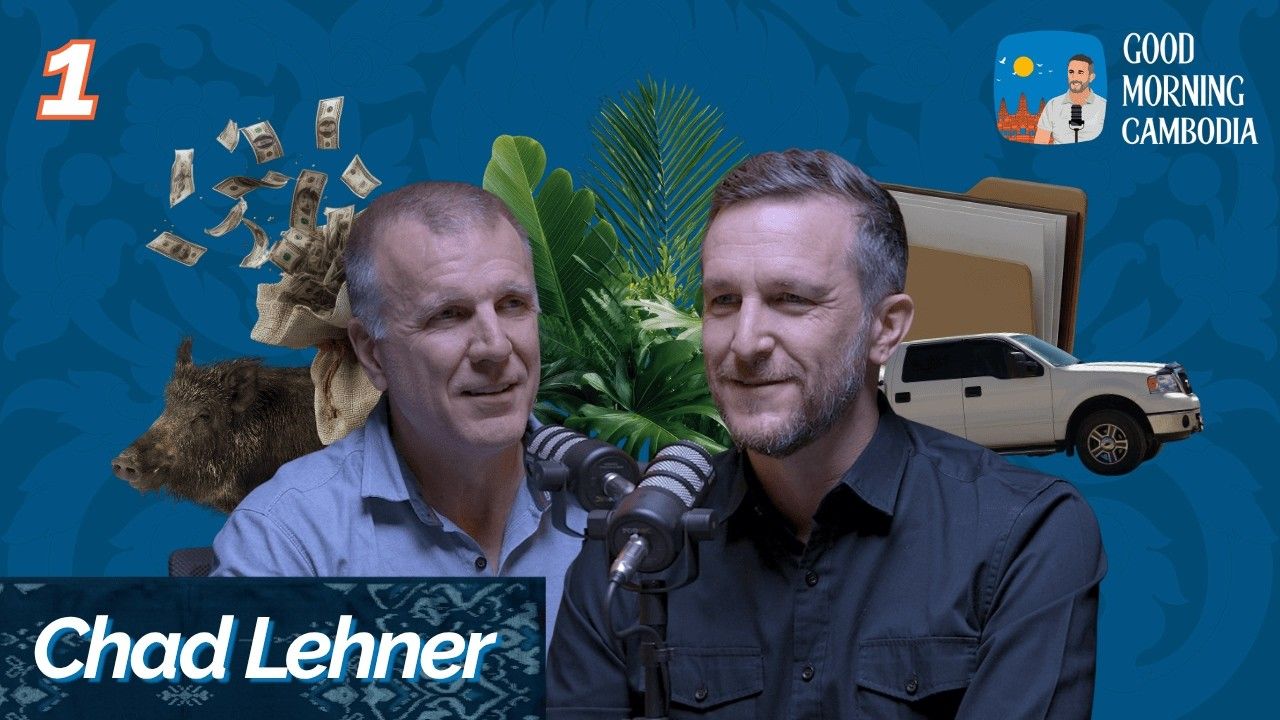
About this episode
Jesse McCaul talks with Chad Lehner, an American former investment banker who first backpacked through Cambodia in 1996 and moved to Cambodia at the end of 2013, choosing it over Myanmar partly because it has one set of investment laws for locals and foreigners. Chad describes years living on his permaculture farms in rural Cambodia, including a staff member's injury and a night stranded with his truck while ill after chemotherapy. He also explains his approach to investing in a frontier market, preferring businesses that do not need an exit or more capital, and why trust with Cambodian colleagues takes time to earn.
Where the stories happened
See them on the story map →Chapters
- 0:00Introduction
- 2:18Backpacking to Cambodia in 1996
- 5:06From investment banking to farming
- 8:54One set of investment laws for everyone
- 13:00Hard early years on the farms
- 16:12What permaculture means
- 23:38A farm accident and its aftermath
- 29:13Illness and a night stranded in the rain
- 37:22Investing in a frontier market
- 54:58Earning trust and other lessons
From the conversation
Cambodia is one set of investment laws whether you're a local or foreigner. And it's very unique.
I can speak enough to go out on a farm and live on a farm with people. Don't speak any English. Yeah. instruct them, train them, eat with them, have fun with them, and sometimes even get angry with them.
I think it takes a long time to gain trust with the people here where they're comfortable enough giving you unguarded, unfiltered opinions and answers on things.
Read the full transcript
0:11 some of them may not be familiar at all with Cambodia. Some of them there might be like you said there's you know there's some wrong perceptions about Cambodia. Some of them haven't visited since you know back in 90 the '9s and we're living in a new Cambodia. What would be your invitation to our friends around the world? the pitch the pitch is the pitch can be long. I'll try to make it more succinct, but you get to live with great people.
0:36 you're living in the tropics. It's relative to neighboring countries. There's no pollution here. There's some dust here, but we don't have coal. You've got a decent quality of life from a affordability standpoint. and then you've got one set of investment laws which makes it very feasible for any type of entity to come here and register and find ways to do business. And I think it's probably easier and less risky to do business now than it was 5 years ago. And I think the trend will continue over the next 5, 10, 15 years at least.
1:14 Good morning, Cambodia. Greetings from the Kingdom of Cambodia. We are alive and well and we're here to bring you some good news of good things happening right here in Cambodia and we're excited to have you with us. Looking forward to some intriguing conversations and believe that it'll be well worth your time as well. Let's talk a little bit about investment in Cambodia. Let's talk a little bit about agriculture in Cambodia as well as even just life and some nice little nuggets about Cambodia. Chad Lehner is with us this morning. And Chad, it's great to have you here. Chad is a veteran of Cambodia for the last 10 plus years here as a as well as a veteran in the region both investment. We're also going to talk a little bit about agriculture and just even life in general. Chad, it's great to have you here and thanks for coming on this morning. No, thanks for having me, Jesse.
2:18 Yeah, Chad, I you know, you and I know each other and of course there's a very interesting story behind the man and so looking forward to hearing some of that story. Chad, you're originally from the from the States, but you've been here based in Cambodia. business investment since 2013. Is that right? Yeah, since 2013. I my first visit here was in 1996. That's a long time ago. Yeah, that was, you know, you can still only the central market area looks and feels the same. Nothing else looks the same.
2:56 Almost nothing else. I was here backpacking before I went to get my MBA and I was through took a trip around the world and we stopped here u back in '96. It was rough back then. you know I mean I've tell everyone that asked and we've both have friends. I mean you're you know you were already here u it was a different place. It lacked the smile.
3:20 Yeah. of course it was so close to, you know, decade plus of some real hardship and you could still see it and feel it everywhere and I didn't I didn't really like it. You could you could see and feel the grip but I could also I could just the grimace u I think they were still in the process of enduring and putting a lot of things behind them. if you know if you came back then and obviously that was just for a visit back then but if you were based here back then whilst there's still so many positive things that we can say about the people and the country but you had to be much more in giving mode than getting mode back then because it was a broken people and there was a lot to give and of course giving is enjoyable and all that but if you're back then 95 59 96 if you're looking for, you know, comforts and all of that as far as living. It wasn't really available back then. Yeah. I mean, that's probably what attracted me to the place. I can remember in 1990 when I was still a student, I went to Vietnam. Y when the US didn't even have a embassy there yet. So, and Cam Cambodia was clearly it had been found by the backpacking community, which I was, you know, clearly a part of, you know, the Lonely Planet book probably in my backpack running around. Yeah. But that was my first trip here. I love the emerging markets. Always have. Yeah. with probably a lifelong interest in Asia's emerging markets. probably at the top of that list. Yeah. But I came here in 2013. my first trip here. I think I even did a trip maybe in 2012 while I was still working, right?
5:06 in Hong Kong at the time for investment banks. And by the way, that's your that's your been your background. I mean, obviously you did the world tours and all that. You moved into investment banking. Yeah. I mean, I was I was really one of those lucky guys that always kind of knew at a really early age. Yep. roughly what I wanted to do. I wanted to do something in investing, something with a secondary market where there would be price fluctuations on a daily basis, you know, something tied to an exchange, whether it was currencies or commodities or bonds or stocks or derivatives. I knew that really early on. and that was the platform that I wanted to exercise my curiosity. Right. So you built that up in the states, states, Asia, states, Asia and then Asia over to Hong Kong and yeah throughout and then they came back and sort of ended in Asia, right? And then came here and my first sort of trip back then it was a look see comparing Myanmar and Cambodia 2012 2013. Yeah. I started coming over there and you know Myanmar was a different place relative to now as well. and that was a cat's meow. There were a lot of people kicking the tires there like me and I wanted to do something agriculture related. I had a list of things I wanted to do. I wanted to do something that didn't require outside capital but had a very entrepreneurial feel to it in agriculture that would ultimately play into the traceability that the consumers want of traceability sort of healthy foods. and I thought it would be something to do with farming and something organic. it ultimately became something that was much more in that permaculture.
6:45 But back then I probably didn't even know what permaculture meant. but 2013 2014 was my first sort of professional entrance into the country where I wasn't a tourist. Right. And so you arrived you kind of moved here end of 2013. End of 2013 there was a already a commitment to come here. Sok Siphana. I' I'd met with him. Yeah.
7:09 A couple of times and figured out I think Matt Randall hadn't quite moved over there yet, but I talked with Matt. I Matt Randall was an incredible spokesperson. I was at a Vietnamese investment conference. Yeah. Before I came here and he had an incredible pitch. and parts of his pitch I have sort of plagiarized and taken to this day as to, you know, why to come to Cambodia.
7:37 Matt did it with elegance, I think. And there was a lot of truth to it. And I've, now that I've lived here for, I don't know, 10, 11 years. There's a lot of truth to that. What Matt and I both probably consider to be, you know, good reasons to come here and live as an expat.
7:55 2013 or those days that you think some of those investment Yeah. conferences in Vietnam were, you know, Vietnam had gone through their was going through their bust period, the boom from early 22 or 2002ish sort of through 2007. and they had a good half a decade plus of over capacity, overinvestment, and they, you know, Vietnam's got a different set, which I'm not fully geared to, but you know, they also had some currency issues and a different government structure. So, it's hard to make complete appletoapple comparison with some of the doldrums that Cambodia can go through and we'll go through. Booms and busts in the emerging markets are inevitable and we're still in the emerging markets. Yep. Yeah, that's right. But I came here to compare Myanmar to Cambodia. And I went to Myanmar first because that's really where I wanted to be. Yeah. Yeah. And I just couldn't get my arms around.
8:54 it just too far out to the right on the risk spectrum. you know, kind of getting back to what the Matt Randall pitch. Cambodia is one set of investment laws whether you're a local or foreigner. And it's very unique. Say that again. Say that again. one set of investment laws. Yep. Essentially, y for all people, you know, Sok and a group of other people. I This is a story that I believe and I think there's probably a lot of truth to it. I'm sure there's a lot of people behind it, but So, and others built helped structure a lot of the investment laws to make it more friendly to outside investment. And the Cambodia government, I think, has done a good job of honoring that. And that's one of the strengths and core competencies of Cambodia, particularly relative to our neighboring countries. Myanmar didn't have that. You needed you needed lots of help and I didn't, you know, I'm just a a little scrapper, I think, is probably the best way to describe me. I had some money, earn money at that, but still I'm a scrapper. And when I came down here, I was kind of a reluctant buyer of Cambodia. It just seemed it seemed like I could do it. Yeah. Where Myanmar, I think I would have had to maybe nestled up to people that I didn't know very well. And that, of course, that didn't that didn't sit so well with me. So one of the key kind of turning points I guess you could say is whether to whether it was Myanmar or Cambodia or wherever was one set of investment laws in Cambodia whether you're a local whether you're a foreigner.
10:37 Yeah. Same rules apply to everybody. Yeah. There's you know there's ownership laws and lots of other things that differentiate the locals from property ownership. For sure. For sure. So it's it's not you know across the board but probably shouldn't be. No, typically no country is sovereign country. Yeah. Yeah. I mean, even Australia and the states, we've we even have our limitations. Sure. But it also seemed just less risky and I do everything out to the right is out to the right on the risk spectrum, right? And every investment you're really trying as hard as you can to have them as much upside but without going too far out to the right. Okay. So that's interesting. And I think that's interesting for our viewers today as well. you know that you know of course your you know background and many years investment banking and you know US, Hong Kong, China and then you're looking at Cambodia and you're seeing that the risk factor here isn't as high as a lot of people would actually think because I think I think Chad I think a lot of people they think investing in Cambodia just the sound of it you know without even digging into you think is it high risk and it probably is high risk. It's certainly higher risk than other places. and it's doable. you can look around. I've can look identify lots of other investments that have been made here that have panned out rather well given the backdrop of being in Cambodia. Y so I yeah I think it's absolutely on a relative basis less risky than Myanmar and that's why I came here and by the way I dodged the bullet right there was lots of political turmoil since then and there was probably a few years before things really started to turn in Myanmar but maybe because I have friends that went to Myanmar that did
12:31 similar things with their own money y that I am doing here in Cambodia and they look smart and I didn't but fortunately worked out for me. Has been working out very well. I know we're going to get into, you know, kind of even some of the I don't know if you want to use the word formula or principles that you have kind of developed personally as well as different people that you work with. We'll get into that in a little bit as far as investing in Cambodia. But what did those first couple years end up looking like you got here?
13:00 Really tough. I almost left with my tail between my legs, you know, finding I wanted to do an upstream farm, right? And you typically want to do I wanted to do a few different properties. Yep. And it just took a long time to get going.
13:18 U longer than I thought. Right. finding land was not easy. finding land that you thought was farmable in a way that you could make money and keep your sanity. So, I mean, ultimately, at one point, I had four different farm plots. I'm I'm now down to two, and I'll probably ratchet it down one more down to one property for my kids. Yep. but I've I lived on the farm, Jesse.
13:46 I think we've probably talked about this in the past. Culture shock. Yeah. Yeah. It's Yeah. I mean, it's like living on the moon. I mean, I lived when I first got here, the first thing I did, I went to this Khmer language school called K I think it's called KSL. I don't think it's there anymore. It's not school of language. Maybe there's a few of them around. Yeah, there was one year near this is near the Russian market. This is a brick and mortar. Yeah. I went there two, three hours a day, had a teacher, they gave me some type of book and I made the mistake of not learning the alphabet. I thought I'll I'll back through that. I speak I speak Chinese and I was like, geez, I don't want to have to go through the challenge of learning another alphabet. I'll I'll pick it up later. And you know, it's an alphabet. It's not a picture graph. It has to be easier. Yeah. Than Chinese, but maybe it is. But I never did learn to read and write. Yeah. But you do speak and I you know, it's debatable. I It depends who I'm with. I think Yeah. I can speak enough to go out on a farm and live on a farm with people. Don't speak any English. Yeah. instruct them, train them, eat with them, have fun with them, and sometimes even get angry with them. Yeah. So you so you got here, you know kind of set the agenda of what things would look like. You jumped into a little bit of language study and then when did you end up moving up to the 20 2015? Yeah. and then started you know sort of plowing and planting end of 2015. That's a big move. That's a big move from you know the city from Hong Kong to Phnom Penh to a farm in Cambodia.
15:28 Yeah. Yeah. I mean I probably wanted I wanted something extreme. and I certainly got it. Yep. I didn't think that I would ultimately kind of be out there for as long as I was. And then I opportunistically there were other farm plots, right, that were that were bought as well.
15:48 Yeah. and that wasn't planned to the extent either, right? But you know, with each establishment of the farm, it I started to sort of mold what worked for me. sort of following the guidelines of being a permaculturalist.
16:07 Yep. Probably helped me. So, you know, it was sort of vetting out the process. Permaculture culturalist.
16:12 Well, Bill Mollison is I think probably the grandfather I was introduced to him by Stuart Brown really indirectly. I don't know if you guys Stu was an a consultant now. He's back in Australia. he's a dear friend and anything ag related.
16:34 Yep. he was always and will always be one of my go-tos. just really smart, knows how to roll up his sleeves and get to work. U and he's also comes back he comes from like a sort of a data standpoint which that's how ag is moving to. So he's doing lots of precision ag work for companies back in Australia. I mean he's always been I think kind of ahead of the curve doing some interesting stuff as the world moved towards incorporating technology even out in the frontier. It's just inevitable. But I don't know what else where we're going with that. Chime in the definition. Bill Mollison would would tell you it's it's sort of regenerative. This is now this is my words into Bill's mouth. It's think of it as being organic is a small part of it. circular economy, regenerative farming is part of it, but it's constructing, designing everything essentially to now I'm quoting other books I've read, you know, sort of capturing all the sunlight and harnessing all the water using all of energy in a way that's optimizing. So, it's a lot more about engineering. Yeah. than it is just about farming agriculturally or coming up with the farm methods to, you know, to create more biomass and throw it back on your soil. But it's effective out here and there are a handful of us out here that are trying really hard to stay true to this. Yep. Some farms are bigger than others, but there they're a group of us and you know, there aren't that many perme out there in the world. So probably proportionately maybe a few less here than maybe back in Oregon or Northern California, but the list will grow.
18:24 Yeah. Well, that's cool. So you 20 what was it? You said 2015 2016 for sure out there on the farm and like you said, you've kind of developed a specific model of what works, what doesn't work.
18:40 It didn't have it at first, right? And that's it. you know, I almost got killed because I couldn't find land that made sense. And then the first couple years I you know, the things I were doing didn't necessarily work. Mhm. So, I took a lot of Yeah.
18:57 Yeah. Yeah. Yeah. And I took some I took some real big hits. Yeah. In there. financially, too.
19:03 Yeah. but I kept to it and caught a couple breaks. Yep. along the way as I think we all deserve now and again and kind of my eye looked up gez I you know the bad times are kind of over at least for a time period.
19:20 What province was this? Kati and Kampong Chhnang and Kong Chenang. Okay. Yeah. And then at one point there was a small lease property outside of Memot.
19:31 Yeah. As well. I don't know if that was Kampong Cham or the new province Mammud is the one now. Yeah. I think there was Jamia. Yeah. Yeah. Yeah. And then Svay Rieng. Uhhuh. and they're all slightly different.
19:45 You all you know you want to cater the farm to the soils partly. and of course I'm pragmatic. I want to be able to sell as much as I can. Yeah. Locally. Yeah. and then you want to you want to have a collection of things that all work on the soil that again you can sell most easily. What type of what type of what type of agriculture were you I mean the sort of the the end game it takes years to kind of establish a farm to this but you're looking for a treebased pasture with systematic movement of livestock through it and the trees also have a commercial element whether it's a coconut and then you've got what are called fodder trees you know trees that you would cut down to feed animals whether the whole limb to ruminate or the leaves kind of ecosystem there. Yeah. Yeah. You want to do that and then you've always got some what are called quick turns things around as well. and you have a very small cottage home delivery thing that I try not to even really advertise. Yeah. But you know that would use mostly the quick turns and the fruit trees. Yeah. that and I try really hard not to try to grow anything that shouldn't be growing in the tropics, which is I see a problem out there sometimes. We're bringing in different items that probably aren't typically grown here for a reason. it's not conducive, right? U permy would shy away from that challenge and want to respect what nature can do and work with it. Yeah. Well, that's that's cool. And I mean kind of a side note question, you're you know, so during these years you're living in the rural areas of Cambodia.
21:33 No. No electricity, diesel generated. If I'm lucky and a good part of the year, I've got running water. Yeah.
21:39 So even the even the toilets Yeah. can be messy. Okay. So, you know, this was not easy. And you talked about, you know, the various, you know, ups and downs and then the breaks came and, you know, it panned out. I've got lots of Yeah. Keep going. Yeah. But I would ask this you know obviously you're you're probably in those regions. you're you know there's not a whole lot of foreigners you know up there and so there are local communities up there and all that. Question is does it change you as a person? Absolutely. I mean I was Jesse that's a good point. I we're all authentic and we all have our authentic path that we take based on the decisions that we make. Yeah. that are probably influenced by past experiences, right? Something along those lines. you know, I I'm looking for platforms to exercise my curiosity for sure. and maybe this was an extreme one and I probably bit off more than I could chew at times. but I've got stories that even talking about them to this day choke me up. Wow. I'll share be one. I would love to hear because this is the story of, you know, Chad Lehner, the investment banker, you know, San Francisco, Hong Kong, and then the rural areas of Cambodia starting up the generator and, you know, building this whole ecosystem. And how does it change you? How does it Yeah, I'll tell you the story and it's a story of inspiration, but it's a bit rugged. Yeah. you become really close with your staff and the staff universally that you're working with from my experience they're they're from the countryside they don't want to move to a city they're have limited education but more importantly probably had limited opportunities to be educated y they run the gamut some I think have a difficult time reading and writing others can do it just fine sure
23:38 some of these people were my dearest friends. Yeah. And one time I was at one of the farm sites and we had a piece of machine that we were trying to fix and these guys just you know these guys can fix anything. That's right. You know with a ball of string and a hammer. Yeah. you know sometimes I think to the chagrin of a mechanic you know a qualified trained mechanic they kind of roll their eyes at this but I look at it with awe because I can't do this. But they were trying to fix something.
24:10 Three staff. Yeah. And there was an commotion and I went over there and one of the staff had lost the end of his finger. Got smashed off. Yeah. And it was on the ground. So I immediately picked it up, got some ice, got like a it was a coffee cup. It's only I could find.
24:28 put it in there with the ice and got a tissue. Yeah. Put that on top. I don't know why. I didn't know what to do. and then got a towel and wrapped everything up in a towel. And I'm like in my pidgin Khmer or whatever, let's let's go to the clinic right now. And the two guys that didn't weren't hurt pushed me away.
24:48 No, no, no. Very calm, stoic. And a fourth guy came out of nowhere. I didn't know he was there. Yeah. another staff. Yeah. And he had this thing that I didn't know that we had at the farm. And it's it's this little it's what you would make I think in a kitchen like in Portland at a reasonably nice restaurant where you'd make the flambe and you'd put that you would you would cook the sugar coat on top. I think you know what I'm talking about when you break into the little plastic thing a little dessert. Yeah. I always thought in the States or even in Hong Kong for sure like you're in a restaurant that could do that. you know, you were you were something nicer than the typical restaurant. Yeah. But they had this little torch thing. Yeah. And I'm like, "What in the world are we doing here? Let's get to the hospital."
25:36 Yeah. If you can call it a hospital, you know, it's a bunch of it's a you know, it's a wooden shack with hopefully some alcohol laying around. But and they the three guys, two guys held him down. Yeah. Put his finger out there and just soldered it, man. Yeah. And of course, you can smell the flesh. And of Yeah, you're Yeah, I'm I'm not comfortable with any of this. Trying to break it up. They pushed me. One of the guys got off the guy, pushed me away, said, "No, you know, we need to do this." And I was haunted by it.
26:16 But later that day, Yeah. the guy that was soldering it, this was a Sunday, and we were we're off work. Yeah. And I had this sort of house thing that I lived in. He was behind it crying. He was the guy that was he was you sitting there crying.
26:34 Yeah. Yeah. And you know, Khmer guys don't cry. No. Especially these are, you know, they're out on the farm. They're on the road. This was their this was my interpretation of crying. His eyes were watering a lot. There were tears coming out, you know, different cry than what I wanted to do inside. Yeah. Yeah. And I got up, you know, tried to hug him, pushed me away. And the next day at work, he and I happened to be at the irrigation pump. Yeah. He I didn't know he was there. The pump, make sure it's going okay. Probably checking the gauges. I'm not a mechanic. Make sure that there's pro in it. And I get a tap on the shoulder. He turns around and hugs me.
27:13 Yeah. Yeah. Yeah. Those are really special moments for sure. Yeah. Yeah. Tough as nails these people.
27:24 Yeah, for sure. And but there's they have a heart as well. Oh yeah. Yeah. Yeah. Yeah. I mean I that's I got funny stories too. I mean one time we were there were some in Campang there were wild boars.
27:40 Yep. And I woke up in the middle of night and I was sleeping in the bed of my truck. I didn't even have a house yet. Yeah.
27:46 And commotion. I didn't know what's going on. And I'm, you know, kind of in like my gym shorts, put on my flipflops, get down, put on my headlamp, which a lot of people have out in the bush. Yeah.
27:58 Typical way to go to the bathroom at night or whatever. And I see lots of my staff screaming. Yeah. I don't know what they're doing in the middle of the night. And I look up and there's this clothes line and there are two kids. Yeah. That had been stuck up there and they're crying. and they're hanging on for dear life and I'm like, "What in the world is going?" And all of a sudden, I look over this way and there's a wild boar.
28:23 Yeah. So, someone had put the kids up there for their own well-being, their safety. It came at me. It charged me. I'm too far. I'm in my flip-flops far from the bed of truck. So, I'm up there with the kids.
28:35 Get me out of here. And what the staff were doing, they were they were hunting and one of the family members, one of the adults, I don't know, male or female. Yeah. and the farm staff love to hunt and fish. Yeah. It's it's and they love to do it in groups typically. Yeah. It's it's a it's a hobby. And then of course they want they want to share what they get or maybe take it to the local wet market and sell it.
29:02 Yeah. Yeah. Type of thing. Yeah. But I you know I can keep going. I mean the one that the one that I thought I was going to say for my girls. Yeah.
29:13 The sort of the story about it's darkest before the sun comes up type of story was I was I had some rounds of chemotherapy in Bangkok. Yeah. And I was I had to get back to the farm. So I didn't have time to really have any R&R in Thailand or in Phnom Penh. Immediately came up by myself up here because I had to get a hold of some money. Yeah. That we had a transaction and I was sick, probably depressed, too. I mean, when you're around when you're around a cancer like that, I I in hindsight, I think it's probably hard not to think about certain things.
29:55 you know, our mortality being at the forefront, right? So, I'm in the down in the dumps, no energy, not feeling well, and I picked up the money. I'm in by myself in the truck. You There's nobody around these places, right? Although, everybody knows where you are. Yeah. Yeah. Yeah. I got a bowling. It's not the middle. And for a description for people, it's not the middle of the jungle, you know, like a rainforest. No, no. These are these are these are dirt roads. These are dirt roads with no electricity. That's right. Typically, I think scattered communities and then there might be a little larger community somewhere down the road. For sure. You're right. This isn't you know monkeys running around and worrying about you know a lost tiger. Nothing quite like that. But you're you've you realize that you're maybe not isolated, but you're not close to much either. It's rural. Yeah. Very rural. It's Southeast Asia rural and only I think rural that maybe parts of Myanmar, Lao, and Cambodia possess. you know, less density, not heavily populated in some of these areas. Yeah. And beautiful on one hand, but I wanted to check the plot of land, which was far from the living quarters, maybe 3, four kilometers. Yep. As the crow flies and it was late. It was It was already getting dark. Not quite dark. You know, the sun sets here quick. We're close to the equator. I want to get I want to get a look see how some crops are growing. So, you're not well. You're not feeling the best about even just life in general, but you got some responsibilities. You got some stuff to do. I literally have a bag of money in the car, in the truck, and I check I check the crops are growing okay, and I realize I lock the I lock the car. Yeah. But I realized I always wear a
31:37 carabiner, right? And my keys were on that, right? and I was like, "Yeah, no problem." And I, oh my god, the belt loop had ripped. so I know the keys are somewhere because I got out of the car and I drove the car, right? But the key is falling off and it's getting dark. It's getting dark and it I'm in the midst of one of these rare 12-hour thunderstorms. And I can't leave the truck. Afraid to leave the truck cuz I have money in it. And everyone knows where I just picked up the money. So the whole neighborhood community knows. Yeah. Yeah.
32:11 it's pouring down rain and it's getting dark, too. Oh, of course, if it's raining, the sky's is already dark. It got really dark. I was there all night. Yeah. At one point I was the truck because again, you know, Shivers, probably sick anyway. My gosh. I get out of there thinking maybe it's going to be a movie, Chad. Oh, it isn't. I mean, the I'll fast forward through it. I mean, at one point I got out because I thought maybe there's lightning everywhere. Maybe the truck is a conduit for lightning.
32:36 Yeah. Yeah. Made through the night. Yeah. And again, not couldn't have felt much worse.
32:42 Yeah. And I got to find my key to get back. Found the key. As I've done since I've moved out here, I have these perpetual conversations with my with my kids. Yeah.
32:53 And I was like, this is going to be that story about I'll give them their pep talk, you know, about when you feel like things are working against you. This will be my antidote that I'll share with them. I was there. I've been there, too. And you can get through it. I got through it. This was going to be that story.
33:12 Yeah. So, I was telling the story to them in my head. I'm like, I got and I write and I thought, I'm going to put this to pen and pad, go back and shower. I'm still not in a good mood. I'm like, you know what? I think that was the bottom. Yeah, that was the bottom. Can't get any lower than that. So, it's all uphill from here. Because I was out there all night and out there looking for the keys in the morning, which took me hours, by the way, to look in the mud completely. I maybe 2,000 mosquito bites.
33:39 Oh my god. Dengue fever. You're you're my head off to you, man. You are a real The It even gets I'll finish up with this. The staffs immediately said dengue fever, you know, after a couple days. No, you don't understand. Didn't tell them. They wouldn't even understand. I didn't tell them. I was sick for other reasons. Like, no, you just Yeah. Why do you have all these mosquito bites all over your body? What's wrong with you? Yeah. Yeah. Yeah. So, at some point I like I they convinced me, "You're right. I'm really sick. I'll get back to Phnom Penh." Hopped in my faithful truck. Yeah.
34:12 And, I couldn't make it back. I pulled over, wrote a letter to my kids. Oh my god. Oh my god. And split the seat back. I'm like, "This is it. I can't go on." and I think I was kind of, you had the bag of money with me, too. I'm like, what's going to I think my last thoughts were, how is this going to be explained? Yeah. I just sort of just gave out on a guy found in his truck on a rural road with a bag of money. I wake up story there. I wake up and it's I don't know if I've been there all night or not. I really don't. It was quite delirious. And this Khmer guy quietly opening up the door to the truck. I'm still in the truck. Yeah. And of course, I don't know him. I think he's trying to Is this guy dead or not?
34:57 What do we Yeah. They're concerned. They see someone, you know, on the side of the road. Yeah. Yeah. Yeah. So, I come to and the first thing I realize I am maybe six in maybe a foot parked in front of the entrance to his house when I got off the road.
35:18 So, you're blocking the entrance to his house. So unblocking. I look I look through the door and I see the family through my passenger window. You know, the whole family there. I'm like, what do we Yeah. How do you again, how do you explain this? I'm sorry. You know, I wasn't fear. They gave me some water. Yeah. A little bit of food and I made the rest of the track home. Wow.
35:35 So, and I had for the longest period of time, I kept the note cuz I was like, I this I'll give to the kids, too. Yeah. And I had a collection of things that when I looked back on it not that long ago, maybe 2018, 2019, 2020, well before COVID Yeah. Yeah. like it's too dark.
35:54 Yeah. It's too dark to even get the kids. Dark. Yeah. So I burned it and put it behind me and try to put a smile on it. Yeah. Yeah. This is incredible. Incredible. My hats off to you, though, for all of this, Chad. And I know you have, you know, many, many more stories. And it changes you, doesn't it? you know, it changes who we are as human beings. These interactions, these experiences, and so many so much, you know, related to the interactions with, you know, the local people here as well. Yeah. I mean, it's it's hard not to be inspired by them. It really is. you know, most of my interactions are with people from the countryside, but and it's different. the people that I work with now that are consultants, they're super well educated, right? They're they've got incredibly lots of ingenuity. They're curious, they're hardworking, they're just smart, smart people by anyone's definition. they have this they have these some of these same traits, too. I mean, this is one of those countries in Asia where a guy can also be friends with other men.
37:04 Mhm. I find that unique to this part of the world to be honest. Yeah. and I see this all the time. but inspiration for sure. by the way, the family that saw me I parked next to the car when I would then go back to the farm. I became friends with them.
37:22 Really? Yeah. Yeah. Bring them bring them some stuff, drop off some stuff to them. You know, I was a crazy foreigner that decide to fall take a nap and block their door. Chad, let's let's fast forward to kind of now in the last several years now. you know, you still have the farms. You're you're you're no longer roughing it really up there anymore. You're based here in Phnom Penh and much more of your life in addition to what you have with the farms is around investment in Cambodia. Yeah. Yeah. Well, I mean investing everywhere. I mean, that's again, like I mentioned, I'm one of those few people that what they liked, what they thought they were going to like doing, they actually really love doing.
38:08 So, and the whole investment banking thing for me and I was in what's called equities and for the most part institutional different types of positions, you know, sort of before my MBA and after. Yep. But it was it was never because of the money or the recognition of having a cool job or something. It was always I loved it because you could exercise your curiosity. It was almost regardless of the type of job you had, you were out of position to learn a lot. Yeah. And try to understand things. And if you didn't have that interest set, you weren't going to be a good investor. Because to be a good investor, you have to see things for what they really are. Yeah. If I had to boil everything down to one sentence, that is it. And that means blocking out unneeded, unnecessary influences, unneeded, unnecessary emotion. Yep. looking at wrong information.
39:07 there's, you know, that I think seeing things for what they really are. Probably we could argue that's at the base of every good decision. Yeah. But, you know, maybe love and things like that I think maybe are a bit different, but that's another conversation. Y but yeah, I've I like I like to invest. I mean, that was the whole farm thing was I viewed it again.
39:31 It was an investment. You know, by the way, when I first came here, I was looking to invest in other companies, maybe other farms, maybe some processing, y other things. in and you know 2013 2014 it just felt too soon to me given you know kind of what I thought my expectations were and looking at other soon to be emerging markets it's my it was my first entree living in the frontier y which Cambodia was clearly considered then by I think by the investment world anyway y a frontier asset class the stock market just opened up and you the banks were moving towards lending more. But back then there was very little lending outside of some collateral based lending. Yeah. it's developed a lot since then.
40:22 Developed a lot. Yeah. Yeah. Yeah. But I couldn't I couldn't find investments that met that met my sort of list or criteria. So that's for sure when I realized all right, I got to start my own. Yeah. So the farms were always in my eyes an entrepreneurial startup slashinvestment. And you we talked here just a few minutes ago. I farms are a good investment, but they're a best investment when the investor is the farm manager, is the administrator, he's or she is all those rolled in one. I don't think it typically leads to outside investment, right?
41:14 I'm sure there are examples even here in Cambodia. Yep. But the ones that I see and from my experience it they typically was work best when the investor is the operator. and it goes to a point that PJ Swan, one of the best value investors I've ever been around, and I think people that know him would agree he's not a recognized name because he doesn't really take on outside money. He's a family office and runs his own money. He taught me all the way back in the 90s. Yeah. the importance of, you know, there's some really good investment opportunities out there that shouldn't be looking for an exit, which is what outside invest investors typically need, particularly if it's through an institutional fund by their mandate. They need exits. Yep. And finding exits in the frontier in a earlier stage emerging markets, I think, has proven to be quite tricky. Yeah. and that's not just a problem in Cambodia. That's typically a problem, I think, in Africa when I talk to people in Africa and even some of the neighboring countries. So, what do you say to others now? you know, we're we're, you know, 2024, 2025, you know, we're we're in a kind of a different environment now here in Cambodia, where, different than when you first arrived, 2013. And for those that are looking to Cambodia for investments, I know you're doing, you know, numerous of your of your own as well. what's your perspective? what's your kind of even, you know, recommended formula? and I know you do this a lot in your dayto-day as well. You're you're working with lots of different Yeah, there's a lot of ways to try to skin the cat. y I would start with that. There is no one formula. you could say that with any investor in any investment asset class, right?
43:23 There are different strategies that work for different people. Y and I think that's the same if you were to look at coming into a frontier market like Cambodia. there's you can go to people they're already situated. You go to people like you and I. Yep. And we could give assistance.
43:42 you could there's a few funds here. Yeah. you the funds haven't typically had the success I think that they wanted partly because of the exits. I think partly because of the scale that they needed. you know they had to put down a lot of money into things and all of a sudden then you're you're willing down the pool of investment things more money that's needed right I found this out when I came here you know I had I had from my network had sort of earmarked money for me when I was looking at stuff and I'm like no I just can't see it and Leopard Capital had been up and running there for a couple years as well u I don't know Leopard, but I know some of the guys that invested in Leopard. So, I was able to talk to the investors in that a little bit. Y and they were able to share some insights about, you know, the trials and tribulations of larger size investments. And I what's worked for me, this is really kind of all I can talk about. So, that's that's what I want to hear. Yeah. I think that smaller sized investments I know typically y typically what everyone wants of course everyone wants positive returns relative to the risk looking for positive alpha I get that I'm right there with those people we're all thinking the same thing y u but in a small market like this I finding scaled entities or entities that can continue to scale in a small little market like Cambodia. It's It's not that easy to find. And they are out there. Yep. But you've you've got to really it there there's not an overabundance and they're not kind of laid out there in a platform for you to as if you're going to go look look at to buy a pair of knockoff Adidas at the local wet market. I'm just going to take a stroll and I'll pick out the
45:43 color I like. Yeah. And try them on and if I don't like them, I'll, you know, I'll go back to my flip-flops. You can't you can't do that in the frontier here. So, you know, the visibility to access this stuff is challenging, but what's worked for me is stuff that when you buy them, you're not necessarily needing an exit for it to be a good investment. M again I'm I'm the exits here worry me when I look at the sort of ecosystem of investing here from like an angel investor to an IPO and this is kind of the background or the this is the world I lived in for a long time there meaningful gaps in this that's part of the opportunity y for investors for sure y and it makes it more difficult to find y but they're out there and but finding things that don't necessarily need an exit that don't necessarily need more investment. and interesting. Yeah. I mean the worst thing you want to do is put something I think and you know this goes right into the face of sort of the venturebacked model of angel series AB and C or whatever, right? I don't know that those work that very well here. There are there's Nham24 and you can get the guys from Mekong Strategic Capital in here and they'll they'll point to lots of winners, but there aren't that many, right? I think there's sort of oneoff things where there's a strong dividend or cash flow to it where there's a niche for sure. Yep. there's defendable, there's a obviously there's you want a good management teams and that sort of thing, but right they're out there.
47:40 Yeah. but what your preference has kind of been whittleled down to is businesses that don't necessarily need an exit and don't necessarily need additional investment after. Yeah. the exits can come from other ways than finding, you know, an outside investor to come in or some type of takeout. Right. So, that's a that's a bit of a shift in mindset for some people.
48:06 Completely different than how I was raised in the investment world. Yeah. Yeah. And like you said, I know that you're you're qualifying everything that's not the only type of investment that's available here.
48:17 Everything's available here. but you know in your many years here kind of the preferred approach that you've created for yourself and you have lots of different things come across your desk and you work with lots of different people as well is this preferred model. Yeah, I think so. I think what never lines up in the frontier in the emerging markets is the operator and the people that live this is the same in China for sure. I saw this all the time. Yeah.
48:54 The what the locals, we'll say the Cambodians for example, what the local entrepreneur or operator owner of the business, their measurement of risk versus the outside world's view of risk. They're typically really not on the same page. Talk about that a little bit and elaborate on that a little bit. it's you know you'll talk to a what they call a private equity fund that does frontier investing. What they mean by private equity it's not your traditional private equity where they're going borrowing money and leveraging and coming in taking a board seat. They're really just investing in private companies more or less. I think when you talk to those set of institutional investors y their understanding of what the risk would be in company A in Cambodia and the operator's opinion of what their own risk is very local operator and this was happening in China too and it took well over a decade for that to line up the locals in a place like China or Cambodia when it was when China was just really starting to be an investment place. Yeah. Like they sort of shrug off certain amounts and certain types of risk, right? Where the institutional investor is even that's traffic's in the frontier markets views it very differently and there be a big gap between a discount rate that you'd use for example to come up with your free cash flows because of that. So there would be because of this different measurement of risk the Khmer owner has a completely higher valuation or opinion of the valuation of his company than the than the foreign investor would have. Y risk helps determine valuation in a big way. Yeah. it's a very simple way to look at things. Yeah. Less risk everything else being equal.
50:54 It's the underlying asset will have more value than everything else being equal. But there's more risk. Yeah. then it's gonna have a lot less value. Yeah. So lower valuation. But Yeah. Yeah. So, so, so Chad, if I'm, you know, if I'm someone that is not that familiar with Cambodia, living somewhere around the world and I'm interested in stepping into the Cambodian market. What would your, you know, recommendations, words of advice be?
51:27 Yeah. Well, first of all, I mean, if you if you look at the GDP per capita, I don't follow this like I did when I worked in an investment bank. I really don't I don't even know if we have good data for that available, Jesse, here. We probably could probably get one of my colleagues Yeah. Yeah. my colleagues to track this down, but you it's I'm guessing it's around 3,000 dollars. Yeah. Typically around 1,500 to $4,000 the GDP per capita. looking at other markets in the past when they have that when they have that sort of amount of GDP per capita it's usually it's there's a good domestic economy that will continue to work so in other words I'm putting these numbers in my mouth but it's roughly you know around 1 1500 once an economy hits that and I think Cambodia hit that this past year we're a little bit beyond that yeah it's usually it there's a lot of reasons that typically make that GDP per capita go up to closer to 4,000 over 10 or 15 years.
52:34 And I thought that when I came here, it's not why I came here, but there was a secondary reason. U in other words, I think on a relative basis, yep, you could pick the ASEAN community I think is going to be an outperformer when I compare it to other places. I know there's going to be countries, you know, we're probably eight different countries maybe in Africa and other places that will that will probably prove me wrong. But I think from a region of the world perspective over the next 10 or 15 years, partly driven by this domestic economy play that I'm talking about. It wouldn't just be Cambodia, but I think at different stages of development, you've got Vietnam and Indonesia and the Philippines, all probably ahead of Cambodia.
53:22 Yeah. but all have reasons to think that this is a good place to invest and that typically you know it would be anything to do longer term if I'm right anything that could touch a domestic the domestic consumer that they want you know y you know anything from processing y probably you know it's a it's a taboo word right now but longer term or somewhere in here real estate I think Kevin and I were talking about that not that long ago, right? The boom bust cycles out here. This is probably the first really meaty one we've had out here. Yeah. In real estate. But and these are famous last words, but I do think what Mark Twain said, it wasn't about investment, but I think history doesn't repeat itself, but it rhymes.
54:14 you typically it's after the bust. Y there's a period of time in Vietnam, it was over half a decade. Yeah. you know, there's there'll be opportunities. Maybe we're probably in the beginnings of buying stuff at a, you know, troughish valuation.
54:33 Yeah. For certain things. Y, not all boats are going to rise, but I you could I think you could point to sort of anything that's going to feed the domestic consumer. Interesting. Interesting. And then on top of that, you've I mean for the first time for lots of political reasons too, you're seeing a different type of manufacturing company come here.
54:58 Whether they're worried about potential trade wars, whether you're seeing a trickle over effect from Vietnam. Yeah. I think you're you I'm seeing signs of that more now than ever before. Yeah. And I think you've got probably a government that wants that and is probably going to in their own ways try to provide a platform for this type of investment. Yeah, that's right. That's right, Chad. And as we maybe wrap up here, I would love to hear what you know, what you've discovered that may be a bit unknown to you know, those watching even today. what are some little gems unknown truths or unknown facts about Cambodia that you know a lot of people may not be aware of that you've been able to discover on this amazing journey over these last many years? I think it takes a long time to gain trust with the people here where they're comfortable enough giving you unguarded, unfiltered opinions and answers on things. And too many times when I first got here, I would take the initial yes response, right, as which is a respectful yes, but it's not necessarily the full picture a scenario that you're looking for. Yeah. And too many times and I still I think I probably still fall into this trap sometimes. That would be one thing that it takes time and you have to earn that trust before you're going to get real feedback, real insights, real Yeah. Yeah. Yeah. Yeah. That's important.
56:45 I think that would that would that's just a cultural relational which also works into you know how we actually function and productivity and all that as well. But that's that's very important. If there's not that trust and even somewhat of a heart connection in some scenarios, you may find it challenging to get accurate feedback that you're asking for amongst your employees or your team members or even your partners. Sometimes that would be one. Another thing you kind of mentioned cuz I get this all the time. It's it's a dangerous place. Yeah. Yeah. Yeah. We hear that. We hear that. Yeah. Yeah. I probably all the viewers are saying this. It's not a dangerous place.
57:36 I think I can also say the same thing. You know, I think the government people that I talk to they're doing lots of great things as well in across the ministries. Yeah. I work for this consulting firm, Sebia, and I'm just really impressed with the people I interact with. Yeah.
57:57 which would also at times go in the face of things that you hear. you know, they're they're qualified. I think they're putting together really good plans. Yeah.
58:08 U, and you know, it's the government, so you're it takes a lot of work and a lot of time. Y, that would be another one. Yep. the I'd have to think about the rest because there's probably a long list of them that we could all come up. Yeah, those are the two come to mind. Yeah. Yeah. Chad, in closing, what would be your invitation to our friends around the world? some of them may not be familiar at all with Cambodia. Some of them there might be like you said, there's, you know, there's some wrong perceptions about Cambodia. Some of them haven't visited since, you know, back in 90 the '9s and we're living in a new Cambodia. What would be your invitation to our friends around the world? The pitch the pitch is the pitch can be long. I'll try to make it more succinct, but you get to live with great people. you're living in the tropics. It's relative to neighboring countries. There's no pollution here. There's some dust here, but we don't have coal. M you've got a decent quality of life from a affordability standpoint. and then you've got one set of investment laws which makes it very feasible for any type of entity to come here and register and find ways to do business. And I think it's probably easier and less risky to do business now than it was 5 years ago. And I think the trend will continue over the next 5, 10, 15 years at least, too. And OA, by the way, we're we're in we're in the right part of the world. Yeah. Yeah. Yeah. Yeah. We are. We are.
59:43 We are. Chad, it's been great. I love it. I love it. We could go on. and you know, the stories, the insights, we could go on and on and you know, for those of you that have been joining us today, thank you for coming into our world here. And these are just little tiny tidbits of what our world is here in Cambodia. And come and explore more with all of us here. We appreciate you being our guest on the Good Morning Cambodia show. And we're looking forward to being with you here soon again.
1:00:23 We'll see you soon.