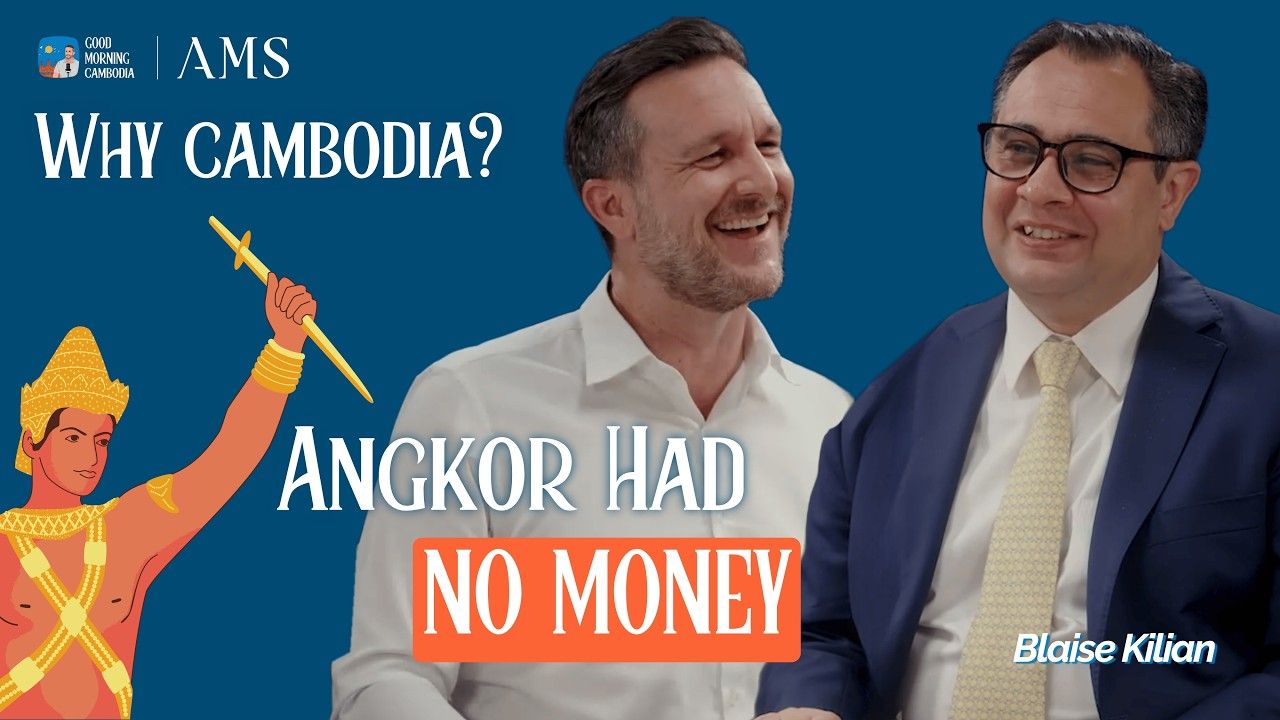
Blaise Kilian of the SOSORO Museum on money, Angkor and Cambodia's story
With Blaise Kilian, SOSORO Museum
About this episode
Blaise Kilian, co-director of the SOSORO Museum, talks about Cambodia's history, from the economy of Angkor to today, and about what he calls the Perception Gap: the outdated picture of Cambodia the rest of the world still holds.
Where the stories happened
See them on the story map →Chapters
- 0:00Introduction
- 4:25Coming to Cambodia to stay in 1999
- 7:46A Cambodian classmate near Paris
- 11:17The perception gap
- 14:58Central bank governors visit Cambodia
- 20:51Learning Khmer, from school to the embassy
- 25:54Telling Cambodia's history through money
- 31:32Ten years to build the museum
- 33:34Funan coins and an Angkor without money
- 37:10From the protectorate to Bakong payments
From the conversation
But if back then anyone had told me how Cambodia would look today, even with all my optimism and my faith and my fascination, I would never have believed it.
so after two years the ambassador was kind enough to make a small farewell for me and I told him I think that now finally I have reached the level you thought I had when you first hired me
I was saying earlier that 50% of the population is below 25 years old which mean that one out of two out of two Cambodians that I meet every day was not even born when I first arrived.
Read the full transcript
0:00 Usually the bad news reach out much faster than the good news. People's mind around the world. I think there is one image of the country that sticks there. Post-conflict country. What needs to be further spread is how much Cambodia has been moving forward. Is how much Cambodia is forwardlooking itself is how young this population is and how much more there is in terms of history, in terms of economy, in terms of demography, in terms of heritage. I always believe that if people come here then they see then they are fascinated then they see how fantastic it is and then they never regret coming.
0:41 Good morning Cambodia wherever you are around the world. Today is a good day and today we have something very special for you. a French young man many years ago. We're still young. but a young man many years ago, 1999, found his way to Cambodia and for the last almost 30 years now has been an integral part of advocating for Cambodia as well as leadership in Cambodia. Blaise Kilian, the director of the currently one of your roles now, and you've had many roles and continue to have many roles, but the director of the SOSORO Museum, money museum as some people call it here in Cambodia. Blaise, it's great to have you with us. And I reckon that wherever you're viewing from around the world, that you're going to be intrigued. You're going to have some very key insights as to what all of this is all about, Cambodia is all about. And yeah, come and visit us in Cambodia, right? Come and visit, come explore, come discover Cambodia as well. Blaise, it's it's great to have you here. Thank you so much, Jesse. Thank you for having me and happy to talk about Cambodia because that's what we are doing, right? Well, let's let's do it. Let's talk a bit about Cambodia and we are we're brothers. We share the same heart as people that were you know started our life journey outside of this country and then this has become a very important part of our life journey. Yeah. And definitely maybe before we talk about Cambodia, maybe briefly you could talk to Cambodia and to our Cambodian brothers and sisters both here and Cambodia and around the world. I mean tell them how much you love them, how much you appreciate them. maybe in the Khmer language is okay. Yeah. Yeah.
3:12 Mhm. I love it. I love it. So, so even though French blood, French born, but our hearts have been transformed to be very much part of this Cambodian culture and society and in a good way. In a good way because I think we enjoy being here because I think as much as we want to contribute, Cambodia has also contributed tremendously to our own personal development. That's right. And I think that the thing that we have been able to do and achieve here, we probably would not have had the same opportunities in our respective countries of origin. Not the same opportunities, not the same excitement, not the same possibility to be part of something that is growing and with which we are growing ourselves. So I think that makes it extremely rewarding and to me extremely grateful to have had those past 27 years in Cambodia and counting.
4:25 Yeah. Yeah. So 27 years ago, did you anticipate that you would be the director of a wellestablished and growing on the international scene museum in Cambodia? Was that part of your plans? Co-director actually, but co-director. Yes. Yeah. I mean I came to stay. That was a that was a goal for me already at a very young age. So I didn't come to just visit. I really came with the idea of staying and being part of something. I was hoping that I would be able to contribute to participate which I think is the right word because especially back then people were saying they would come to help but it's not about helping because Cambodia has been through so much that the word help I think is a bit too dismissive. So I came to be part of something to contribute what I could to participate to learn as well to learn because there was a lot to learn and before learning I think I had to unlearn a lot and then relearn you know the basics the basics of being here. So unlearn and then learn and then contribute.
5:34 Exactly. So what I thought I would become I had no idea but I knew that I wanted to be part of whatever Cambodia would become. Right. I think that was the ideal that was in my mind when I first landed here in 1999. Yeah. Yeah. I've not heard you say that before. but for me that really resonates because when I came here 1995 around that same time in my very simple young man thinking without you know the worldwide web being widely available and much information about Cambodia and all that but just that Cambodia was a country that was being rebuilt And I don't I'm not a superstar. I don't know what I have to offer. I'm not, you know, pretty simple guy, normal guy, but maybe I can be involved somehow and it will probably be transformative for me as well. Yeah. Yeah. Exactly. I believe is that same type of thinking. I think that's that's the idea. And and indeed it's been extremely rewarding. I think transformative it's been a learning journey and I think we are still learning every day. but to be part of it is it's extremely fulfilling. Yeah. Yeah. How did you back in, you know, 1999 or before 1999, how did how did Cambodia end up on your radar back then, you know? Well, it wasn't through TikTok, it wasn't through Facebook, it wasn't YouTube because they weren't around, you know. in France there is a large community of Cambodian people, most of them refugees who came to France during the war. some of them to France, to Australia, to the USA as you know. So and I was my father was a civil servant and so every two three years we had to change town basically following his career path. Yeah. And so as a kid I didn't have many friends because it was too short you know you spend two three years in the school and then you go to another city you have to make new friends
7:46 right but at some point my father was appointed in a city called which is within which is around Paris. Okay. and in there was a lot of Cambodian people living there and for some reason he stayed longer than the usual. He stayed six years. So it was for me an opportunity to make friends more lasting friendship which became friends for life and family actually. And so at a very young age at 10 years old I was in contact with Cambodia through Cambodian friend in my classmate right who started to tell me about Cambodia who started to tell me about King Sihanouk who started to tell me about the 1970 coup about the war. And so I had a very romanesque view of Cambodia through the storytelling of this friend who was a fantastic storyteller. Yeah. and I remember myself going back home one day when I was 10 years old or 11 years old in the first year of secondary school opening the dictionary for two words Cambodia and so so this is how it started and then it became fascination and because these friends you know became very close friend and their whole family and so really became family. So I was always somehow you know interesting interested in Cambodia, always learning about it, always reading on my own. Yeah. and then later on after the high school diploma, I went to do what they call useful studies which were very useful indeed. But once I completed my degrees and so on, then I took another degree in Khmer language and civilization back there in back there in Paris. Yeah. In Paris. Yeah. and then and then yes I had the opportunity finally to come. So it's been a long story actually. It's it's a it's a lifelong story that started way before 1999. Yeah. I think in ' 86 or something like that
9:45 when I first arrived in this city. and it was really defining for me in every man of the world. Yeah. Yeah. Wow. Wow. Incredible. Incredible.
9:57 I have, you know, the utmost respect for you and, you know, the journey that you've been on. Many more years to come. Of course. you know, I thought I knew Cambodia pretty well.
10:11 I probably know pretty well. you know, I believe so. But you know every time I'm around you or you know the different times where I've been able to visit the ever expanding SOSORO museum I see your fascination is what I can say. You know it started way back then with you know your classmate and the dictionary and these things. but I see your fascination.
10:40 It's always been a history from the heart, you know, and then it grew into moving there, professional development and so on. But it always had a very yeah connection to the heart which makes it like this is how you dedicate your life to something, right? so if fascination is contagious, Mhm. Yeah. spread some of that fascination to our viewers around the world. Maybe they'll catch it as well because I think fascination can be contagious.
11:10 Yes, for sure. And you have it. You have it. So spread some of that with some of our viewers around the world.
11:17 I think the maybe one very important thing about Cambodia is what we call the perception gap. Cambodia has been famous around the world but for things that are important but to which you cannot summarize the country. so Angkor of course is known everywhere. The Khmer Rouge sadly you know of course worldly infamous.
11:40 the war has stuck to the mind of many people. but there is so much more about Cambodia and also I think something that is very important is that as you know usually the bad news reach out much faster than the good news. That's the way the world works. Unfortunately, unfortunately and so in people's mind around the world, I think there is one image of the country that sticks there which is a post-conflict country where you have those wonderful marvelous temples and where the Khmer Rouge used to be here maybe they are still around who knows you know and that's it and I think that what needs to be further spread is how much Cambodia has been moving forward is how much Cambodia is forwardlooking itself is how young this population is and how much more there is in terms of history, in terms of economy, in terms of demography, in terms of heritage, in terms of so many other things which is fascinating about Cambodia. They're not just what people stick to which are cliche and true in a way, but you cannot summarize this country to this. And so I always believe that if people come here, then they see. Yeah. so the it's a little bit like SOSORO you know who goes to a museum of economy and money you know you need to make a choice but once people are in there then they are fascinated then they see how fantastic it is and then they never regret coming but you need to bring them in first. and for Cambodia we have I think this main challenge is to convince people to have a look with their own eyes to come and see on their own so that they actually understand what Cambodia is where it's coming from and where it wants to go that's what matters and once you are here and once you see how much it has it
13:28 has evolved and how much it's willing to move forward then it is it's extraordinary because when I first came in 1999 it was a choice of the heart I was happy to be here. But if back then anyone had told me how Cambodia would look today, even with all my optimism and my faith and my fascination, I would never have believed it. So we should never forget, you know, how far this country has been going regardless everything else. Yeah, that's absolutely right. I mean back in the '9s for instance if someone would have said you know this is what Cambodia will look like in 2026 2025 or you know later on even it would be it would be almost impossible to envision. True. True. And you know we I'm sure before showing up here we enjoyed our nice coffees and we drove on properly paved streets and proper vehicles and we're sitting in a very nice you know aironditioned studio with modern equipment and after this we're going to go have lunch and you know proper restaurants and we are surrounding with young people who speak good English who you know who know their job. They're more talented than me and you in a lot of ways. Very talented and who are forwardlooking and who bet on the future of this country. It's also something very important. Yeah. yeah, I think it's it's it's really about bridging this perception gap.
14:58 It's it's extremely it's extremely important and I was recently as you may know the National Bank of Cambodia who owns the museum hosted an important meeting which was the meeting of the French speaking central bank governors. I saw we had people from all around the world, Africa, Europe, America, Asia, who traveled to Cambodia for this meeting, including famous people like Christine Lagarde, but also other governors from central and western African countries and even from Canada and so on and so forth hosted here in hosted here in Thorre and then they went to course and they were fascinated and they were so happy with what they saw. And they were so grateful and often the question came out like how did you go so far so quickly? Yeah. So quickly means that they still had this image of a post-conflict country stuck in their mind and when they discovered what Cambod Cambodia is actually nowadays they were positively impressed and they really loved it and they really enjoyed it and we have received extraordinary feedback because they saw something that is way beyond what they imagined. and whether they would come from very developed countries or emerging countries or postclling countries, they saw in Cambodia something that was extremely inspiring for us. And I think that is something that is very, you know, important. And for me, I believe that when they go back to their respective countries and their respective continents, they can somehow become spokesperson for Cambodia because when they will hear next time about Cambodia, they will say, "No, I've been there.
16:36 This is not like that. This is how it is. This is how dynamic it is, how young it is, how well organized it is, how forwardlooking it is. Yeah. They, you know, so many people they ask is there anything worthwhile visiting or doing in Cambodia? and sorry to say, but this is a very ignorant question, you know, it's a very ignorant question. And then is it safe and, you know, clean? And again, sorry. you just have to visit to realize that you like you mentioned, you know, these governors, I'm sure they stayed in very nice hotel properties here in Phnom Penh. They were well taken care of. There's no shortage of whether it's hotels, resorts, restaurants, play food, you know, you name it. And then they travel by car to Kong and then further by car to Siem Reap. So they were on flat asphalted roads. They could see the landscape visit some of these ancient heritage sites. Exactly.
17:42 But also processing factories but also just seeing you know the houses of the people along the road. So of course city and province are different but everything that they saw was way beyond anything that they had imagined before coming. So every I reckon for them and this is just one example of course this is this is true I believe for almost any visitor that comes over for any good reason that any question about is there anything worthwhile in Cambodia that question was completely gone after their trip. Is Cambodia safe? Is Cambodia clean? all of that was gone and they realized, wow, I really had some outdated views of Cambodia and I think many of them are looking forward to coming back because they really liked it and that I think takes us to what's more and more people say now is the main asset of the country. So we have I mean we have wonderful landscape we have four heritage sites right world heritage sites we have four now we have intangible heritage but more and more people agree that the main asset is the people their warmth you know their smile their welcoming you know behavior towards everyone how friendly they are and so this is something that comes out of many visitors is that one of the most important asset of Cambodia despite such a huge heritage, such a one such a wonderful geographic landscape is also the people.
19:12 Go where you are welcomed. Exactly. Right. This is a good rule in life.
19:18 Right. You know, you can go anywhere you want. It's up to you. But you can go to a lot of places and I'm not talking just tourism. I'm just talking even as an individual, you know, course.
19:29 but why would I why would I go where I'm not really that welcomed, you know? And it starts with that because of course if you come as a tourist people want to make business so or they sell you stuff but as an individual you know being welcome by genuinely friendly people. It matters. Yeah that's right. And that is that is the Cambodian people. Exactly. Very accurate description of the Cambodian people. Very welcoming, very warm. Yeah. And welcome you into their society, welcome you into their homes. Yes. Yes. And if it ends up being career or employment or business or entrepreneurship or just multiple visits, it's always welcomed here. Yes, it's one of those countries where even the diplomats they tell you that this is where one of the countries where they are the most able to establish personal connection, people-to-people relationship with the local population whether they are you know members of government or just you know people nearby or friends and so on. In some countries you know the expats live with the expats and you have very little you know mingling with the with the local population. In Cambodia it's not like that. When you come to Cambodia, you are with the Cambodian people. You are welcomed by the Cambodian people and you can you can have relationship with whoever you want from very much the grassroots all the way to the top level. Everybody values this access to people that matters.
20:51 Yeah. Yeah. That's right. And makes a difference. Yeah, that's right. Blaise, you speak the language, speak understand the Khmer language very well. I try. yeah. Yeah. Has that been has that been since when you were back in school there or was it after arriving here? It's been I think it's a journey and it's probably not finished. as a kid with my friends, I was bothering them and asking them or their parents, you know, what is this? What does it mean? What did you say? So I was probably a bit annoying. So I had this willingness to learn already. then I reached probably a certain level which was capped because it was based on what I could hear and reproduce sounds. Then when I finished my studies I went for another degree in Khmer language and civilization willingly.
21:39 so I learned how to read and write and that helped me to pass another level because when you can read you can make the difference between such and such sound which is not familiar to you. That's right. For instance, I would not be able back then to make the difference between okay and okay I got it. So this kind of stuff you know of stuff and then and then when I came here of course being in total immersion within Cambodia I could even improve more. My first job was in a local private company. So you know the meetings were in command so I had to make do. I spent two years in the local contract during the press review of the French embassy. so every morning by 9:00 am I had to make to give an overview of the written press to the ambassador which mean that I had to read everything before that and at the beginning it was very difficult read it in Khmer.
22:36 Yes. Yes. In my Cambodian newspapers and by 9:00 a.m. I had to meet the ambassador and tell him okay this is these are the main news and this is where France is mentioned or whatever. Right. Right. by the end of the day I had to make a written summary in French of all of this. Right. And so at the beginning it was very tough because they hired me because already people thought I was very good at but back then I was still in the learning process and I still I still am I believe and so it helped me a lot because when you have no choice you just you know when you have your no choice then you have to work on it right that's you have to so for two years I had to wake up very early in the morning you know and then start reading the papers and it helped me to learn a lot of vocabulary it helped me to understand a lot about different topics especially politics and administration because as usual is the main news and after two years you know when I when I stopped working there because it was a local contract so the perspectives were not very good but it was extremely formative and so after two years the ambassador was kind enough to make a small farewell for me and I told him I think that now finally I have reached the level you thought I had when you first hired me after two years of endless early mornings Exactly. Stretching your brain to try to get this. Exactly. So, so it helped me a lot. And then I had another I was lucky in another way because as you might know, I've been working in different fields, right? So, a private sector and then a UNESCO with heritage and then a business chamber and our museum. So, and I used
24:06 to teach economics as well. So, wherever I go because my willingness was always to work closely with the Cambodian colleagues. This is always something I was looking out for, not to come to Cambodia to work with just expats, you know, it's not what I wanted. And so every sector that I worked in, I was able to I had the opportunity to learn a little bit of vocabulary from here and there that sector. So when I go to UNESCO, I learn how to say and then you know when I go to the business chamber, I learn about I don't know or whatever. And then so everywhere you pick a little bit here and there, you learn you make many mistakes. So people are kind enough to teach you because here again you know the friendliness and the will and the happiness when people see that you try to learn their language. And so I kept learning and trying to pick whatever I could wherever I was. and it's still ongoing actually. I mean and working now with the National Bank the central bank museum. Well you know something that I really wanted to learn before was to write my own administrative report. you know because you have all this formula and all this stuff. So I learned you know and I force myself to do it to do it myself and so I believe that in the many years to come I hope I will keep on learning and there is always more to learn. There always is. Yeah. So it's been a journey always you know trying to learn more and always having the opportunity to learn more because you never know enough and yeah that's right and whatever you know there is still yeah so much that you don't know so yeah wow that's cool so now with the SOSORO museum and I know you know we talked about fascination I believe this is it's a
25:54 significant role But at the same time, I believe it's probably a passion project for you as well. Something that you're passionate about at least. And you know, you took on the directorship after the museum had been started a little while. It's grown and expanded quite a bit since your directorship and your leadership. But how does tell us a bit about the SOSORO Museum and how it tells the story of Cambodia through money. I think this for many people this will be quite intriguing and a bit of a new concept for them as well. Well, that's what I was saying. You know who goes to a central bank museum?
26:33 Usually you have to be passionate about that maybe being into numismatics but here it's different. So SOSORO first SOSORO actually is the is the easiest way to market it in any language actually which means so is the acronym for museum of economy and money. Yes. And the official name is the press san museum which is even more difficult to so you know is best way to market it. SOSORO museum. Okay. So what do we do in there? What do we show? Yeah. well first of all it started with a vision. the previous central bank governor his excellency Chanto yes had this vision to tell the monetary history of the country to show why money matters in society and the economy not in a profit making vision but to show why it mattered in the society. and so he also had this vision that it's very important to share knowledge and to educate as much as possible which is the role of a museum by the way. Yeah. and then it happens that Cambodia is a very good case study to show how much political changes geopolitics social evolutions, economic choices and monetary policies are closely related to each other. You know, when your political regime change, your economic choices and your monetary policy change. when geopolitics evolve, as we know nowadays, it has an impact on economy and money. And so Cambodia because sometimes it has money, sometimes money disappeared, sometimes money was abolished, sometimes it was part of a larger monetary union in Indochina and even nowadays we are dollarized to a large extent. So Cambodia is a perfect case study to show that. and so there came the idea of telling the history of Cambodia from the economic and monetary perspective and showing for each important period on the history of the country what was the geopolitical, political and social situation and how it impacted you know
28:32 how it was interconnected with economic and monetary choices. Yeah. And there came this museum. And then there is a second aspect that makes it even more interesting which is that in Cambodia we have very beautiful museums, wonderful museums and the main model is the national museum of course which is mostly dedicated to archaeology. Yes. Because we have this vast you know Cambodia is a little bit like the Italy of Southeast Asia. So everywhere is an archaeological place. And so you even just watch the news nowadays they're always finding new sites. Exactly. That's right. And so but usually it's a stone, a date and a place, right? So you have a beautiful stall and this is where it is and from where it is. M and in the case of SOSORO there was this also vision to create something very modern, very interactive, very colorful and you've been there you see that the coins and the and the banknotes are merely like an illustration of the narration of the history where we add audiovisisual components where we had we add interactive touchcreens you know digital items where we add even games for people to test their knowledge. So that makes it's a very interactive museum, very interactive, very modern, very lively with a storytelling as well.
29:43 That's right. Throughout the whole exhibition and so that makes it very attractive to a larger general public. So SOSORO today is the only place in the whole kingdom where the history of Cambodia is being told from 2,000 years ago until nowadays through a very modern interactive and therefore appealing and attractive way. And in a country where 50% of the population is below 25 years old, it matters to have something modern and interactive and attractive, right?
30:09 So that's the idea. and that makes it indeed very appealing and nowadays we attract a lot of visitors, a lot of young visitors. 85% of our visitors are Cambodian nationals. But we also have tourists. We also have a lot of delegation. It's a very good also way to tell diplomats and visiting delegations more about Cambodia what we were seeing at the beginning. So you know when they come here many the ambassadors start their mandate by coming at SOSORO because then they learn where Cambodia comes from. They understand maybe more about the present they understand what is happening in the future. So everyone who has an interest in the history of the country or in the country comes here and where we are quite proud is that this is an actual summary of the existing scientific knowledge about Cambodia's history. So a lot of experts contributed. This is not something that we just you know made up or came out with. It is a summary of the existing scientific knowledge and when you have historians, economists, central bankers, you know, people expert in Cambodia who come, they actually praise the museum, which for us is absolutely wonderful. So, so yeah, this is this is this is what we do. But I came after the opening, the museum was the vision of his excellency Chanto.
31:32 We have an expert who is also French, Mr. Gardier, who is an economist who has worked very hard to create the concept and the synopsis. It took 10 years to realize this museum. 10 years from the original idea 2009 until the inauguration in 2019. Wow. 10 years starting with 3 years of deep reflection. Y 2009 to 2012. And then from 2012 they start creating it physically and it took 7 years because it was very pioneering. It was very new. There was nothing like that in Cambodia. Few examples some around the world. So there was also a lot of traveling and learning from outside by Jean Daniel Garder and then the inauguration in 2019 and then the national bank understood that this is not their core expertise right I mean they are here to ensure monetary stability for price stability and so on. And so this is when the idea came to hire someone to come and help manage it. Ah and then you know I passed a few interviews and they found the best I don't know the best of the best. It was a good opportunity and for me it was it was quite an interesting yeah quite an interesting thing to do as well. Yeah this is incredible. Yeah this is incredible. So for Cambodia, I mean cam the Khmer civilization is an ancient civilization and you know there's different there are still some ancient civilizations around but like where I came from in the United States you know it's couple hundred years that's nothing you know compared to you know the history that a country has. So I just out of curiosity some of the different stages of money here in Cambodia, what were the earliest the earliest monetary circulation is during the Kingdom of Funan which is the so far the earliest documented polity that existed in Cambodia and a little bit beyond. And so there was a monetary circulation probably from the fourth fifth century
33:34 onwards. and very interestingly those coins were probably not made in Cambodia originally. We know that the original model comes from the Pyu city-states which was somewhere in Myanmar. and so they were circulating they were made of silver they were bearing symbols to which people could relate mostly related to Hinduism or Buddhism but on those coins you have no indication of any state authority no ruler no issuing authority we would say in the modern world and you don't have any also you don't have any geographic indication so it means that those coins which were discovered in Cambodia in southern Thailand in southern Vietnam so throughout peninsula Southeast Asia were probably circulating through some trading networks. They're probably used for large payments from fiscal payments, for religious donation, for large transaction, but they were not controlled by an issuer. And so at some point, that's the interesting part, at some point it will dry out and when Funan will stop being the major stopover along the commercial maritime routes that were connecting China, India and the straits, you know. well, very interestingly, a few centuries later during the time of Angkor money disappears. we have no evidence of any monetary transaction of any monetary valuation during the Angkor Empire. Okay. So you have the you have you have the Funan Yes. civilization here. Funan kingdom here. Kingdom. And then you have about 4th century from the 1st to the 7th century. First to 7th century AD.
35:06 Yeah. And then after that you have Chenla. Shorter time. Yes. Shorter time. And then of course from 800 onwards you have Angkor. Yes. Angkor. And which you know the Angkor you know empire and the Khmer Empire at its height even. Exactly. But then you said there was no there's no evidence that we have found so far whether it is the Chinese testimonies chwan. Yeah. Whether it is the stone inscriptions about purchasing land about settling debt about making donations. Whether it is the bas-relief on the Bayon temple which are the one that tell us about everyday life. All of this points to a barter economy. A barter economy. So, so, so the Khmer civilization, the Khmer people through the Funan and then the Chenla and then to the Angkor empire, it grew to its height and money disappeared and money disappeared and historians are still scratching their head to understand that because usually when you have an increase in the opposite, right, you would have an increase in monetization. So maybe simply the model was completely different. Some authors, you know, are very interested in the role of temples, of course, as religious monuments, of course, as tools of political legitimation for the ruler, but also as places which were absorbing a lot of riches through donations, including land donations, including labor donation, including intellectual partnation, including seeds, and who were that were reinvesting the wealths they would absorb in the surrounding lands. so that's very interesting. Some authors have even compared the Angkor temples to some kind of investment banks because they were absorbing a lot of religious donation and they were reinvesting this for the benefit of the people. So and probably the villages were quite autoarchic in the way that people would produce and barter among themselves whatever they would need. So it's a question mark but there is no evidence to say that there was any
37:10 monetary system during the time of Angkor and when you tell history you have to be based you know it has to be evidence-based right and so yes at its apex the Cambodian civilization apparently was a barter economy. Yeah, that's incredible. That's incredible. Should be interesting. So, that's something for people to come and dig into more and explore. And there's a lot of other like, you know, little hidden unknown treasures or unknown knowledge that people aren't aware of about Cambodia. Exactly. There is so much more to say. And in this museum, of course, we have an post-Angkor period, which is also extremely interesting. We have the French protectorate. We have the independence time. We have the post coup Khmer Republic, the Khmer Rouge, the post 79, you know, attempt at rebuilding but still waging war and the current period. And we just recently we updated the contents to include everything all the way until 2024. So post-COVID, you know, and then raising this very important question of how to secure the next two decades of growth. We had two decade of extraordinary growth from 98 complete stabilization to the COVID. Yeah. which really Cambodia you know uplifted Cambodia to reach this lower middle income economy level that's right and now we are post-COVID and so it's all about you know the next the recy for the next 20 years of growth so we reached that point and we talk about a lot of other things including Bakong we have now something about Bakong to show this very important system that allows for interoperability among banks and QR code payment which again some countries from outside are extremely interesting to learn about. when we host our colleagues from the francophone countries back and the way Cambodia has mastered digital payments a single QR code payment interoperability in the banking system it's a source of inspiration for many countries
39:12 because they see an opportunity in emulating that. So to see Cambodia, which like a few decades ago was just out of war and exhausted and destroyed, you know, now being a possible source of inspiration and emulation by other countries. Yeah, it's it's extraordinarily extraordinarily rewarding, I think, for the country. That's right. Cambodia is well recognized as really one of the leaders who has mastered digital banking transactions. Yeah. And we could we could talk a lot about that, you know. central bank, blockchain technology, you know, one of the first in the world. there's so many things that stand out about Cambodia.
39:55 Yeah. And new things and again things that sadly are not enough reflected in the in international press. Yeah. Where one bad news will be all over the the place. Yeah. But so many good news are not very much disseminated. Yeah. That's right. You enjoy your life in Cambodia. I do. I do. I do. I do. Always. Smile on your face. Yes, of course. I mean it's also been extraordinary to witness the change of the country's not only infrastructure but even people behavior consumer behavior people relationship the whole the whole country has been moving forward and you know I was saying earlier that 50% of the population is below 25 years old which mean that one out of two out of two Cambodians that I meet every day was not even born when I first arrived. So I mean it's it's mindboggling because we come from and we're still young. I mean of course but we come from countries which are more made of elder elderly populations right and we come here in a country that has such a rate of generational renewal and people who have been who grew up were educated got their first job in a very dynamic economy. So they are very eager you know with what is coming next and they are very eager to move forward.
41:11 and yes it's extraordinary to imagine that well even you 95 so even before me when you first came you know half of the people you meet were not were not born. That's right. So it gives a sense of how fast how dynamic you know the country is moving forward. Yeah that's right. What's your message to the world? your invitation your message to the world regarding Cambodia. I think it's very easy whether you are an investor, whether you are a tourist, whether you are curious about traveling, just come and see by yourself. That's it. Yeah. There's nothing like you know seeing things by yourself. There is this old saying that you only believe what you see. Yeah. So I think Cambodia deserves to be seen by people with their own eyes so that they can see the reality of the country here. Yeah, that's right. Anything you want to say finally in Khmer our Cambodian friends around the world?
42:13 for Blaise. Thank you very much. It's been great catching up. an inspiration.
42:28 Much respect everything that you do as well. And for all of our friends around the world, thank you for joining us. We're looking forward to seeing you again here very soon on Good Morning Cambodia. up here. Blaise.