
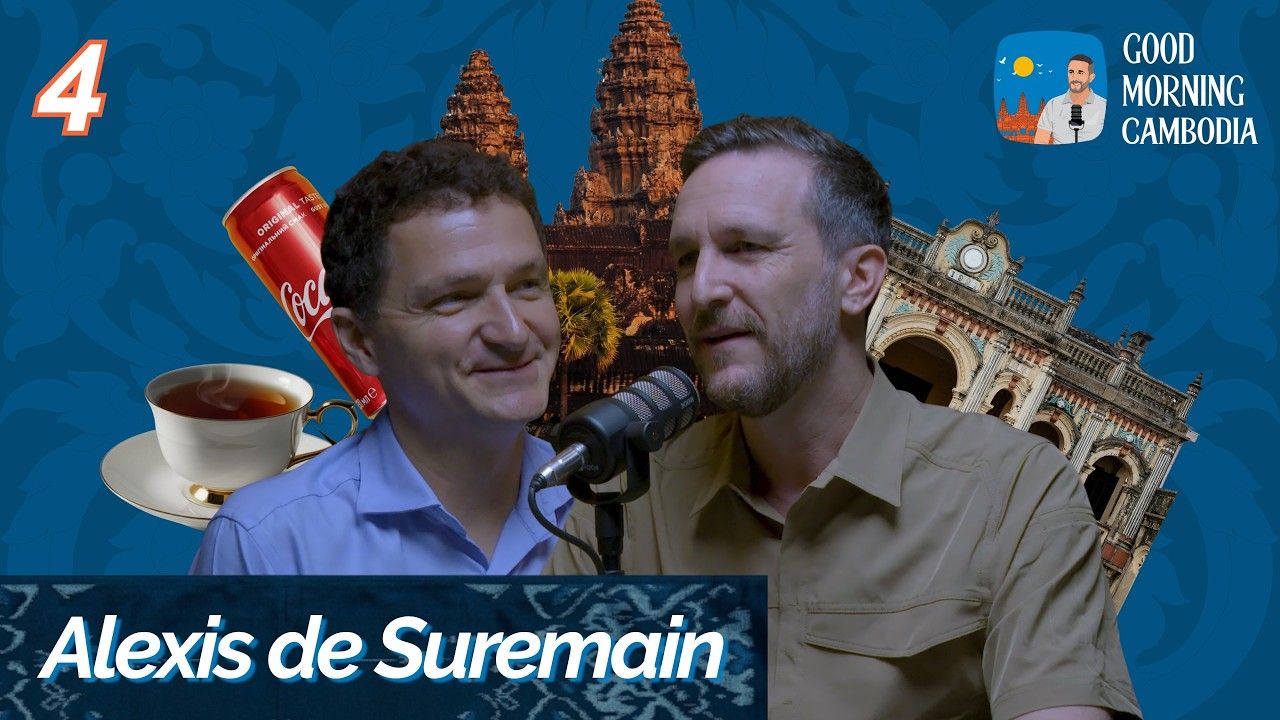
Alexis de Suremain: the three-month assignment that lasted two decades
With Alexis de Suremain
About this episode
Alexis de Suremain arrived in Cambodia in January 2002 for a three-month assignment with Pharmacists Without Borders. He never left. Over the next two decades, he launched Elsewhere, Pavilion, Kabiki, and other hospitality ventures that welcomed over 600,000 guests. In this episode of Good Morning Cambodia, he shares how accidental opportunities led to a career in boutique hospitality, his reflections on Cambodia’s transformation, and why the country needs more original thinkers in tourism. He also explains why Angkor Wat alone is not enough to sustain Cambodia’s future as a travel destination.
Where the stories happened
See them on the story map →Chapters
- 0:00Introduction
- 3:58Arriving with Pharmacists Without Borders
- 9:08Elsewhere and the First Friday parties
- 14:10How Pavilion became a boutique hotel
- 21:51Kabiki and the hotels that followed
- 27:39Knowing his limits and finding locations
- 34:42Angkor's shadow and the untapped Mekong
- 42:12Working with Cambodian colleagues
- 48:04A birthday bottle of champagne
- 57:55Why Cambodia needs more original operators
From the conversation
I lost my return ticket. I don't know what happened. And no, but I'm I'm still here. So, initially it was a 3-month contract and I ended up here.
we were selling tickets to nowhere and end up in the rice fields in the middle of the night and girls with high heels would go in the mud and we'd party in the rice fields.
We need to have people doing weird stuff and more original stuff so that so that we can reach this critical mass that will trigger our destination to be recognized as a complete destination.
Read the full transcript
0:12 those that aren't as familiar with Cambodia or maybe their familiarity with Cambodia was a long time ago and obviously a lot has changed as well. What would be your message or invitation to our friends around the world? Yeah, it's always interesting to see. I meet some Khmer in France. Some say, "Oh, I will never go back after all that happened." And some say, "Oh, I came I came back." And it's so different from the early '7s. And u yeah, it's a country that has evolved.
0:49 no country is stays where it is. So of course for those who knew this or that period it leaves positive or negative feelings but I would say yeah the probably the culture is still there everything is unchanged but the country has changed a lot I mean especially the urban centers so I don't know we say preu in French you have ideas that are very set. But by visiting you can revise completely your perspective your perspective and adapt to a reality that is today's reality. Good morning Cambodia.
1:41 It is a good day to be alive in the kingdom of Cambodia. Good things happening and we're thrilled to have you with us wherever you are. thank you for taking your time to zoom in on Cambodia and we are alive and well and Cambodia's alive and well and we're excited to bring you into what Cambodia is all about of course including our lives and then some of the very special unique things happening right here in Cambodia. And great to be here this morning with Alexis de Suremain. And Alexis, it's great to have you this morning. Alexis is the founder of MADS, pioneer and leader in hospitality in Cambodia. since 200 2001 2002, right around that time is when you first got here, Alexis. And here we are today. So looking forward to sharing some of the stories, some of the insights and some good conversation.
2:51 Welcome Alexis. Good morning. Thank you so much for inviting me and giving me the opportunity to share my thoughts about my own destination now which is Cambodia and Phnom Penh in particular. Yeah. So Alexis born in France, born in a diplomatic family.
3:11 Yeah. I was born in Paris travels from a young age, right? And yeah, I was born in France 58 years ago already. Yeah, we're all young. We're all young. Yeah.
3:23 And spent 17 years in Russia and former USSR, so a long time there. spent 22 years in Cambodia. So that's the country I've spent most of my life. Yeah. Wow. Incredible. Incredible. So yeah, you know, you have lived abroad for, you know, large portion of your life, many different countries and then in the latter part of 2001 into the beginning of 2002 somewhere in there, you ended up in Cambodia, right?
3:58 What's that story and how did that happen? So at the time I was working for an NGO called pharmacist without borders. I have an interesting way because usually people go from NGOs to business. I was in business before spent a lot of years in Russia working in Nijnov. Yep.
4:16 And doing business there and then from there I went to pharmacist without borders. spent almost 11 years with them and I was in Moldova before and there was an opportunity to come to Cambodia because the head of mission here had to go on maternity leave. So she had a 3 month maternity leave and they needed somebody to take over during those three months. Yeah.
4:44 So I arrived in I think it was January 2002 for 3 months. Okay. And I and you'd never been before. I lost my return ticket. I don't know what happened. And no, but I'm I'm still here. So, initially it was a 3-month contract and I ended up here. So, I continued for a few years with a pharmacist without borders cuz she didn't come back and so on and then I decided to get back to business. so, then I started various businesses. and then but I could never completely forget the NGO part of me. So even like last year I did a mission for Oxfam in the Tonle Sap and so we always kept a lot of activities related to nonprofits and cultural promotion and all sorts of things like that. So I'm one of the few people who are completely built from the two cultures the NGO nonprofit and business orientation. so I'm always on both of these identities.
5:54 Yeah. So back in 2002 that was quite early. and there was the there was the need and the opportunity for you know important humanitarian work pharmacists without borders I'm familiar with them of course and so you came over at that time and I remember what it was like you know back in 2001 2002 there's still a lot of need and you know honestly anywhere in the world there's there's need and there's opportunity to you know help people out, support and even more strategic endeavors of you know eliminating poverty and need and things like that. So you came over at that time focused initially the first couple years on the humanitarian side of things.
6:51 Yeah, pharmacist without borders was very much specialized in sexually transmitted diseases at the time. Mhm. which is a topic I'm not very I don't really enjoy working in and so I didn't try to stay too long on that on that. Before that in Moldova we were on pediatrics, children hospitals and things like that which I found a lot more stimulating for me and I was thinking that probably it's a wrong thing to put a male responsible for a mission on sexually transmitted diseases because it's linked to a lot of male misbehavior I would say. So you share some of the guilt and so it makes it you were very biased in the so yeah it's it's a complicated topic sure yeah but I didn't feel very comfortable in that particular activity right I thought children hospital I was in Kyrgyzstan and Tajikistan on supplies improving medical supplies to hospitals I felt a lot more comfortable yep in those things yeah so 2002 to leading, you know, the the work of pharmacists without borders here in Cambodia for a couple years, but you're here with your family as well. Yeah.
8:13 And of course, you know, living in Cambodia and those were somewhat early days. The reason I say its early days is because Cambodia had its first elections in 93 and so that was you know less than 10 years and you know the there were some growing pains and becoming stable and all of that in even some of those earlier years and so that was still quite early. you're here with your family. you're leading, you know, some humanitarian work here as well. but you also had a background in business as well. So you had your eyes open as well. and what kind of happened during those first couple years that I know were key stepping stones to what the journey has been of course for the MADS brand and everything that you've done and pioneered to a large degree here in hospitality as well.
9:08 Well, it has been really interesting and spontaneous experiences. the first the very first business we opened was called Elsewhere and it was just a real estate guy telling us, "Hey, you really should look at this property there." My wife always wanted to do some fashion related activities, clothing and stuff like that. Yeah. And real estate guy showed us the villa on Pasteur Street that was going to become the first our first business and we called it elsewhere. It was really because of the opportunity of this beautiful villa. Yeah.
9:44 that so real estate guy says, "Hey, there's this beautiful villa right here kind of in the center of town. You should do something about it with it." Yeah. And so it was a very inspiring place and we started from there and it went quite well. And at that time my wife had another partner in business and the activity of the clothing and a few parties that we started the first elsewhere first Friday parties.
10:12 Those who were there in here in those days would still remember those parties. Once a month we'd throw a party and many people would come. What was for those that wouldn't be familiar? What was what became of that became called Elsewhere? What was that?
10:26 It was a kind of a pool party with DJ and then people would come. We had a very small pool. The pool was 3 m by 8. So you see it was really small. Yeah. Yeah.
10:36 And people would come and we'd have parties, but it was the only regular party in the country and it was apparently the only regular party in the peninsula. So yeah, at the end people would fly from Bangkok for the first Friday of the month and some people would sometime fly also come by bus from Ho Chi Minh City and yeah it became somethingies for the monthly parties and then we lost and these were held at the villa with the pool right here in the middle of town. Beautiful garden. Yeah.
11:08 And then at one point the long story but the villa was sold and so on. We tried to do the same kind of parties but moving from one place to the other which was quite fun because we did twice at the railway station and we did we had a train go away and we had parties in the rice fields. I was we were selling tickets to nowhere and end up in the rice fields in the middle of the night and girls with high heels would go in the mud and we'd party in the rice fields. So it was a bit crazy. Yeah.
11:39 Wow. And so this was this was what like 2004 2005 somewhere around there. No, that was 2008. 2008. Okay. Yeah. Yeah. 2008. Okay. Yeah.
11:51 And pulling steam engines in the near the with wagons and having rock bands on the wagons and steam from the DJ inside the steam engine chimney. Yeah, it was really we had a lot. It started with the villa and then it moved to events at all of these unique locations in the city, outside the city, different angles, different Yeah. floating platforms in the river, you know, those big platforms for the passengers. We turned that into dance floor also. So, a lot of fun things.
12:23 And these weren't just for those based here locally. These kind of became regionally. Some people were coming from outside. Yeah, we rented the top floor of the Canadia Tower also when there was a crazy party up there with drummers, crazy drummers on the corners of the tower on top. A lot of fun, a lot of fun.
12:43 So, so it started with someone saying, "Hey, there's this villa here, little tiny pool with a nice garden. You ought to do something." Yeah. And so that got the wheels turning, right? Of well, what could we do with it? Right.
12:54 Correct. and that turned into events there and then realizing hey this actually works pretty well. Y and that grew there at the elsewhere location of course but then from there when we lost the house we had to find other locations. And so we were trying to change every but at the time it was still okay to make noise in the middle of the city.
13:17 You know as you said it was the very early days. Now you would not be a allowed to do things like that. You know put 5,000 watts of speakers somewhere and then you know nobody could sleep and 500 meters around us. So yeah that was that were the early days.
13:34 Wow. Wow. Well that's I mean that's that's interesting. It's unique. Rather than you kind of being here, living here, saying, "Hey, where are all the events?" And why doesn't somebody put together some events, you kind of said, "We could do this."
13:52 And that wasn't necessarily even your background, right? You know, but just something that could be done and give it a go. And it flourished for many years. Yeah. So then what did that kind of lead to after that?
14:10 So same story for the pavilion which was a real estate guy telling me, "Hey, you should have a look at this house. It's really interesting. You like heritage buildings." So and pavilion was kind of a heritage Yeah. type villa as well, right? Yeah. Yeah.
14:26 So the guy told me, "Hey, you like heritage buildings? Have a look at this one." So And so I visited the place. It was very small. There were two bedroom two Yeah. two bedrooms upstairs and that's it and garage at the back and parking in the front. And I said, "Yeah, the building is very interesting, but it's too small." Yeah.
14:44 And then so the agent introduced me to the owner and the owner told me, "Um, yeah. I had this villa. I started knocking down the whole villa. So the roof is was gone." So there was no roof at all. Yeah.
14:58 Because I was knocking it down and I had this dream and that I should not demolish the villa. and we should do something about it. So I stopped the demolition. Did his dream include this French guy named Alexis coming to meet him or No. Okay. Okay.
15:12 He and he's not gay. So probably I was not the one but so he had this vision of doing something with that villa instead of demolishing it. So he was looking for somebody to make use of it. Right.
15:26 So initially to demolish it, then he had his dream. That was in 2005. Yep. Yep.
15:31 And so I told him, "Yeah, well there are not many boutique hotels in Phnom Penh and it would be nice to do something, but we would need at least 10 rooms and there are only two." And he said, "So we started working together and interestingly he had this architect or builder working with him that had been trained in Russia. So he told me here this is my builder." So I started talking to the guy his Cambodian builder. Yeah. Yeah. But trained in Russia. Yeah.
15:59 Spoke Russian. Yeah. That's what I found out. And so I couldn't speak and his English was poor.
16:05 And then suddenly I realized, hey, he's fluent in Russian. So we started talking and then so we got along very well because it the communication was easy. No language gap and he had the trust of the investor. I mean the owner landlord. And so the landlord paid for the construction that I was needing to operate a boutique hotel.
16:26 Yeah. So I was very lucky in that because it's the landlord who arranged the whole setup so that I could operate a boutique hotel. So I didn't have to do the investment because I didn't have the money. Right. Right.
16:39 So I had only I bought only the furniture. There were no TVs in the rooms and no fridge no you know there was really minimum but as we were the first one it went quite well. Right. Then I told him you know it's too small 10 rooms. I need to get the villa next door and do you allow me to break the wall between the two if I manage to convince the landlord. And he said, "No, no, no, no, no, no. You talk to no one.
17:04 Let me deal with that." And so he came back after maybe two weeks. And he said, "I bought the villa next door. I bought the village. I've solved the problem.
17:14 So then you can have it." I said, "But okay, but we have not negotiated the price or anything." No, don't worry. Don't worry, don't worry. So then I said, "Yeah, but you know, we need something unique. So we need swimming pools. So we need four swimming pools for each of the rooms downstairs to have private pools." Yeah.
17:28 And he said, "Yeah, okay. That's going to cost you that more every month." Yeah. And then I'll do the pools for you. Yeah.
17:34 So he did the pools for me and then that's how we started. So he was kind of the person who helped a lot. I mean he made a very good in you know I calculated the amount of money he's made with that house since we pay rent. Yeah.
17:50 I think we paid close to six times the price he paid to buy the land. Yeah. Overall in rental over all these years. He's made a good return on his investment as well. Yeah.
18:02 So you were you came here with your family. you were doing humanitarian work. you begin to see you know different kind of opportunities here as and then as a as an individual living here in Phnom Penh real estate guy comes says hey you're a foreigner you should look at this you start to have the ideas for the events run the events for many years and then again as a businessman here in town another one says hey you know you should look at this heritage house over here and that turned into pavilion yeah but to be very honest, it's more the opportunities they came to me. Mhm. Yeah. Yeah. Yeah. Yeah.
18:43 You were you're you're a businessman here in town and someone I don't want to say I've been passive. No, it's not the word. But I was lucky that things came to me. Yeah.
18:52 Yeah. Yeah. Yeah. So as but as a you know as someone that you have your family here in Cambodia, you're running you know different businesses here in Cambodia. this came to you for these early businesses. Yes.
19:08 Then I started digging myself but in the first the first opportunities I must be very honest I was lucky to have them come to me. Yeah. Yeah. And it sounded like you had a great you know partner with a landlord there. very easy to work with. Yeah.
19:24 as well. Yeah. And so still is. I met him two days ago and Yeah.
19:30 Yeah. Yeah. And that's, you know, by the way, that's that's one of the very special attributes of Cambodia is the people, of course, and welcoming us as outsiders, you know, into their homes, into their societies, finding workable solutions for different business collaborations and things like that. Was a bit tough during COVID when we had difficulties in paying lease. So, the tension started to grow a little bit.
19:57 Yeah. Everyone is a bit stressed but it's it's smoothened out. But there were moments I would say when not just for me but for everyone during COVID especially in the hospitality world when you know you don't have international travelers anymore at all at all. Yeah. No flights coming in of course. Yeah.
20:14 Owners see that you don't pay the rent sometimes. Yeah. And they may be feeling their own pressures for whatever reasons as well. They also have because they live on some people live on rental. Yeah. Yeah. Yeah. Yeah. That's right.
20:25 It's been an interesting time. But that's when you see that even though there were sometimes moments but that as you said people like to smooth things here. Yeah. And I have this feeling that the relationship is stronger now than it was. I wouldn't say it was weak before but this whole overcoming these crisis Yep. Yep.
20:48 was you know the bonds are bonds are strong. Yeah. Yeah. Yeah. Yeah. gone through the crisis and hopefully no more but yeah you've gone through the crisis and yeah but then they see that you've made the effort to compensate somehow and some of it we paid back and so you create you know I mean of course it's been 18 more than that 18 years so it's a strong relationship yeah that's that's incredible so fast forward to now tell me about Whoa yeah we're going to do a big leap and fast forward to now talk about what has happened in you know since pavilion project number one well before that obviously elsewhere and the events but then as far as you know boutique hotel very high-end I' I've enjoyed pavilion myself as well to now go through you know some of the different businesses and projects that you've been involved in over the last several years now.
21:51 Okay. So, in terms of hotels, we've we did the Kabiki, which was a hotel dedicated to kids and families. Yeah. Because I was accused by a lot of people of being a bit fascist with the pavilion. I even had a paper in there was a newspaper called Cambodia Daily. They did a whole page on me saying I'm a fascist because I don't accept Khmer children in the hotel.
22:20 And then I said I'm even worse than that because even those who are not Khmer also don't accept. So it's not it's not it's not it's not focused on children. Yeah. Yeah.
22:29 It's focused on children. So it was an adult only hotel romantic. Nothing weird was happening there. it was very conservative and and but it's just but they just didn't want little kids running around. That wasn't the Yeah. I didn't want the noise and the disturbance of the kid but of the kids.
22:46 But I was also very concerned about the private swimming pools without the pavil has at the moment pav has six swimming pools and so the risk is high and a lot of unsupervised areas and so on. So I decided that this hotel would be without kids. And I even one day got a letter from the UNICEF complaining about this. And I thought this is really unfair because there are hotels in Cambodia, not just in Cambodia, but everywhere which don't accept children and women and you know there are two in Cambodia which accept only men and they nobody bothers them. But for me I accept women and so anyway I decided to open a hotel dedicated to families.
23:27 So that was Kabiki. Kabiki and that was here in Phnom Penh as well. Yeah, it was just less than 100 meters from pavilion and it was completely dedicated. We had pizzas in for in the shape of clowns.
23:38 We had two swimming pools so that the one would be very shallow, the other one was less a little less shallow but a lot of things really dedicated to children and families because I felt one I had to do something for the families after rejecting them at at Pavilion. And so then we had the blue lime which was a bit of an industrial setup near the royal palace. And then we had so that was that was the that was another one right here in Phnom Penh as well. Yeah. Another one we did in the 240 was a hotel of 10 rooms in street 240. It lasted maybe five six years. We had another one which was an elsewhere hotel on street 278.
24:14 Y then we did a big one for us which was plantation 84 rooms. So that was a kind of a big project which was interesting because I managed to put in there a lot of art related activities with exhibitions openings almost every month and a half. So we were quite active with this. we had the Malibu bangalows inville for maybe two years. Mayura Hotel in Mondulkiri for one year.
24:47 Yeah. Kirirom Mountain Lodge for three, four years. Yep. Templation Hotel in Siem Reap that we still operate. Yep.
24:56 Island Center Point on Koh Rong Sanloem that we operate now. we're working one on one in near Koulen Mountains on the side of Beng Mealea temple in a beautiful location with a vat which is called plumb absolutely stunning place. what else? so these are for the hotels but then we've been very active on the cultural side and that's the part that is interesting to me. We've had Chinese house which was a also a heritage building. So we renovated three heritage buildings in Phnom Penh. Pavilion.
25:36 Yep. Four. Pavilion elsewhere. Chinese house and plantation.
25:44 These were heritage homes that were renovated. Yeah. Yeah. And some of them with the help of French historic architects, right, to help us identify how they were in the 20s, 30s and putting them back into exactly their original shape. So it was quite an interesting an interesting journey I would say but so Chinese house was a place for exhibitions performances we had bokur we had Phare circus we've had punk groups from Beijing we've had all sorts of things. So that lasted almost 10 years I think and we stopped just before COVID yeah so that's then now we do a lot of I work a lot on bioclimatic architecture recycling construction material of construction materials floating solutions we have a floating restaurant floating restaurant here yeah we work on converting containers into discarded containers ers into floating solutions.
26:55 We work a lot on floating on recycling on so I have a team of designers who are an architects who are working specifically on this. At the moment we're we are converting a water tower or repurposing a water tower into a cafe and a and a room. So, I'm going to I'm going to interrupt because all of this is very unique and obviously throughout the last many years, the way you see things is unique. I can say that, you know, and we're friends and it's a genuine compliment, you know, that the way that you see I have an answer to that. Yes. And so, that's what I want to hear.
27:39 You know, what is your kind of framework? what is your little formula of how you see things here in Cambodia? And you know, again, you shared how you first got started, but it seems like you have had and you've continued to maintain and develop kind of a certain you know, way of seeing things, thinking about things, kind of a framework of how you how you look at things here. Yeah. as I was telling you just before we started this conversation, the one thing I have is I know my weaknesses.
28:16 Maybe not all, but at least some of them I know. And and I'm I know I'm not a great architect. I'm not a great designer. I'm not a hotelier. I'm not a restaurant manager. And so, yep.
28:32 there's no way I can compete with real professionals. if you have somebody who's a real designer, a real architect, he beats me in creativity or in hotel management or anything. So, yep. All right. So, that's that's so that's that's that's my awareness is that I am not any of those. So I can only go to activities and directions where there is no strong competition because otherwise I will fail if you can't compete with those sectors. Yeah. Yeah.
29:07 A good example would be the Aquation office spaces in Koh Pich. We have about a 100 offices there. and for those that aren't aware, this is a very nice green waterfront office space right here in the middle of Phnom Penh. It's a kind of a little oasis right here in the middle of Phnom Penh. Yeah. So, one thing I'm good at and one thing I'm better at than other people is finding the locations.
29:37 But that's the only thing I'm better than other people about. That's the only thing. I can find the locations better and faster and the better locations than anybody else. Interesting.
29:49 And that I have this talent, but then all of the other things I'm very weak and I don't know how to operate a hotel properly. I don't know how to design an office space properly. I don't know how to operate a restaurant properly. None of you know, you would never go to any of my restaurants and say, "Oh, this is the best food I've ever had." No, it's not true.
30:09 Yeah. So, same thing for the hotel rooms. They're not the best hotel rooms you've ever you've seen. I mean, so we try to do I try to do things where I don't have competition. So, I try to be original because I know that if I have competition, I'll fail. M and if you give an off a space like Aquation to a real team of architects that will really design the circulations, the roofs, the windows, the everything design them properly in the interior design that we don't have an interior design at all. People just come and put their tables there and full stop.
30:44 Yeah. Yeah. But if you have a real professional doing a green office space in the middle of Phnom Penh, I'm dead. M so I'm doing things that other people are not doing because I'm not to their level and I have to be very aware every time I do a project that Yeah. I'm I'm not saying it's we're doing they're bad but they're not to the level of professionals.
31:11 Right. Right. Right. So I need to be very aware of this in order not to make mistakes. Mhm.
31:19 Not try to be somebody I'm not. Yeah. Yeah. And so you have discovered all of these gems, niches, niches all throughout Cambodia, not just Phnom Penh, a lot in Phnom Penh, of course, but all throughout Cambodia.
31:34 Y your eyes have caught them. You've taken the task and the risk of going in and securing these locations. 1% of those I've found. Yeah.
31:48 Yeah. Yeah. Yeah. Yeah. Yeah. Yeah. But they, you know, the they stand out all throughout Cambodia as well, you know, and both people locally that are living here that have lived here over the years as well as people from all around the world have enjoyed your your various locations as well. Yeah, I had a I had a I did a calculation a few days ago because I needed to convince that we are able to attract people because I try to be a voice in the tourism industry. Yeah.
32:23 And I was making a very rough projection of how many people have slept in our beds. Yeah. And since we So what's the rough projection? It was 600,000 people.
32:33 600,000 people slept in our beds. Yeah. So that's an accomplishment. That's an accomplishment. Absolutely. Absolutely.
32:41 Not all were blondes, but Yeah. Yeah. Yeah. Yeah. Yeah. Yeah.
32:45 Yeah. 600,000. All that. That's incredible.
32:48 Let's you know, just briefly who's who's visiting Cambodia. Look, you know, you and I both know we live in a big world. There's a lot of destinations all around the world. who's and you know your story of coming here and you know I have my story of coming here and you know families and living and all of that is very doable which you and I can witness to can attest to but then even just visiting who's who's visiting Cambodia who are those 600,000 people it's tricky it's I mean it's it's a long and complicated question if you have clear answer on that then you can solve the issue of tourism in Cambodia. So it's a very vast topic. and the reasons why people come here for two three days to visit or stay 10 years or 15 are very almost opposite. Yeah. Yeah. Yeah.
33:54 And so I would say Phnom Penh is a very easy city to sell for living. I mean why are you here so long? Why am I here so long? I mean, it's very clear.
34:05 It's there's there are so many things that you know, do we would we want to live in neighboring cities? I have an apartment in Bangkok. I could go and live there if I mean could I don't know. But so it's it's a choice and is liveable. Cambodia is livable.
34:24 Yeah. The question for me is it visitable? So livable my answer is very clear. I mean, you know, it's so I could lay 100 reasons why I'm here and I've been thinking about it. So, it's it's not just em emotional, it's also rational. Both emotional and rational.
34:42 now the question is for travelers, what's what's the traction? And that's and yeah, Angkor has been the magnet. Yep. Yep.
34:51 But it overshadows the rest of the country. I always say it's the luck and the curse of Cambodian tourism. This is this is an important statement that you made there as well, Alexis, that of course Angkor is the attraction. there's only one Angkor Wat in the world and it's in Cambodia, right? but I like that statement that it to a degree it overshadows the rest of what's available here in Cambodia.
35:20 Yeah. So that's that's really a problem because for a lot of people when they identify Cambodia to Angkor Mhm. and more even specifically on Angkor Wat. Yep.
35:31 I mean, it's also on the on the on the flag of the national country. It's everywhere. It's everywhere. And every time you talk about tourism in Cambodia, you always have the picture of Angkor.
35:41 Yeah. If you talk about if you talk about Egypt, you're going to think pyramids, you know, they use they use a little less the pyramids because they have a more diverse type of heritage. I mean if you look at the tombs and the temples the valley of the kings with the tombs and all the temples that are along the Nile have very strong identities which are very different from the pyramids and they have the heroglyphs and so on. So the problem is Angkor is what we have here is more temples.
36:14 You have Angkor Wat which is the main one but you have the rest is most of the heritage is temples again. So, it's a more challenging destination to sell, but very much like Egypt. It's an archaeological destination and wonder destination and you've seen it, you've seen it, right? And the problem is that Angkor is on the bucket list or at least was on the bucket list of many people which have seen it and they tick the box and because they identify Cambodia to Angkor if they have and if they have seen Angkor Wat they have seen Cambodia so done and so it's very difficult the overshadowing part that you're talking about it's very difficult to generate repeating customers which our neighboring countries don't have they don't in Vietnam or Thailand, you don't have one big heritage archaeological site. Yeah. Yeah.
37:09 That people will identify as the only destination, especially a bucket list destination. Yeah. So for us and that's where we as the private sector need to come up with more attractions and to diversify the experience of people coming to Cambodia so that they so that people don't identify us just as one temple because how long do you need to visit a temple even if you really like that temple one and a half days so you know shortcut one and a half days to visit Angkor Wat so one and a half days to visit Cambodia and done right so that's That's some That's what we're up against. Right. Right. So, there are other destinations and other things to do in Cambodia besides just the Angkor and the Angkor Wat temples.
37:57 Yeah, there are a lot, but we need to reveal them. Right. Right. And so this is what you've been working on you could say the last 20 plus years even.
38:06 Yeah. The consensus is that we have a lot of things and people don't know. my perception is no. My perception is that we haven't revealed them sufficiently and we need to have people like me but not just me you know hundreds and hundreds of entrepreneurs to do this job of revealing and making the destination more diverse right and enriching than what it is so that people will be could be blown away and would feel the need to come back right because yeah, Cambodia is not small and there is there's enough there are enough things that we could use in the country in order to make it a strong destination. Right. Right.
38:58 Maybe not leading but at least strong much destination. Yeah. Yeah. Yeah.
39:03 That's my that's I thoroughly believe it. Yeah. And that's one of the reasons why I'm here. So this is something that obviously you've been very involved in.
39:13 there's others involved in. Is there space for people outside the country to come and to first of all discover Cambodia but then potentially be involved in discovering and finding and promoting more of kind of the gems, the sites, the destin developers. Yeah. In any Yeah. potentially developers or people in the tourism industry. Are there is there is there room for people to continue to come into Cambodia and you mean to work and develop work develop these sites? Definitely.
39:54 Yeah. Yeah, I mean definitely I was just telling you for what I believe is a destination an a strong upcoming destination the Mekong which is the second site most wellknown in Cambodia worldwide. I mean the Mekong is the seventh most famous river in the world. Mhm.
40:15 we haven't really tapped into that yet at all in Cambodia. Vietnam very scarsely with the floating markets, but they haven't done much and so yeah, the Mekong is long and wide and should be a road a major road trip in Asia destination. Yeah. And a destination. So yeah, and that would require I mean that there's a space for hundreds of developers of floating hotels, restaurants on the mighty Mekong Exactly. Yeah. Yeah.
40:52 That's just one example, but there are many things to do. Yeah. So, this is this is home for you, Alexis. And I mean, you know, part of your story, you could be anywhere in the world, but something has gotten into your heart, you know, over the last 20 plus years.
41:14 talk to me a little bit about you know as a as a businessman as you know of course as a husband and a father you're living here but you're working with the Cambodian people the last 20 plus years and so you're part of this society as well and you're very active in you know the hospitality industry here. I know that you know even at different levels and you know government forums and things like that you have a voice. But putting that you know kind of to aside talk about just life interactions with our Cambodian brothers and sisters here. in your experience over the last 20 plus years have you integrated into Cambodian society to a degree or what does that look like for you?
42:12 I would say that much. I have some Cambodian friends but to not many to the point that I go and visit them or have dinner together at their home. I have some Yeah. what could I say about that? people have yeah I mean it's in every study it's the some of the amongst the nicest people in the world in terms of welcoming and collaborating with too much sometimes where you know because you're the boss or you're the authority they will they will not tell you when you're wrong. M so I have some colleagues that are expats and when I do something which doesn't make sense it's the expats will tell me the foreigners will tell me that's a difference in culture there.
43:05 Yeah you're really going in the wrong direction that your project sucks completely that's that will come only from the foreigners. M even the Cambodians that are with us since a long time, they are very reluctant in confronting us on with s with so they have ways of expressing things and yes but thoroughly they will you know you can tell them something that makes no sense and they will follow it. Yeah. So it's I find it a little bit frustrating that they put themselves lower.
43:44 Yeah. Which the ties or the Viet are not doing. You know, if you talk to a Thai and he's not happy about what you say, he'll just it will bounce into your face immediately. The Cambodians will polite politely smile and ignore. M so yeah it makes the everyday life very pleasant professionally it's it's more challenging because it relies only on you right because if you go wrong they will not tell you right yeah right so that's very strange and you know the collaboration is very strange so of course those who work with you since a very long time they dare more right easier to get feedback from different things. Yeah. Yeah.
44:29 But so that's a huge asset for tourism and when there was a GIS report recently, I mean last year showing that a lot of people were coming here for and they knew and the most the strongest point for making it Cambodia their destination was the temples. And then when they when they leave you ask the same question. And what did you like most in Cambodia was the people? Wow.
44:58 So in the GIS study it shows very well because it's quantified and there are indicators and then they go a little bit deeper but so people come for the temples but they leave not because of the people on the contrary. that's what touched the most. Right. Right.
45:15 So people we should not be over relying on the people because the There's a big tourism expert called Stefan Bern in France. He's the mastermind behind a lot of policies in France. And he said, you know, you have to be careful. He was here and he made a conference. Be careful. Don't rely too much on the Cambodian people who are so nice because we French are the nastiest in the world in terms of welcoming foreign tourists, especially in Paris.
45:47 We're the really nastiest and we have 100 or 80 million people visiting us. So there's very little correlation between how you greet people. So if you if you take it from the French, you have to be nasty and then maybe people come back. I don't know. But it's an interesting just the bottom line and about the dollar. Okay, you can say that. But you know, I mean, life it shouldn't just be about the bottom line either. You know, you can do both. You can have I like to say you can have a double bottom line.
46:17 You can have a bottom line financially. Yeah. And but you can also have it relationally and right you know. Completely. Yeah. Completely. Yeah.
46:27 But I was I was it was an interesting Yeah. And I think that's one of the things that keeps us here as well. You can do both. You can you can have you know good bottom lines financially. There's plenty of space.
46:42 There's plenty of opportunity here. but you can also you know you can be part of the growth and development of this country which is kind of cool to be able to look back on you know you can look back on what you started with elsewhere many years ago and think you know and I know that you know humility and appreciation for all of those around that's that's that's that's how we're wired as well but at minimum you can say yeah I was I was part of that and then later on I was part of this and later on part of this and actually 600,000 you know visitors later that is decently significant and it's not doesn't mean I'm the most awesome person around but at least I got to be part of it's kind of cool you know I found the right location yeah I found the right location these people came but then the I don't want to you know use this common thing oh it's the team did it d everybody says that in order to look good but They have done the daily effort. Sure.
47:46 Yeah. Of course. So I cannot you know not say that they have been doing and I'd like to if there's time enough for story. I went to a nice hotel called Bale Hotel in Phnom Penh, north of Phnom Penh.
48:04 And it was for my birthday and I went there with my wife, my mother-in-law and the two kids. And we asked before, can we bring a cake cuz it's my birthday and a bottle of champagne. And then the general manager said, "Yeah, sure. You can have your own cake and bottle and da." So at the end of the of the meal, my mother-in-law was tired, so she went to go on a and laid down in a sunbed and fell asleep by the pool. And we were I was with the two kids and my wife. And then the guy comes and the waiter comes and then he starts trying to open the bottle of champagne and he couldn't because you know this little wire around and so on and then so he tries he tries and it he's starting to sweat a little bit and he just can't handle it.
48:52 Yeah. And so I get the bottle I take the bottle from him and I said I'll open it. So I remove the wire and then I start opening the cork and then he says from here I know. So yeah. And so he starts he starts pouring the champagne to the glasses and at one point he felt really bad and he said you know I'm really sorry I couldn't handle that and I'm from the village next door and it's the first time I opened a bottle of champagne and so I they trained me and she so he was so genuine and so he started explaining me this story about he's there and then so my this is a very by the way Bale is a very nice you know nice location you know by the river we were by the river. Yeah.
49:32 Yeah. And so the we were only us were there and then the glass of my mother-in-law was there and she was sleeping. So I said, "Pour some of the champagne and you have to try." Oh, no, no, no. During my work, I'm not allowed to drink alcohol.
49:48 Nobody will see. This is off the record. It's your first time opening a bottle. You at least have to have your first glass.
49:54 I'm not giving any names here, right? It was a long time ago. And so he opens the bottle of champagne. So, so he pours and then he, "No, I can't drink. I can't drink." I said, "At least try a sip." Yeah. And so he drives he takes a sip.
50:08 It's not bad. And so we just drank. He drank that much. And what I want to say is that there was a true story.
50:17 You go to Paris, Les Deux Magots, for example, and you ask for champagne. Some random guy will come. It will be the perfect temperature. It will be the perfect glass. It will be the guy will there will not be one drop out. He puts the bottle and he's gone. You don't bother him, he doesn't bother you.
50:31 Champagne ship here. Even the fact that he failed Yeah. to open the bottle of champagne. It was an a real deep emotional experience because you know champagne's from my country and he was opening it and so and we started a connection. And so what I want to say is that Yeah.
50:52 He there was so much more Yeah. than opening this bottle of champagne. Yeah. the right way.
51:00 Yeah. If he had done it the right way, you know, why would I leave Paris? You know, I would have had So, yeah, if you want perfectly opened and poured champagne, sure, there's plenty of places where you could go around the world. You won't even remember the face of the guy or anything. And so, and you may happen to remember what it tasted like and the temperature and the flavor. You may not.
51:22 Maybe not even. But on your birthday, what you remembered and what stuck out Yeah. is the relationship and how and I think Cambodia is very much about that is that there are stories that you build here which would be difficult to build in other countries. Yeah. And I always like to come up with this story of my about my birthday because it's it's it was very profound to me this whole experience even though I'm analier and so to me that is how I relate to Cambodia with the stories and the people and how we connect on minutes like that.
51:57 Yeah. And I could I could say another story. I was with a millionaire who was going to be one of our partners and it never happened. But anyway, went to see the Tonle Sap Lake and the guy is in the very high-end industry in France and always invited in the best restaurants, the best hotels, the best openings, the Christian opening, blah, jetet and so on. And we ended up in a in a in a minivan somewhere and there was a parking quite filthy with trash and there was only warm coke to drink and we were sitting on these small chairs, plastic red chairs.
52:41 Y and so we drank the coke. it was hot and so and so we started talking about everything and we got back at the hotel and later on the guy told me you know you believe it or not it's the best day of travel I did I've done in the last 20 years sitting in the heat warm coke on some plastic chairs but it was it was true it was genuine and this guy he's experienced everything yeah and this guy travels in first class and best hotels and you know whatever. And usually he needs to compare the caviars and but yeah, and this is a this is also why we're here. And those who make the little effort to get out of their normal schedule and a little bit off the beaten tracks, you have a huge reward of doing it. Yeah. Yeah.
53:40 I don't know if I Yeah. I think it was articulated very well. I think you know what we could say is it's it's a it can be a breath of fresh air because at the end of the day we are human beings. We are I think I think the average human being does enjoy and appreciate genuine human relational interaction over a lot of other things. I think I think as a human being you know look I can sit in front of my TV I can play with my phone I can drive my car you know those are all you know necessities or luxuries or whatever but the you know I think deep inside a lot of us or most of us maybe there's that there's that there's that desire for genuine human relation and interaction that oftentimes has no strings attached. Look, you know, we understand business and we understand dog eat dog worlds and we understand that, you know, there's a lot of what people call drama out there and all of that. But when you can find genuine interactions with no or very little strings attached and just real nice people with good intentions for each other, it's kind of a breath of fresh air, I think. Yeah. rewarding.
55:08 Yeah. Yeah, it really is. So, you know, Cambodia the maybe two Ps, the people and the places. there are places there are locations, there are destinations here in Cambodia and from of course the majestic, you know, Angkor Angkor Wat temples and the ancient city up there. It is it is incredible.
55:31 But there's a lot of other amazing destinations both developed and some that of course there's the opportunity to develop but then there's also the people and it is I think it is a breath of fresh air for many that are able to discover and jump in like we have Alexis. Yeah. But it requires a little bit of effort. Yep. It's not Yep.
55:58 It's not available right there. You need to make a little effort to go beyond and then you have the reward. Yeah. And Yeah.
56:07 Alexis, what would be maybe in closing here, what would be your message or even invitation to those outside Cambodia that may have you know they may have different levels of familiarity to Cambodia. of course we have our own Khmer. They're living outside the country even. of course but even more than that those that aren't as familiar with Cambodia or maybe their familiarity with Cambodia was a long time ago and obviously a lot has changed as well. What would be your message or invitation to our friends around the world?
56:50 Yeah, it's always interesting to see I meet some Khmer in France. Some say, "Oh, I will never go back after all that happened." and some say, "Oh, I came I came back and it's so different from the early '7s." And u yeah, it's a country that has evolved. no country is stays where it is. So of course, for those who knew this or that period, it leaves positive or negative feelings. but I would say yeah, the probably the culture is still there. Everything is unchanged but the country has changed a lot. I mean especially the urban centers so I don't know we say preu in French you have ideas that are very set but by visiting you can revise completely your perspective your perspective and adapt to a reality that is today's reality. Mhm.
57:55 And so yeah, we need competitors in order to grow. and not just because we need to we need a stimulation. me as a as a as an operator, I'm always of course cautious when I see competitors coming in and they will compete with me. But I think we need to reach a critical mass and I always placed the I knew very well the people behind Bassac Lane, you know, the brothers Moon Brothers.
58:24 And I was always telling one of them that you need a critical mass. You do one bar, two bars, it doesn't work. You need to create a destination. And the destination you cannot create alone unless you're a billionaire. But you and and so you need to reach a critical mass in order to gain the visibility. So we need more people doing things in an original way and we need more people coming in and developing helping us or competing with us in the in the hospitality industry in the restaurants in the hotels in the activities in the and all of that and we have not reached this critical mass and we need more people. and a lot of people say yeah you have an over supply of rooms especially in Siem Reap and Phnom Penh what are we going to do if more developments come and yeah but it's true that there's an over supply but there's an over supply of the same and it's not diverse enough and so we need to have people coming in and doing things a bit differently so that our proposition is more diverse and complete right and we have a lack in this it's clearly identified. We need to have people doing weird stuff and more original stuff so that so that we can reach this critical mass that will trigger our destination to be recognized as a complete destination. Right.
59:51 This is what we need. So we yeah we need more people but don't come and do exactly what's been done before. Come with a new mindset. Bring something unique. Yeah. Yeah.
1:00:01 Yeah. Yeah. Well, be our guest in Cambodia. of course, you know, check out the MADS portfolio as well.
1:00:11 there's some amazing destinations there, but come visit us in Cambodia and have a cup of tea with us. We're your friends here in Cambodia. And, it's been great having you here on the Good Morning Cambodia show. So, it's been great to have you here, Alexis. Thank you. It's been a great morning for this opportunity.
1:00:39 Yeah, it's been a great conversation, a great cup of tea, and we'll talk to everyone next time soon. Bye.