
Rithy and Nisay: building something from nothing in Cambodia
With Rithy and Nisay, Winnis Coffee
About this episode
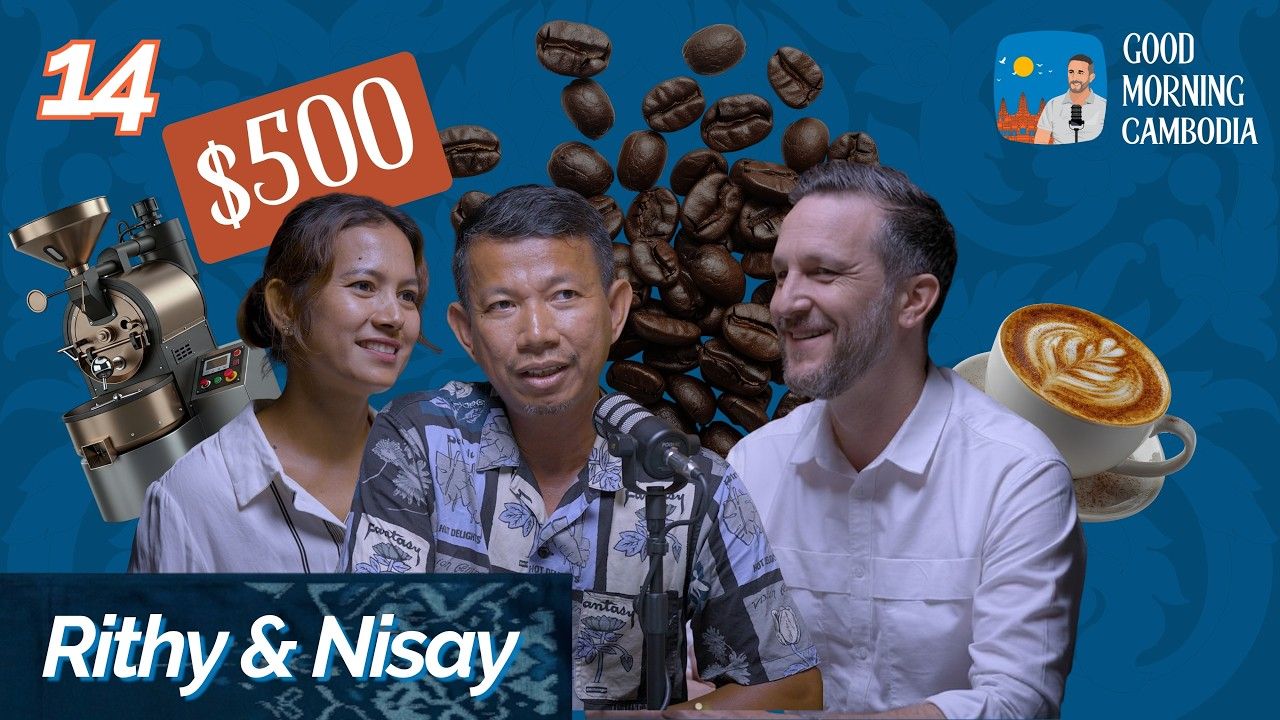
Jesse McCaul talks with Rithy and Nisay, the husband-and-wife founders of Winis Coffee and his friends of more than 20 years. They describe how Rithy learned the coffee trade from 2007, how they started a roadside cart outside a Khmer language school with $500 of savings, added a secondhand Italian espresso machine six months later and built a 20-kilo hot-air roaster for about $6,000 rather than paying close to $100,000 for one. The couple also talk about training baristas and small coffee businesses, Cambodia's growing coffee culture and limited local bean supply, and marketing on Facebook and TikTok.
Where the stories happened
See them on the story map →Chapters
- 0:00Introduction
- 5:19Names, families and meeting in Battambang
- 10:20Cambodia's coffee culture since the 1990s
- 16:45Learning the coffee trade from 2007
- 20:23Starting with a $500 coffee cart
- 27:20Building their own hot-air roaster
- 31:46Training other coffee entrepreneurs
- 38:04Future plans and a coffee plantation
- 41:48Phnom Penh's coffee scene and popular drinks
- 44:26Marketing on Facebook and TikTok
From the conversation
During that time, I know that not so many Cambodian people know what is a good coffee and what is a bad coffee. So I start talking. I went to around the country hotel and coffee shop.
So back in the 1990s when I arrived here, that was it. And it wasn't that popular. Coffee wasn't that popular as a drink back then, but now I mean there are coffee shops and coffee stalls and carts
My dad actually when I was born my dad was not around right. He was away to work but then he felt sick. So on that day he returned back on the time I was born. That's why he gave that name to me.
Read the full transcript
0:13 So I don't have much money to start right because I need to married I need to saving some money for the f future and so so I just have a small amount of money like $500 dollar. Okay. So, you had $500. Yeah. I'm I'm plan out and I start like with a small coffee cart and through my H experience because I used to teach people how to making coffee. I still using the best co coffee. Yeah.
0:45 By brewing like we call a cold brew. Cold brew. Yeah. I think so. Cold brew. You don't need an espresso machine. Yeah. No. No, we don't. Because it would cost more to do that and you only had $500 of startup capital. So the coffee carts is cost $270 for the cart. For the carts.
1:01 And this is like a roadside cart, right? Yeah. Yes. The mini small one. Yeah. Yeah. 270.
1:08 Yes. Okay. So then you had So the rest we buy a kind of a bottle or tongs and some spoon and some other equipments, right? So we start with that and then after three to six month yep we trying to understand what our customer need. Where was your first location of your coffee cart? This is like a roadside cart. It the opportunity. Yeah. that we have one place that is u we heard from my wife that oh they have one place free for her to rent at Sana and it's not really the best road Sana shopping mall area Sana yeah it's at that at the at den a dead end dead end street yeah dead end street yes so I and not so many people driving or use this road much.
2:07 It's a dead end. So yeah. Okay. Yeah, it's a opportunity still. So we let do it our best. Right. So we start with that. Right. But you were also if I'm not wrong, you were right in front of a school that taught foreigners the Khmer language, right? Right. And so you had customers from the offices and the businesses kind of around that area. there was a shopping mall not too far. Yes.
2:37 but you also had all of these foreigners. Yes. That were coming to learn the Khmer language. My language. Yeah. And they liked your coffee, right? Yeah. They support us and they love the coffee. Ah interesting. Interesting. Yeah. Yeah. Yeah. Yeah. And yeah after six month right?
2:56 Yeah. After six month we were able money to buy the second hand of coffee machine. Okay. So you started with just drip coffee, cold brew. Yes. For the first six months.
3:08 Yes. Because that's less investment. Yes. Right. Of course. And then from there you after six months you were able to save up enough money to buy a secondhand Yes. espresso machine. What kind did you buy? What brand? Do you mind sharing back then? it we just heard from our friend their cafe is closed and they want to resell right their coffee machine. I think okay the new is almost $6,000. So the second hand only $3,000 400.
3:44 Greetings from the kingdom of Cambodia. Good morning Cambodia. We are glad to be with you wherever you are around the world and welcome you into our world. Why Cambodia? What's going on here in the wonderful Kingdom of Cambodia? And I guarantee you that you're in for a treat today. We're going to have some wonderful, intriguing, insightful, entertaining conversations. And we're glad to have you as our guests today. And this morning we have Rithy and Nisay, the founders of Winnis Coffee Roastery and entrepreneurs, business people and of course personal friends for the last 20 plus years as well. So it's wonderful to have you here this morning and Nisay.
4:35 Yeah. Hello and good morning. Yes, good morning and thank you so much for inviting us and we are so excited to share our story and yeah looking forward for that today. Well, let's let's talk a little bit and you know Rithy and Nisay we've known each other for many years. I you know I love you as friends. I love your story. I love what you're doing for the country of Cambodia. And I believe that our friends outside of Cambodia would love to hear a bit more about what's going on in Cambodia as far as business, entrepreneurship, life, and the coffee industry as well, which is really interesting.
5:19 Rithy, your name is Rithy, but for many years I've called you W I N, right? Yeah. And h how did that happen? I mean I you know I know your formal name is Rithy but even Winnis Coffee is a combination of of your name and then your nickname of Win W. Yes.
5:46 yeah. How did you get that nickname? Let me talk. Yeah. My official name is Soi. Yeah. and when I was born and I just feeling that I'm looking for you know I want to be a man that champion or win to the situation in life. So I'm I'm interested with the ne my nickname I'm and talk with Jesse and then I love to change my name and interested with win winner like a winner a champion right yeah so yeah it start from that I think is a long time ago a long time ago I think almost more than almost 20 years ago yeah probably 20 years ago 20 years ago so I really love that and when we start Winnis Coffee and my wife her name is Nisay.
6:47 Yeah. Yeah. So we start thinking and start our own brand. So we connect that is why Winnis Win your nickname winner like winner. Yeah. Yeah. Win. And then Nisay. Yeah. Yeah. So Winnis Coffee. Yeah. Winner and love. Yeah. Yeah. So Nisay what does your name mean in Khmer by the way? My name means lucky kind of lucky.
7:12 Yes like lucky or almost kind destiny. Lucky it's your destiny or something like that. Yes. My dad actually when I was born my dad was not around right. He was away to work but then he felt sick. So on that day he returned back on the time I was born. That's why he gave that name to me. Yes. Destiny. A lucky name. Wow. Wow. Interesting.
7:38 And so in this conversation, I'm going to go back and forth calling you Win and Rithy because no problem. Yeah. I usually call you Win but of course a lot of people know you by Rithy as well. So Win where is your homeland in Cambodia? I was born in Phnom Penh.
7:56 Born in Phnom Penh. Okay. So a city boy. Yeah. Yeah. City boy. And how about you Nisay? Where were you born? I was born in Preang. Preang province. Yes. Okay. Yeah. So that's south of Phnom Penh.
8:08 Yes. South of Phnom Penh. It's about two hour away from Phnom Penh. Right. And then if you don't mind and I I know it's just it's part of your story. I know that your mother passed away when you were quite young.
8:23 Yes. And then your father got remarried. Yeah. And your stepmom is British.
8:29 Yes. Is that right? Yes. Yeah. And she still lives here in Cambodia, right? She loves Cambodia.
8:34 Yes. is here for a long time. Yes. Yeah. Yeah. So she love helping here and working here and enjoy the environment and she help with a lot of people especially children. She teaching children at one of the church in Yes.
8:53 Wow. Incredible. Incredible. And then you guys met up in Battambang province, right? We met in Battambang.
9:00 Yeah. Yeah. Yeah. Yes. We unfortunately he's looking he was looking for the perfect woman at that time. So he found her, right?
9:10 Yeah, he found one. That's great. So you met up in Battambang and then you know one of the your life of the last 17 years I believe has been focused on coffee and you brought your wonderful wife into your world. she just wanted to get married to this nice guy and have a nice family which you have two beautiful children of course. but then he said, "No, no, you're not just not it's not just married. You're going to come into the coffee world with me as well." So when you've been in the coffee industry almost really kind of one of the pioneers of the coffee industry, one of them. There's others, of course, but one of the pioneers of the coffee industry in Cambodia. And I'll put a little bit perspective into that. because when I first arrived in Cambodia, 1995, there wasn't much of a coffee drinking culture in Cambodia.
10:20 And the only coffee that you could get was a little bit of the street side. you they kind of called it like Vietnamese coffee back then. You know, the drip coffee with a lot of sweetened condensed milk and then ice coffee with sweetened condensed milk. that was really that or just the really strong shots of drip coffee. So back in the 1990s when I arrived here, that was it. And it wasn't that popular. Coffee wasn't that popular as a drink back then, but now I mean there are coffee shops and coffee stalls and carts and we live here in Phnom Penh, of course, on every street corner, but really around the country as well. The coffee industry. Yes. is huge here in Cambodia. I don't know. and I didn't bring any exact numbers on the size of the coffee industry here in Cambodia. I don't know if you guys know any exact numbers. Probably not exact, but maybe approximate numbers on the coffee industry here in Cambodia. It mean right now. Yeah, right now.
11:38 I'm not really sure about that. what is your question again? Well, what is what do you know? I mean the amount of let's say the amount of coffee beans brought into the country, roasted in this country, consumed in this country per year. Do you do you have any numbers on that? It's I mean we have coffee shops everywhere and new ones opening up all the time as well. Yeah. What I know in Cambodia themsel we could produce like 300 ton to 500 ton produced in country. Yeah. In country. Okay. But also we got the coffee bean from the neighbor con country like Laos or with Vietnam too. I don't know the exactly number but it's a lot. Yeah. Yeah. Yeah. It's a lot of amount from that. Yeah. I think it really need Yeah. Yeah. Zozo, I mean the coffee industry now is growing and the coffee drinking culture is very strong now. Coffee shops, stalls all over the country. and that's become kind of part of the lifestyle here. So you were pioneers in that really during this time you know is u harvest time like people in Bulgari they collect the bean and they start threading right sale. So we want to buy like more than like example like I need only 10 ton of coffee and now they don't have it because people collect all the from the farmer you know and so the farmer need produce more because they still have free land in Mondulkiri Ratanakiri because they cannot northern provinces. Yeah. Yeah.
13:40 Yeah. What we've just find out lately that some local people they do own the land but because they don't have financials to start with. So they don't know how to start with planting the coffee beans. Right. Right. But what we have heard that they would like to plant some more for their local beans as well. Mhm. Yes. So that is more one of the difficulty for them for the local one. So the demand for coffee beans here in Cambodia is much larger than the supply. Yes. From the two provinces that can grow coffee bean, nice good quality coffee beans is Mondulkiri and Ratanakiri province.
14:24 So there's an opportunity though because there's plenty of agricultural land up there. Yes. That coffee beans can grow. So there's a there's an opportunity. Yeah. Huge opportunity.
14:35 Yeah. for those who can invest in planting the coffee beans there. Yes. Interesting. Soy yeah good land so good land and the weather is cooler than others in a part of the Cambodian basis. Yes.
14:52 So there's an opportunity because of the demand and the supply from the local coffee plantations is limited. Yes. but there is good quality coffee beans grown here in Cambodia. definitely the taste of it is so nutty.
15:13 Fruity. Yeah. I purchased my home coffee machine from you guys and my regular supply of coffee beans is of course from you guys as well. So I enjoy it every morning as well. Yeah. but you got started in this really 17 years ago. Yeah. And you have been involved in many different aspects of the coffee industry.
15:48 And I know that if we if we fast forward to now that of course you run several small coffee shops. You also have a coffee roastery. you've also provided training to several hundred baristas across the country. And you've also provided training to at least dozens if not hundreds of young small business people as well across the country as well. Exactly. Yeah. And then you've also you've you've studied the coffee industry including the coffee plantations up north and the export markets and all that. So I can really say that you guys are pioneers have been pioneers in the coffee industry. But how did it start many years ago?
16:45 What was what was the starting point? you know in 2007 I start looking for the business opportunity and then I start interested with the coffee. Yeah. And I don't know anything about the coffee. So I start doing research around like I went to Thailand. I went to Smar and Vietnam start researching about the coffee drinking coffee and trying to know what is it and why the coffee shop they sell with different brand and what kind of flavor something like that.
17:25 Yeah. But for the my first time I'm really feeling so exhausted after I drink coffee in I mean I got sick. Yeah. Yeah.
17:41 Too much coffee. Too much coffee. Too much coffee testing. Yes. Yeah. And then I really start focus and work on the coffee since 2010. Okay. I'm work like a sale and marketing manager and then I become a general manage manager. Yeah.
18:06 During that time, I know that not so many Cambodian people know what is a good coffee and what is a bad coffee. So I start talking. I went to around the country hotel and coffee shop. I went to all of them and trying to talk about good and bad coffee because back then, if I can interrupt, back then you know, as Cambodia is a developing nation, in the past, everything would be about the price. Just give me the lowest price, you know, but you get terrible quality sometimes. And so you begin to realize, no, there's a lot of different options for coffee. And when you're talking about good and bad coffee, yeah, you can you can get, you know, some garbage coffee for low price, but it's terrible, you know. And as a you became over those few years, you became a coffee connoisseur and began to appreciate, you know, the different qualities and different Yeah. tastes of coffee. Sorry to interrupt, but yeah, I understand what you're saying. Yeah. Yes. Yeah. and then later a few year later and people the cam people they start realize what is good coffee right for them to drink and they not really care about the price they not looking for the cheap coffee right I think talk about the purpose that right now is really much better than before. So right now people they love to drink coffee from the espresso machine something like that. Yeah. Yeah. That's right. So after I work in the com company and I work only with the coffee because I'm interested with co coffee. So I'm looking for company who doing business with the coffee. Yep. So after that maybe after six year five to six year to work and then I'm I'm looking to grow more because I want to own my business right so I don't have much money to start
20:23 right because I need to married I need to saving some money for the f future and so I just have a small amount of money only like $500. Okay. So, you had $500. Yeah. I'm I'm plan out and I start like with a small coffee cart and through my ed experience because I used to teach people how to making coffee. I still using the best co coffee. Yeah.
20:52 By brewing like we call a cold brew. Cold brew. Yeah. I think so. Cold brew you don't need an espresso machine. Yeah. No. No, we don't. Because it would cost more to do that and you only had $500 of startup capital. So the coffee carts is cost $270 for the cart. For the carts.
21:08 And this is like a roadside cart, right? Yeah. Yes. The mini small one. Yeah. Yeah. 270. Yes.
21:15 Okay. So then you had So the rest we buy a kind of a bottle of tongs and some spoon and some other equipments, right? And then start up Yeah. Yeah. Around that.
21:29 So we start with that and then after three to six month y we trying to understand what is our customer need and then we start doing that and then we saving money during from the six month. Yes. Yeah. Yeah. Sorry if my English is not really No, it's great. Yeah. Yeah. It's great. It's great.
21:54 Yeah. So where was your first location of your coffee cart? Is this like a roadside cart? It the opportunity. Yeah. That we have one place that is u we heard from my wife that oh they have one place free for her to rent at Sana and it's not really the best road. Sana shopping mall area. Yeah. Sana.
22:23 Yeah. It's at the at the dead end. A dead end. A dead end. A dead end street. Yeah. Yeah. Yeah. Dead end street. Yes. So I and not so many people driving or use this road much.
22:35 It's a dead end. Okay. Yeah. It's a opportunity still. So we let do it our best. Right. So we start with that. Right. But you were also if I'm not wrong, you were right in front of a school that taught foreigners the Khmer language, right? Yes. Right. And so you had customers from the offices and the businesses kind of around that area. There was a shopping mall not too far. Yes.
23:04 but you also had all of these foreigners. Yes. That were coming to learn the Khmer language. My language. Yeah. And they liked your coffee, right? Yeah. They support us and they love the coffee. Ah, interesting. Interesting. Yeah. Yeah. Yeah. Yeah. And yeah after 6 month, right? Yeah. After six month to buy the second hand of coffee machine. Okay. So you started with just drip coffee, cold brew. Yes. For the first six months. Yes. Because that's less investment. Yes.
23:38 Right. Of course. And then from there you after six months you were able to save up enough money to buy a secondhand Yes. espresso machine. What kind did you buy? What brand do you mind sharing back then? it we just heard from our friend their cafe closed and they want to resell right their coffee machine. I think okay the new is almost $6,000. Right.
24:07 So the second hand only $3,000 500, right? So we closed deal with that. What brand? What brand was it?
24:13 Astoria. Astoria. Yeah. Yeah. From Italy. Yeah. Yeah. So we go and check it out. Oh, it's look it's still new. So we got it. Yeah. Yeah. So we buy it. Wow. And so you added that to the coffee stall, the coffee cart. Yes. Right. You still didn't have like a shop or anything like that. This was still a roadside. Just the roadside. Yes. We I think at that time we are the first one who display a coffee machine outside outdoor right because there's a big coffee shop the the popular brand they have the coffee machine inside indoor yeah and we just decided because we don't have money to rent a big place so we just decided to place it the coffee machine outdoor and then push in and push out inside the school. So you had a Italian Astoria espresso machine. Yes. $6,000 new. You know, you bought it secondhand, you know, $6,000 new on a roadside coffee cart. Yes. And back then maybe nobody was doing that, right? Nobody started during that time yet. Nobody. So I think we are the first one who display that outside. We kind of worried as well because it's quite expensive to put it outside you know for me we just do it and then I think this is a good idea and then we solve the problem let later like do it when it's heavy rain coming so we need to find something to clo to cover Yeah. our coffee machine. Yeah. Yeah. Yeah. Yeah. And as far as like seating or anything like that, did you have any like seating or anything for people to come and sit or was it all takeaway or We have a few chair only two four. Yeah. Two chair. Two chairs.
26:04 Unless at the weekend when the school is off, we can put more chairs. Add a couple more chairs. Add a couple more chairs. But you couldn't have chairs there because it's blocking the entrance of the school. It's a small space rent.
26:15 Right. Right. Yes. So most people local and foreigner they are takeaway right. Right.
26:20 They come do takeaway. Yes. And so as you kind of got started and six months you know you bought the additional machine you were able to save up some money. and after you started for a while how many how many cups a day were you selling back in those early times? Yeah when we use cold brew we sell like 30 cup.
26:45 Okay. a day. Yeah. But when we upgrade to u the espresso machine, right, it look interested from pe people outside. Yeah.
26:55 So our sales start go more like I think almost 200 cup 200 cups per day. Every mo morning people just come around our car for dinner and come they drink our coffee and waiting and I'm so excited and it was almost all takeaway right? Yeah. Yeah. Yeah. Take away. Yeah. Yeah. And during that time we can sell more.
27:20 So I start saving more money because I want to build my own coffee roaster right with my team. Right. So yeah that I that we start to do to do that and we build our hot air coffee machine roaster by ourself. So, so yeah, talk to me about that because so your coffee cart business and you know, I appreciate what you said that you during those years when you first got started, you learned to value and to appreciate good quality coffee and you know, you studied it, you traveled, you jumped into that industry. and so then you begin to make good quality coffee you know, your coffee cart. Mhm. but then you also kind of had a dream to begin roasting. Yeah. Right. And that requires a roaster. It also requires the knowhow. You have to know how to do it, right? but you as well as supply chains, you know, of the green beans, the green coffee beans and all that. so you saved some money and then you said you wanted to have a coffee roaster. Yeah.
28:38 Did you buy it? Did you build it? what did you do? We searching we want to buy it maybe easy. Yeah. But during that time very expensive for the coffee roaster machine like 20 kilo. I was research is almost 100k do 100k $100,000 US. Yeah. Yeah. Yes. For a 20 kilo hot air roaster. Roaster. Yeah. Yeah. And we think that oh very expensive and we searching for with different brand of that tool and it's still expensive is not we cannot do it right. But for us I think that I think that okay we can do it. Let's try to build our own roaster. Build your own hot air coffee roaster.
29:31 Coffee bean roaster. Yeah. Let try to do to do that and we try to do it for coffee bean roasters. There's there's hot air and there's drum, right? And so different. But this was your first one. You said you wanted to you decided let's figure out and try to build our own. Did you have like a teacher or like a manual like a book that told you know this is how you build it?
29:55 Yeah. Or how did you I mean my team how do you build it? My team we work on that and then we know okay which part we need to build. Yeah. So we start okay doing that but we fail like one time two time we still testing it fail like two one time two time or three time and then we find out okay now we can complete it. So, but you didn't go to the library and like get a book on how to build a hot air coffee roaster through our experience.
30:25 We didn't have like an international consultant come and say, you know, this is how you build it or something like that. Just experimenting. Yeah, we research a little bit around. Yeah, we do research but mostly through our experience and we know all the part that we used to work and then yeah we search from YouTube a little bit and then when we test it and then we see okay let's try some something look looking for this tool or this tool make it a consistency when we roast right but yeah and then we can do it we spend almost I think six month or eight month okay yeah experimenting try this not quite Right.
31:07 Exactly. Right. Try this. Adjust it a bit. Yeah. And so after six or eight months, Yeah. we can complete that. Yeah. Yeah. And you had your own coffee roaster? Yeah. We spent only like $6,000 on 20 kilo as well or Yeah. 20 kilo coffee roaster. 20 kilo. Yeah.
31:27 Yeah. Yeah. Yeah. Yeah. And also is have her to pay like step by step like 2,000 2,000 and then Oh, is it good? Yeah. Yeah. Yeah. Yeah. Yeah. Wow. Wow. And so you had your coffee roaster and then you begin acquiring green coffee beans.
31:46 Yeah. And begin creating your own roasts, right? Create our own flavor and we start u people during that time we have a people they want to start a business and they come to us and then we open let have them to start their business too, right? So and then we start roast our own c coffee and then also supply to them as a family and then we supply to them right. So yeah we have them and right now we can we still can see them they growing their business and then they make a really good pro profit to support their family. Yep.
32:24 And also themsel Yeah. Some of them they have like four coffee shop or five coffee brand. So, so, so, so during those years after you begin to have your own coffee roasting facility, you begin to have a lot of people show up and talk because you had both at that time. You had the coffee cart, but then you also begin to have your own different roasts of beans as well. Yeah. And so they would show up and they would say, "Hey, I want to start a coffee cart like you." somewhere, right? Yeah. And so you would train them both in the brewing of coffee, right? As well as how to run a small business, right? Yeah. And consult, we give them we have help have help have help them when they have problem, we go and sit down and talk, right? So whether it's problems with, you know, the machine or the actual brewing or the business model, you would go and consult them and Yeah. Yeah. And so now you have students, you have students all around the country. And now it's a student or partners. Students are partners. Yeah. Yeah. Yeah.
33:40 All around the country. Right. All around the country that at some point in time came, learned from you. Some of them even just learning how to brew coffee for the first time. Many of them, right? Many of them. Yeah. Coming and spending time at your stalls and just saying, "Okay, you know, how do you brew a coffee? How do you use the machine? How do you, you know, put the, you know, the We teach them the basic first and then we allow them to stay with us and practice the selling and the brewing, right? So that's how we help them alongside and once they know how to do it.
34:18 Y and then they start their own coffee right at their area. Uhhuh. Yes. So we go alongside with them and try to support them along alongside.
34:29 Right. Right. Right. Wow. That's how we start to do it. Wow. Wow. Incredible. And so but then at the same time of course the coffee roasting. Yes. was happening. Yeah.
34:42 And I know later on you also did you buy or did you build a drum roaster as well, right? Do you buy it or build it? we buy the drum roaster and then we go to because it's not really good all the part so we need to change all the part. So you modified it. Yeah. Yeah. Yeah. Yeah. we work on that and Yeah. Ah okay. So what's the difference in hot air roasting and drum roasting? Creates a different type of product a little bit, right? Yeah. Yeah, the what's the difference?
35:22 The hot air it roast the coffee bean with the with the air and flame together just go with the bean around and the drum it just the coffee bean was hit under that and then the bean is it touch with the drum the chamber. So it just a little bit different on that. And also the when the coffee roast come out also different too. Right. Right. the coffee from hot air is more soft and from drum is more harder.
36:02 Yeah. But the taste is it's good with the hot air. I like the coffee bean roast from hot air. Yeah. It roast and it's also consistency. hot air is a bit more consistent than the drum roaster and it's not burned by touching the chamber.
36:21 Ah, interesting. Interesting. So, how many how many blends of coffee beans do you have? Is that a is that an okay question? Yeah. And I think I know the answer. I think I know the answer. But how many blends do you have or can you have or we create like a simple blend five blend right now just seem simple and then if pe people at the cafe they want to have their own blend so we do it for them in different level of blending right yeah I think I can say like 50 or 100 blend no problem for that we can do what flavor that they like.
37:07 Uncountable, right? Yeah. Right now we've got specialty one. Yeah. Arabica blend one. the special blend one. The special blend we can do a few types more in special blend.
37:20 Right. And a strong blend and a flavorful blend. Okay. So those are the five main ones.
37:26 Yes. but then for any customers that they want a specialty blend just for their shop, then you can work with them on that as well. Yes. Yeah. Yeah. And that's that's you know the sky is the limit for that, right? Yeah. Yeah. Yeah. Wow. All right. Interesting. And so what's what's your vision for the future? What do you what do you see as your vision for the future for Cambodia, for the coffee industry of Cambodia, but then also for yourselves? What's what's your vision of the future for Cambodia?
38:04 for the coffee industry of Cambodia and for yourselves. Let my talk little bit coffee better. Nisay, what is your what is your both of your visions? Yeah. Well, one of our vision is we want to become the one of the good quality coffee roasted bean that we can supplies to all around in Cambodia and also if we have the opportunity to supply outside the country. Uhhuh. And that would be a lot of yeah privilege for us as well to share our own coffee flavor that we created.
38:44 Yep. and to share a Cambodian coffee flavor to all around the people, not just in Cambodia, but outside Cambodia as well. Yep. Yep. So, that's that's what we want to see.
38:57 And we also have a dream for coffee plantation as well, but we go step by step with our financial. Yeah. Yeah. Yeah. So, we are saving for that and hopefully one day we are able to do that as well. Have a coffee plantation. Yeah. Coffee plantation and that's a lot supply. There's a big demand so help supply. Yeah. Yes. Yes. Big part of that supply chain. Yeah.
39:21 Yes. Oh, that's that's great. Both of you have traveled a lot. we were talking before the show, you know, you visited the UK many times and you know, around Southeast Asia, Japan, the States as well. I'm trying to remember. Not yet. Not yet. Not yet. yeah, but you've you've traveled quite a bit and when you travel and when you talk to people about Cambodia Yes. what do people understand about Cambodia when you're traveling?
39:59 before I mean before when we used to travel before not many people know a lot yet. They know Angkor. Okay. Yeah. they know a little bit in Phnom Penh city.
40:12 Yeah. Yeah. But lately in the last few years when we been out, they understand more and they heard more about Cambodian and they heard more about our culture and the food. Yeah.
40:30 And kind people. Yeah. Yeah. Especially the kind people that I used to hear from lots of foreigners when they come and visit. They said, "Oh, Cambodian people like to smile and they're very kind." Yeah. And definitely, yeah, we like to care for each other and we like to have as possible as we can and if especially with lots of foreigner when they visit. Yeah. But that's how we are. We like to make a lot of friendship and make friends and smile and welcome those who are really want to come and visit. Yeah. Yeah. Well, together with the coffee culture that we have here in Cambodia now, it's a good opportunity to come and connect for anybody outside of Cambodia, right? For them to come and connect. And you know I described it a little bit maybe you could describe it a little bit as well even just here in Phnom Penh. Phnom Penh's a big city you know maybe three million people here. are there coffee shops, coffee stalls, coffee carts around Phnom Penh?
41:48 What does the coffee drinking culture look like here in Phnom Penh? right now. I think the c the coffee the small cafe is a lot everywhere. I think u last in 201 15 I was a go around and I still know the number is about 200 50 including a hotel and cafe and restaurant right back then. Yeah. And right now small business I think is a lot. I cannot count because I just start thousands maybe tens of thousands like a bomb.
42:31 Yeah. Yeah. Yeah. Every corner. Yes. Every corner. Every street you just go and you see everywhere with the coffee machine outdoor. Yeah. Take away. Yeah. So the coffee now is very popular.
42:45 Yeah. Yes. So that lots of people Sorry. Yeah. Go ahead. Go ahead. Lots of people they learn how to drink more coffee and when they drink coffee I think they make them feel good.
42:56 Yeah. Yeah. Yes. And cool looking good and that's Yes.
43:02 Yeah. As far as coffee drinks that are popular here in Cambodia at all of these shops and stalls and carts. What are some of the most popular drinks at all of these shops and stalls? Iceed coffee with condensed milk. Iced coffee with condensed milk is still very popular. Yeah.
43:27 And ice latte people they know ice latte and ice capuccino. Ice cappuccino. Yeah. Because we're a hot country, so they're all with ice, right? Yes. It's always ice.
43:38 Those are the most popular ones. Of course, hot drinks are enjoyed as well, but we are a hot country. So the ice ones are more popular. Yeah. Yeah. We sell a lot of iced coffee with condensed milk. Mhm. people like coffee, but then they said please add more condensed milk.
43:59 Sweet. Yeah. Yeah. Yeah. Yeah. It's very nice. So for all of you outside of Cambodia, just like what Rithy and Nisay were saying about, you know, the warmth, the friendliness of our Cambodian people, it's not hard to find a place to come and sit down and have a cup of coffee with some friendly Cambodian people. Every street corner. Yes. It's not easy. It's all easy.
44:26 That's right. Yeah. So it's not difficult to come and connect and build some friendships with our wonderful Cambodian people. Yes. So Win Nisay talk to me a little bit about marketing, how what are some of the marketing techniques that you've learned for let's talk about selling drinks, selling a cup of coffee or selling a drink. What are some of the marketing techniques that you guys have discovered?
44:56 for me I use just something that is simple like I we do some something that is new. Yep. like picture with Yeah. with poster and then with the number and our bri it just we need to be sure that with the price too because this is our strategy B too like we sell like a $125 cent or $130 per cup. Yeah. Yeah. Yeah. we like to post on Facebook.
45:40 People use in Cambodia, they like to look on Facebook a lot, right? So, we can do marketing and just post on every group on Facebook. Yep. And you recently started a TikTok account. Yeah, I just start to do TikTok. Yeah. And it's it's not bad.
45:59 People just watch and follow it as well. Right. Right. So, we just put a picture that we don't copy from the internet, right? We take it the real picture from ourselves of one of your own drinks, your own brewing process or something. Yes. And so we just post it on social media and people just follow it at that at that time. Not people follow it after we post it right away, right? customer will chat to us and want to buy our coffee especially the coffee beans after a few of our post. Mhm.
46:35 So like a few like a month or two months. Yep. And then she will she said that oh she saw poster post every day but she doesn't know doesn't dare to ask. And then after a few months she dared to ask and she said oh she's been so seeing a lot of post and now I would like to ask about your price and then I would like to order some of the coffee beans for my shop. M so that's how we do it. we doesn't know if it work right away, right? But we keep doing it every day. We post it. We share information. We share about our beans. We share about the quality. We don't know who see it and who's going to buy it. But that's how we do it. We do it every day and then the result will come it later.
47:26 Very interesting. So that's how we do it. So, what I'm hearing and what I know about you guys is that in your roasting process, consistency is a priority, a high priority. Y yes. In your brewing process of your drinks, consistency is also essential. Yes. But it sounds like in your marketing, consistency is essential as well. So, it sounds like the key word is consistency is key, right? that consistency. Just keep, you know, keep showing what your products are. Keep showing the quality of your products. Consistency and work hard and yeah, consistency and keep the quality of our product and focus on what we're doing. Coffee is coffee, not something else.
48:18 So that's how we do it. Consistency is key. Mic drop. That's great. So, how much I mean I know that in Phnom Penh the price range of coffee can vary and of course it depends you know whether it's you know an air conditioned shop or a five-star hotel or a streetside stall. what are the price ranges in Phnom Penh or in Cambodia even for coffees would you say? they like the if they are brewing by normal they start like 075 cent per cup.
49:04 Okay. 75 cents per cup. Yeah. For the low range. Yeah. For the coffee machine or the small coffee shop that use a coffee machine, they start from $1 up to $2. So, if it's like drip method, it's going to be like even maybe under $1, very simple. Yeah, that's not as common anymore. But like maybe in some of the markets or something like that, they might have it or maybe a noodle shop or something like that maybe.
49:34 but then if they're using a proper machine, it's going to be a dollar up. High-end high range. what would be the high range? Like, you know, a fivestar hotel or something like that for the coffee cup. I think is $5 to $6. Five to $6. Okay. Between a dollar to5 to $6.
49:56 And what about you guys? What do you guys sell? A You talk about a hot latte. So what is a what does a hot latte cost? It's $1 and a half. Dollar and a half. Yeah. For hot latte. Sometime we do promotion to ice latte. Ice latte. Ice latte is the same. Okay. Same. Yeah.
50:14 Yes. only the coffee with condensed milk that we sell 125. 125. Okay.
50:20 Yes. And then of course you have a presence on all the various delivery apps as well and so people can you know order these and the delivery cost adds a little bit more to it or something like that. Yeah. Yeah. Yeah. Yeah. Those people those customer who come to regularly to the coffee shop they always come regularly to the coffee shop and that's that's how we make it. we brew better and we keep with the staff. We also checking with the staff because we have the staff to work for us. So we mostly university student that come to study in Phnom Penh and they are looking for a job. So even though they have no experience with the coffee, we just pro provide them the opportunity and train them y to brew the better coffee to understand more about the brewing coffee. Right. And that's how we keep working with them and provide them job as well. So very cool. Very cool.
51:23 Rithy and Nisay maybe as we as we finish up what would be your message or maybe even your invitation to all of our friends around the world. Some of them maybe know Cambodia a little bit. Some of them aren't very familiar. Maybe some of them haven't visited for a long time. what would be your message and invitation to our friends around the world? yeah come and visit us and we will welcome and we have many nice place for visit like mountain Mondul Mondulkiri or Ratanakiri coffee plantations up there right and we have a beautiful sea beach yeah we have a lot of beautiful places and a lot of places that people would like to visit and the weather is nice. Mhm. for this for this month the weather is so nice. Yeah. It's great in the not too hot and not too cold. Yeah. And please welcome to Cambodia to visit us and we will really appreciate it and welcome you to visit us. There's a lot of places that you will love to see. Yeah. Yes. Oh, that's great. And of course, people can connect with you on social media at Winnis Coffee. W I N I S, right?
52:52 Yes. Yes. Yeah. Win and Nisay. Yes. Right. Yes. That's great. And by the way, your two children, what are their names again? Oh, the first one is SA. Yeah. The second one means anchor. So SA means like a rock. Yeah. And then means anchor. Anchor. That's cool. That's cool. Yeah. Yeah. That's cool.
53:17 So, both boys. Yeah. I know you guys are busy with them. I know. Yes.
53:22 Well, Win Nisay, it's been great having you this morning. Thank you for the wonderful conversation. Looking forward to having a nice cup of coffee with you guys soon. Yeah, please come anytime. We have two coffee shop. One at Savana area and one at BKK Street 310.
53:41 So, please come anytime. enjoy the coffee with us. Of course, of course, of course. And to all of our friends outside of Cambodia or wherever you are, thank you for joining us. And like you heard, come and be part of our world here in Cambodia. if you happen to be a coffee lover, come and enjoy a nice cup of coffee with us. And we're looking forward to connecting with you more right here on Good Morning Cambodia.